Does social media advertising work? An honest answer
Does social media advertising work? Yes, but not at the job most founders hire it for. What paid social is good at, when it fails, and what to fix first.
Does social media advertising work? It is one of the most common questions we hear from founder-led business owners, and it usually arrives after a few hundred dollars have gone into a boosted post and nothing obvious came back. If you want to talk through your own numbers, you can book a free discovery call. Otherwise, here is the honest answer, which is neither the “yes, here are nine benefits” you find on every agency blog nor the “social is dead” line you hear at networking events.
TL;DR: Social media advertising works, but not at the job most founders hire it for. Its real strength is creating demand: putting your offer in front of people who were not looking for you and would never have found you. It is weak as a rescue plan for an unproven offer or a page that does not convert. Four things have to be true before you spend: you have sold the offer to strangers, you know what a client is worth, the page after the click works, and you can fund a two week test without panicking. Get those right and paid social is one of the fastest ways to buy attention. Get them wrong and it will quietly drain money while the real problem stays hidden.
Does social media advertising work?
Yes. The more useful question is what it works at, because that is where most of the money gets lost.
Every channel is either catching demand that already exists or creating demand that does not. When someone types a problem into Google, they have already decided they want a solution and they are shopping. Being found there is a matter of showing up and looking credible. Social media is the opposite situation. Nobody opened Instagram to buy what you sell. They opened it to be entertained, and your ad is an interruption in the middle of that.
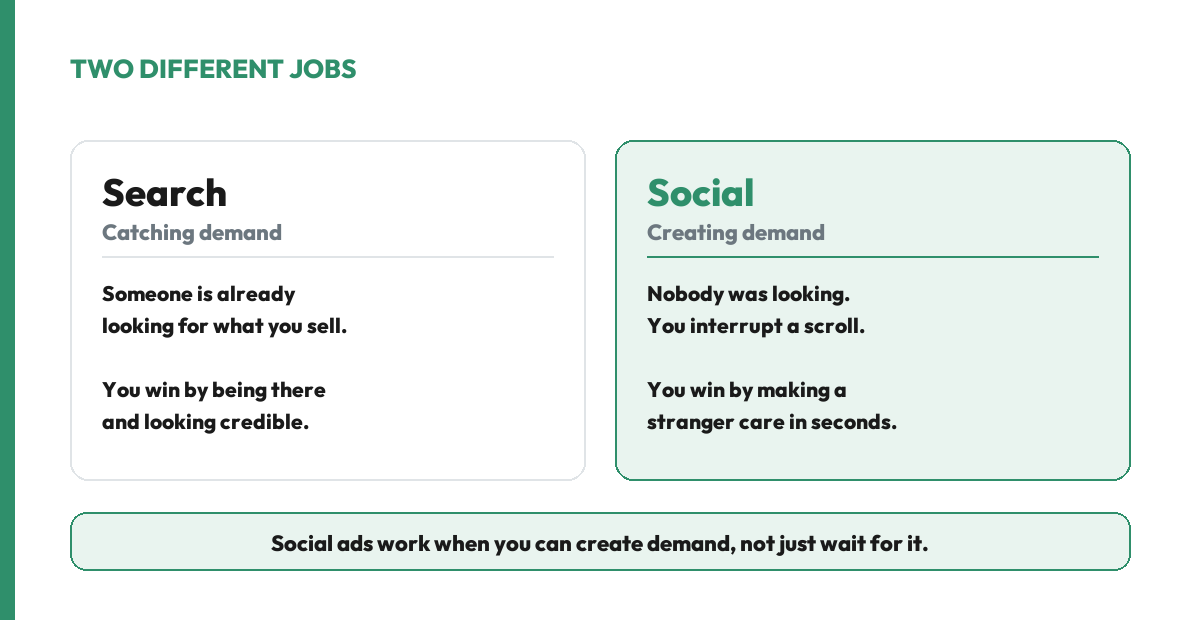
That interruption is not a weakness. It is the entire point, and it is something search can never do for you. Search only ever gives you the people already looking, and for a lot of founder-led businesses that is a small and slow-growing pool. Social advertising is how you reach the much larger group who have the problem you solve but have never gone looking for a solution, or who did not know a solution like yours existed.
So it works. It just does a specific job, and it is expensive when you ask it to do a different one.
What paid social is actually good at
The first thing it is good at is reach you have not earned. You can put a clear offer in front of thousands of people who have never heard of you, this week, without waiting months to build an audience or rank for anything. Nothing else buys attention that fast.
The second is precision about who sees it. You can narrow by location, age, interests and behaviour, which matters enormously for a local service business. If your clients come from three neighbourhoods, you can spend your entire budget on three neighbourhoods.
The third is that it makes everything else you do work harder. People who have seen your name a few times click your search result more readily, open your emails more readily, and reply to your messages more readily. That is real value even though it never shows up cleanly in an ad dashboard, which is exactly why it gets ignored.
And the fourth, the one founders underrate most, is speed of learning. Running ads tells you within two weeks which promise people actually respond to. That answer is worth having even if the campaign itself only breaks even, because it improves your website, your emails and the way you talk about your work in a sales call.
When social media advertising does not work
Now the part the benefit lists leave out.
It does not work when the offer is unproven. If nobody outside your friends, family and referrals has paid for this thing, ads will not tell you it is good, they will just tell you faster that it is not. Paid traffic amplifies whatever is already there. If the offer is weak, you have bought a louder version of weak.
It does not work when the maths cannot carry it. Interrupting a stranger is more expensive than catching someone already searching, so the value of one client has to be big enough to absorb a lot of clicks that go nowhere. This is the same discipline behind working out how much to spend on ads in the first place: the budget and the verdict both come from what one client is worth to you, not from a percentage someone quoted on a podcast.
It does not work when the destination is broken. If the click lands on a slow page, a confusing page, or a page that asks for too much too early, the ad has done its job and the page has undone it. Fixing a landing page that does not convert is almost always cheaper than adding budget, and it is the single most common reason a campaign looks like a failure when it is not.
And it does not work when the purchase is a long, high-trust decision made mostly on reputation. If people choose you after a referral and two conversations, ads can warm the room, but they will rarely close anything on their own. That is not a failure of the ads. It is a mismatch between the channel and the way that particular decision gets made.
What has to be true before you spend
Before you put money into paid social, four things should be in place. None of them is exotic, and every one of them is cheaper to fix now than to discover halfway through a budget.
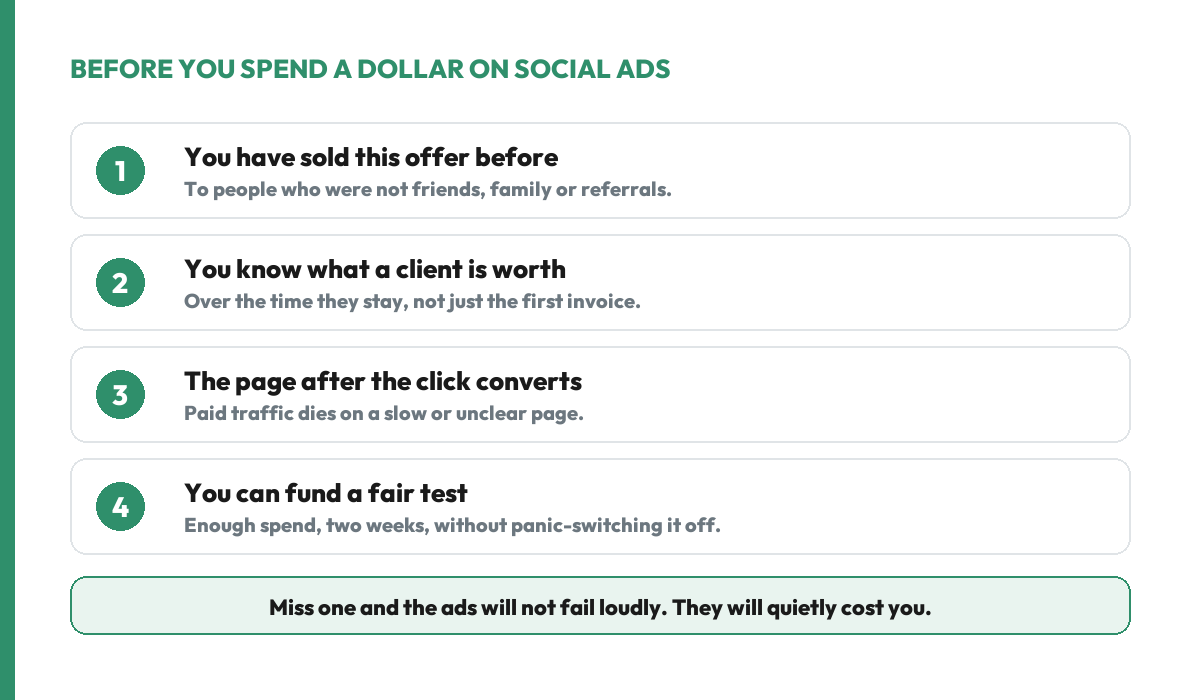
You have sold this offer to somebody who was not already in your circle. You know what a client is worth over the time they stay with you, not just what the first invoice says. The page you are sending traffic to actually converts a visitor into a booking or an enquiry. And you can fund a fair test, which in practice means a modest daily budget you can sustain for two weeks without switching it off on day three because the first numbers looked ugly.
Miss one of those and the ads will not fail loudly. They will produce clicks, some likes, a bit of a dopamine hit from the dashboard, and no clients. Then the natural conclusion is that social advertising does not work, when what actually happened is that it worked perfectly and delivered strangers to a broken destination.
Is organic social or paid advertising the better place to start?
They do different jobs, so this is less of a choice than it looks.
Organic social builds trust with people who already know you and gives an interested stranger somewhere to land. Paid social buys reach you have not earned. If your profile is empty, ads still work, but you lose a share of the people who click, look you up, and find nothing that reassures them.
The practical order for most founder-led businesses is: get a handful of clear, useful posts up so the profile looks alive, make sure the page behind the click does its job, then spend. That is also the honest answer to the related question of whether you need a website at all or just Instagram. A profile can carry the trust; something has to carry the booking. If you are still working out where social media, paid or organic, actually fits against everything else in the mix, that is the exact question we answer in social media marketing vs digital marketing.
The honest answer
Does social media advertising work? Yes, when you use it to create demand for an offer that is already proven, with maths that can carry the cost, and a page that converts what it sends. No, when it is asked to rescue an offer nobody has bought, or to compensate for a website that loses people the moment they arrive.
If you are already spending and cannot tell which of those you are in, that is a solvable problem, and the way through it is to follow the money rather than the dashboard: what you pay for a click, then a lead, then a paying client.
If working all of this out is pulling you away from the work you are actually great at, running paid social is exactly what we take off your plate. When you want a clear read on whether paid social is the right lever for your business right now, book a free discovery call and we will map out your Growth Plan together, starting with the change that will win you the most clients for the money.
Frequently asked questions
Does social media advertising work?
Yes, but not at the job most founders hire it for. Paid social is good at creating demand, which means putting your offer in front of people who were not looking for it and were not going to find you any other way. It is much weaker as a rescue plan for an offer nobody has bought yet, or as a way to make a slow, unclear website suddenly produce clients. The businesses it works best for have something people can decide on reasonably quickly, a clear offer they have already sold to strangers, and a page that turns interest into a booking. If those things are in place, social ads are one of the fastest ways to buy attention. If they are not, the ads will not fail loudly, they will just quietly cost you money while the real problem stays hidden.
Is social media advertising worth it for a small business?
It depends far less on your size than on your maths. What matters is whether one client is worth enough to you, over the time they stay, to justify what it costs to win one. A service business where a client is worth a few thousand dollars over a year can afford a lot of clicks that go nowhere. A business selling a one-off thirty dollar item cannot. Before you commit a budget, work out what a client is worth to you, decide the most you are willing to pay to win one, and treat that as the number the ads have to beat. Small budgets can absolutely work, as long as you can fund a fair test rather than switching things on and off every few days.
How long before social media ads start working?
Give a campaign one to two weeks and enough spend to produce a meaningful number of leads or bookings before you judge it. The first few days of any campaign swing wildly while the platform works out who to show your ad to, so early numbers tell you very little. The most expensive habit in paid social is reacting to those early numbers: turning ads off, rewriting them, changing the budget every morning. That resets the learning and burns money without ever giving you an answer. Pick a modest daily budget you can sustain for a couple of weeks, leave it alone, and then read the results honestly.
Should I do organic social media or paid social ads first?
They do different jobs, so the honest answer is that neither one replaces the other. Organic social builds trust with people who already know you, and it gives you a place for an interested stranger to land and think yes, these people are real and they know what they are doing. Paid social buys reach you have not earned yet. If your profile is empty, ads still work, but you lose some of the people who click through and find nothing. The practical order for most founder-led businesses is to get a handful of clear, useful posts up so the profile does not look abandoned, make sure the page you send traffic to converts, and then spend on ads.
Want a clear roadmap for your own growth?
Every partnership with The Growth Project starts with a free Growth Plan. Book a discovery call and we'll map out yours together.