How much does SEO cost for a small business?
How much does SEO cost for a small business? The quoted ranges are useless on their own. Here is what you are actually buying and how to set your own ceiling.
How much does SEO cost for a small business? It is a fair question with an annoying answer, because every guide you find quotes a different monthly range and none of them tells you which one applies to you. If you would rather just talk it through with someone, you can book a free discovery call. Otherwise, here is the honest version, including the part most pricing pages leave out.
TL;DR: There is no single market price, because three completely different purchases get sold under the same two letters: doing the foundations yourself, a one-off project to fix the site you already have, and a monthly retainer for ongoing work. Quoted ranges average all three together, which is why they are so wide and so useless. Instead of hunting for the going rate, work out your own ceiling: what one client is worth to you, how many extra clients a month would be a win, and what share of that prize you are willing to pay. Then a quote is either under your ceiling or it is not.
How much does SEO cost for a small business?
The reason you keep finding different numbers is not that everyone is being cagey. It is that the question is underspecified. Asking what SEO costs is a bit like asking what a vehicle costs. The answer depends entirely on whether you mean a bicycle, a used van, or a van plus a driver on staff.
So before any number means anything, you have to know which of three things you are buying.
The three different things sold as SEO
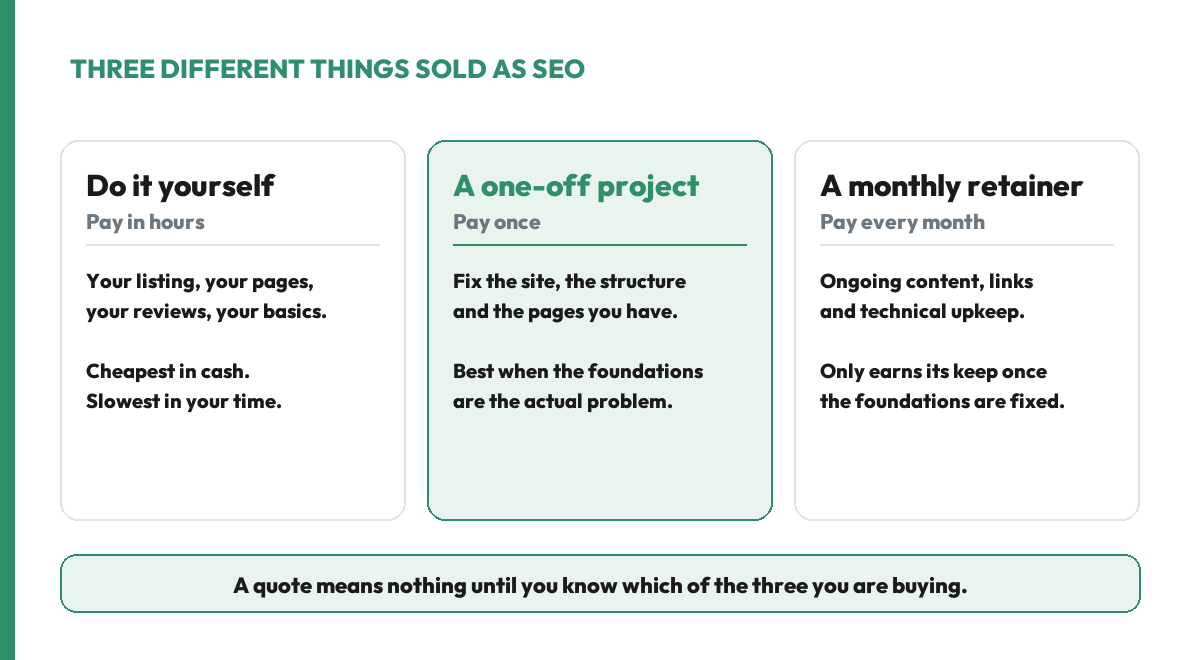
The first is doing the foundations yourself. Claiming your Google Business Profile and filling it in properly. Asking happy clients for reviews. Giving each service you sell its own page instead of burying all of them in one paragraph on a homepage. Writing those pages so they answer the questions people actually type. This costs almost nothing in cash and a real amount of your evenings, and for a lot of local businesses it is where most of the early wins live. If you have not done this layer, paying someone monthly to do clever things on top of it is building on sand.
The second is a one-off project. Someone goes through the site you already have, fixes what is broken, restructures the pages, rewrites the ones that matter, and hands it back. You pay once. This is the right purchase when your foundations are the actual problem, which they often are for a business whose site was built years ago by whoever was available. It has a defined end, which also makes it the easiest one to judge: either the site is better afterwards or it is not.
The third is a monthly retainer. Ongoing content, links from other websites, technical upkeep, and someone watching the numbers. This is what people usually mean when they quote a monthly figure, and it is the only one of the three that keeps charging you. It earns its keep when the foundations are already sound and the constraint is momentum rather than repair. Bought too early, it quietly pays someone to publish new pages on a site that cannot rank any of them.
What actually moves the price
Within any of those three, the same handful of things push a quote up or down, and none of them is mysterious.
How competitive your market is comes first. Ranking a plumber in a mid-sized town and ranking a law firm in a major city are not the same job, and no amount of skill collapses that difference. How many services and locations you have matters next, because each one needs its own page and its own attention. The state of your current site matters more than most people expect: a fast, sensibly built site is cheap to improve, while a slow one held together by plugins can absorb a whole budget before anything gets better.
Then there is how much content is involved, which is usually the single biggest line in a monthly retainer, and how much of the work you keep in house. A founder who is happy to write drafts and hand them over is buying something meaningfully cheaper than one who wants the whole thing off their plate.
Notice that none of those factors is your revenue. Plenty of pricing is set by what an agency thinks you can afford, which is exactly why you want your own number before you go looking.
How do you work out what SEO is worth to you?
This is the part the pricing guides skip, and it is the only part that actually settles the question.
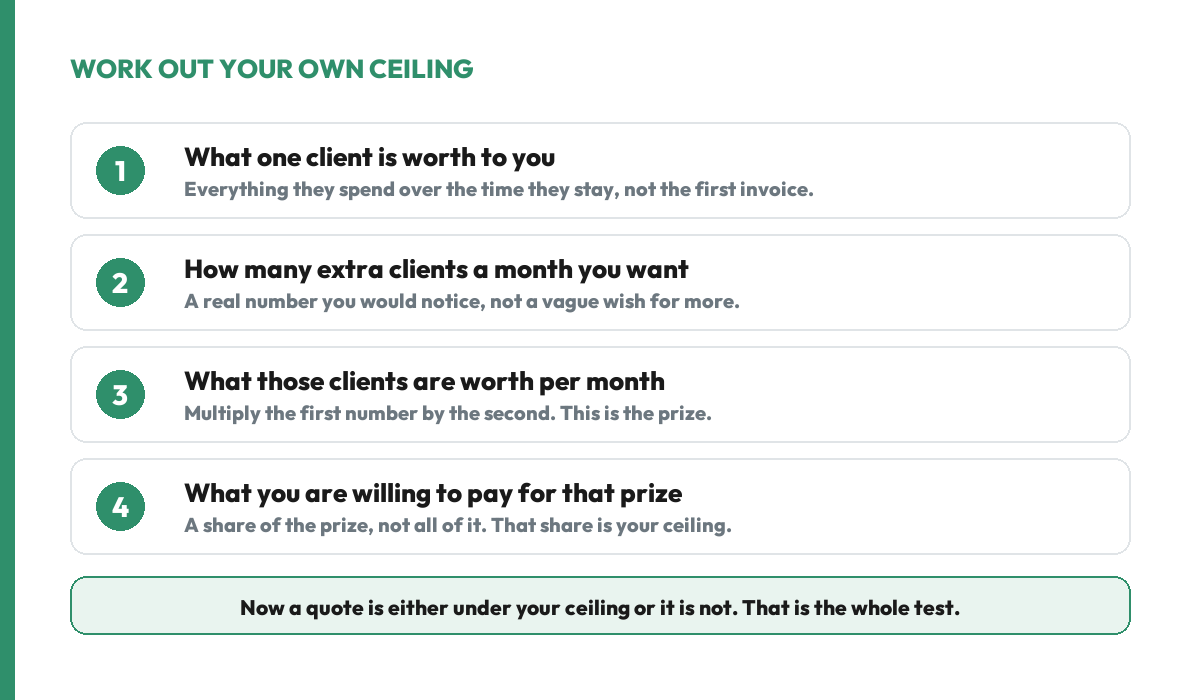
Start with what one client is genuinely worth to you. Not the first invoice, but everything they spend over the time they stay with you. A physiotherapist thinking in single appointments and a physiotherapist thinking in courses of treatment will reach very different conclusions from the same fee.
Then decide how many extra clients a month would count as a win. Be specific. Three is a number you can test against a quote. More is not.
Multiply the two and you have the prize: what those extra clients are worth to you every month. Now ask what share of that prize you are willing to hand over to win it. Whatever that share is, that is your ceiling, and it is yours rather than the market’s.
This is the same discipline behind working out how much to spend on ads. The channel changes, the maths does not. Once you have a ceiling, a proposal stops being a mystery and becomes a straightforward comparison.
When SEO is the wrong thing to buy right now
Two situations come up often enough to name.
The first is when the searches do not exist. Search catches demand that is already there. If almost nobody types anything resembling what you sell, then ranking first for a term nobody uses wins you nothing. Check before you commit, because this is expensive to discover late.
The second is when you need clients this month. SEO compounds, which is its great virtue and its great inconvenience. The work you pay for now tends to pay you back later, and a new site starts with no standing at all. If the next quarter depends on new clients arriving quickly, the honest advice is to spend on something faster first and let search build underneath it. Email marketing to the people who already know you is usually the cheapest of those faster options, because you are not paying to reach strangers at all.
If you are a local service business and the searches do exist, the good news is that getting found locally is one of the cheaper corners of this whole discipline, and a decent share of it is work you can do yourself this week.
What to ask before you sign anything
Ask what specifically will be done in the first ninety days, in plain language, and be wary of an answer you cannot picture. Ask what happens to the work if you stop paying, because a one-off project leaves you with assets and a retainer that mostly buys publishing leaves you with a gap. Ask how progress will be reported and what counts as a bad month. And ask what they need from you, since the plans that stall are almost always the ones that quietly assumed the founder had ten spare hours a week.
If you are weighing this up against hiring more broadly, the same tests apply to deciding whether to hire an agency at all.
The honest answer
How much SEO costs for a small business depends on which of the three purchases you are making, how competitive your corner is, and what shape your current site is in. Anyone giving you a confident single number before knowing those things is quoting an average, not a price.
What you can settle today is your own side of it. Work out what a client is worth, decide how many more you want, and set the ceiling you are willing to pay for them. That number turns every proposal you receive into a simple decision, and it protects you from both the quote that is too high and the cheap one that was never going to work.
If working all of this out is pulling you away from the work you are actually great at, SEO and GEO is exactly what we take off your plate. When you want a straight answer on whether search is the right lever for your business right now, and what it would sensibly cost in your situation, book a free discovery call and we will map out your Growth Plan together, starting with the change that will win you the most clients for the money.
Frequently asked questions
How much does SEO cost for a small business?
There is no single honest number, because the word SEO is used for three completely different purchases. Doing the foundations yourself costs almost nothing in cash and a real amount of your time. A one-off project to fix an existing site is a fixed price paid once. A monthly retainer buys ongoing content, links and upkeep, and it is the one people mean when they quote a monthly range. Any range you read online is an average across all three, across every industry and every country, which is why the numbers you find swing so wildly. The useful move is to stop hunting for the market price and work out your own ceiling instead: what one client is worth to you over the time they stay, how many extra clients a month would count as a win, and what share of that prize you are willing to pay to get it. A quote is then either under your ceiling or it is not.
Is SEO worth it for a small business?
It is worth it when people are genuinely searching for what you sell and you can afford to wait for the results. Search catches demand that already exists, so it only works if that demand is there. If nobody types anything resembling your service into Google, no amount of spending will manufacture those searches, and your money belongs in a channel that creates demand instead. The second condition is patience. SEO compounds slowly and pays back later, which makes it a poor fit if you need clients this month to keep the lights on. When both conditions hold, it is one of the few channels where the work you paid for last year is still bringing in clients this year without you paying again.
Is it cheaper to do SEO yourself?
In cash, yes, and the first layer is genuinely worth doing yourself. Claiming and filling out your Google Business Profile, asking happy clients for reviews, making sure each service you offer has its own page, and writing pages that answer the questions people actually ask are all things a founder can do without hiring anyone. That layer is where most of the early wins for a small business live. What is harder to do yourself is the ongoing part: publishing consistently, earning links from other sites, and diagnosing technical problems that stop pages being indexed. Those need either real time every week or someone whose job it is.
How long before SEO pays for itself?
Plan for months, not weeks. New pages take time to be indexed and longer to be trusted, and a new site starts with no authority at all, so early results are slow even when the work is right. A reasonable expectation is small movements within a couple of months and a meaningful change somewhere past the six month mark, with local search usually moving faster than competitive national terms. This is exactly why the payback maths matters before you start. If the spend only makes sense on the assumption that clients arrive next month, it is the wrong channel for the situation you are in.
Want a clear roadmap for your own growth?
Every partnership with The Growth Project starts with a free Growth Plan. Book a discovery call and we'll map out yours together.