Is email marketing free? The honest answer
Is email marketing free? Mostly, at first. Here is exactly what stays free, what starts costing you, and the point where most small businesses cross the line.
Is email marketing free? For most founder-led businesses starting out, close enough that the honest answer is yes, with two catches worth knowing before you build anything on top of it. If you would rather skip straight to what this should look like for your business, book a free discovery call and we will walk through it together. Otherwise, here is exactly where “free” ends.
TL;DR: Yes, at the start. Every mainstream email platform gives you a free tier that comfortably covers a small list, a welcome sequence, and a basic newsletter. It stops being free in two ways: your list eventually outgrows the free cap, and your own time spent writing and sending was never actually free, whatever the invoice says. Free is an honest description of the barrier to entry. It is not a description of what running email well costs once it is working.
Is email marketing free? What “free” actually covers
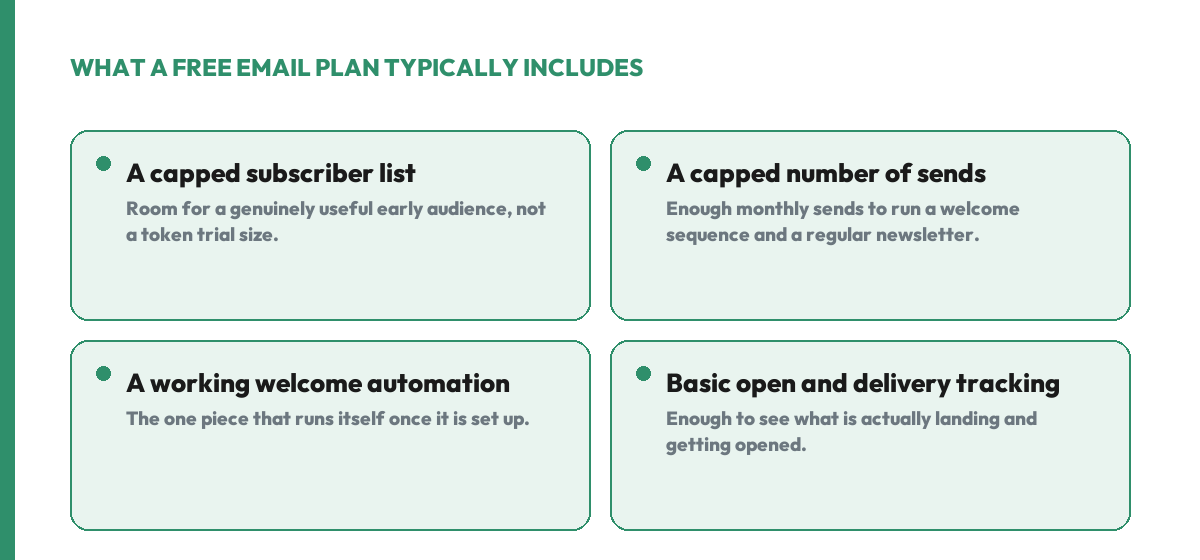
A free plan from a mainstream platform is not a stripped demo. It typically includes a capped number of subscribers, a capped number of sends each month, a working welcome automation, and basic open and delivery tracking. That is genuinely enough to run a proper welcome sequence and a steady newsletter for a small, growing list. What is usually missing is the more advanced automation, deeper reporting, and priority support, none of which a business sending its first hundred emails a month actually needs yet.
So for the question people are really asking, can I start email marketing without spending anything, the answer is a clean yes. You are not being handed a crippled trial to pressure you into upgrading. You are being handed the actual product, sized for where a new list starts.
Where the free line actually sits
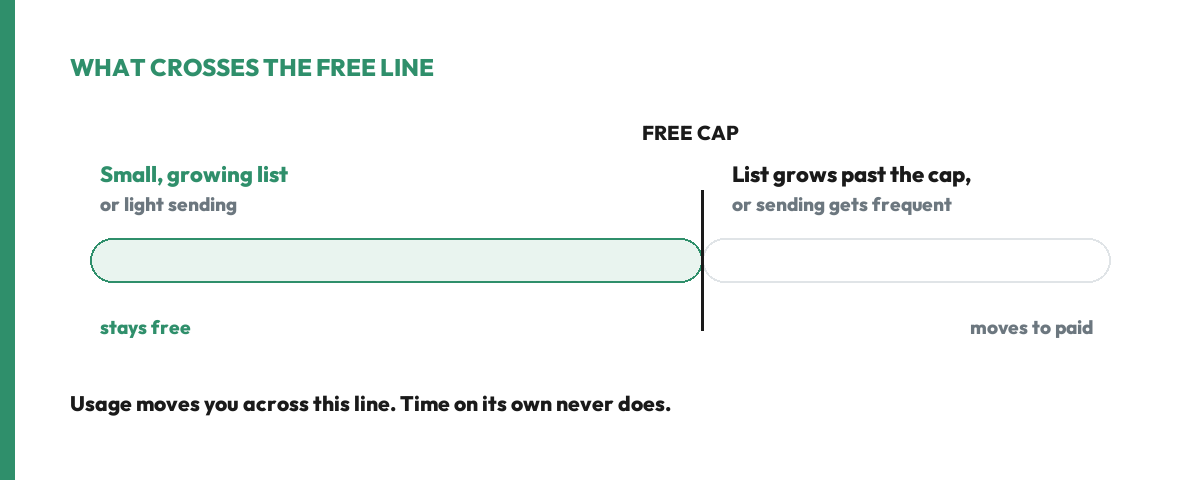
The free tier ends at a threshold, not a date. Most platforms cap either how many subscribers you can hold or how many emails you can send in a month, and you cross into paid pricing the moment either number is passed, whether that takes three months or three years. A business collecting a handful of emails a week at checkout or at booking will eventually cross the subscriber line just by staying open. A business with a smaller list that emails very often can hit the sending cap first instead.
Neither is a penalty. A platform asking you to pay once your list has grown is asking you to pay because the channel is working, which is a different thing from a tool that was never really free to begin with.
The cost the invoice never shows
Even while the platform bill reads zero, email marketing is not actually free, because your own time is the part nobody puts a price on. Writing a welcome sequence that greets every new person properly takes real, focused hours, once. Writing a newsletter worth opening takes an hour or two every time you send it, for as long as you keep sending it. A free account with nobody writing to it is not free email marketing, it is an unused login.
That is the honest cost most “is it free” questions are actually asking about, once you look past the software line item. We cover the full breakdown, platform cost, time cost, and what paying someone to run it looks like, in how much email marketing actually costs, and if you want the tier-by-tier platform pricing once you do cross the free line, see how much do email campaigns cost. If you are weighing that against what other channels cost, is email marketing expensive lays out the comparison.
How free email compares to the rest of your budget
It is worth saying plainly: email is the cheapest channel in a digital marketing plan by a wide margin, free tier or not. Paid ads charge you again every single time you want to reach someone, so the moment you stop paying, the reach stops. An email list works the opposite way. Once someone joins, reaching them again costs nothing extra, whether you are on the free tier or three pricing steps past it. That is the real reason free email marketing looks so generous next to almost anything else you could spend on: the model behind it is built to get cheaper the more you use it, not more expensive.
That does not make it a replacement for paid acquisition, since the two do different jobs. It does mean the free tier is rarely the part of your marketing budget worth worrying about.
Should you stay on the free tier?
For as long as it comfortably fits, yes. Staying on a free plan is not a compromise while your list is small: it is the correct decision, and upgrading before you need to buys you nothing. The moment worth watching for is not a specific subscriber count, it is whether the free tier’s send cap or list cap is starting to get in the way of what you actually want to send. Founder-led businesses that treat email marketing as one piece of a wider plan tend to notice that moment early, because they are already tracking what the channel is bringing in against what it would cost to keep growing it.
If your list is still small, the free tier is not a placeholder version of email marketing. It is email marketing, and the only thing that changes later is scale.
The honest answer
Is email marketing free? Yes, for the stretch that matters most to a business just getting started, and the software cost stays close to nothing for a good while after that. What was never free is the time it takes to write a welcome sequence properly and keep a newsletter going on a rhythm people can rely on. Once you count that honestly, or hand it to someone else to run, you can decide with open eyes whether free is still the right answer for where your business is now.
If working out that answer for your own business is the part that keeps slipping down your list, book a free discovery call and we will map out your Growth Plan together, starting with what email marketing should actually cost you.
Frequently asked questions
Is email marketing free?
Mostly, at first. Almost every mainstream platform lets you send to a small list at no cost, so if you are just starting out, the honest answer is close to free. It stops being free in two separate ways: your list eventually grows past the free tier's limit, and your own time writing and sending is never actually free, even when the software bill reads zero. Free describes the barrier to entry, not the ongoing cost of doing it properly.
What exactly do free email plans include?
Enough to genuinely run a small list well. A free plan from a mainstream platform typically covers a capped number of subscribers, a capped number of sends per month, a working welcome automation, and basic delivery and open tracking. What it usually leaves out is the more advanced automation, deeper reporting, and priority support that only start to matter once your list and your sending get more complex. For the first stretch of a founder-led business, the free tier is rarely the thing holding you back.
When do you start paying for email marketing?
The moment you cross the platform's free subscriber cap, which most small businesses eventually do simply by being in business for a while and collecting emails at checkout, at booking, or on a signup form. Some platforms also cap free monthly sends rather than list size, so a business with a small list that emails often can hit the ceiling from that direction instead. Either way, the trigger is usage, not time. A quiet list can stay free for years; an active one crosses the line faster.
Is free email marketing actually worth using?
Yes, and it is usually the right place to start. A free platform removes the only excuse for not having a welcome sequence and a basic newsletter running, and the cap you eventually hit is a sign the channel is working, not a problem with it. The real decision is not whether to use the free tier, it is what you do once you outgrow it: pay the platform's next tier and keep writing it yourself, or bring in help so the newsletter keeps going without eating another evening every week.
Want a clear roadmap for your own growth?
Every partnership with The Growth Project starts with a free Growth Plan. Book a discovery call and we'll map out yours together.