What is email marketing examples? A small business guide
What is email marketing examples? Five real emails, a welcome note, a newsletter, a launch and a win-back, broken down so you can copy the structure.
What is email marketing examples of, in practice, beyond the vague idea of “sending newsletters”? If you would rather see the structure applied to your own business than work it out alone, you can book a free discovery call and we will map it out together. Otherwise, here are five real ones, broken down line by line.
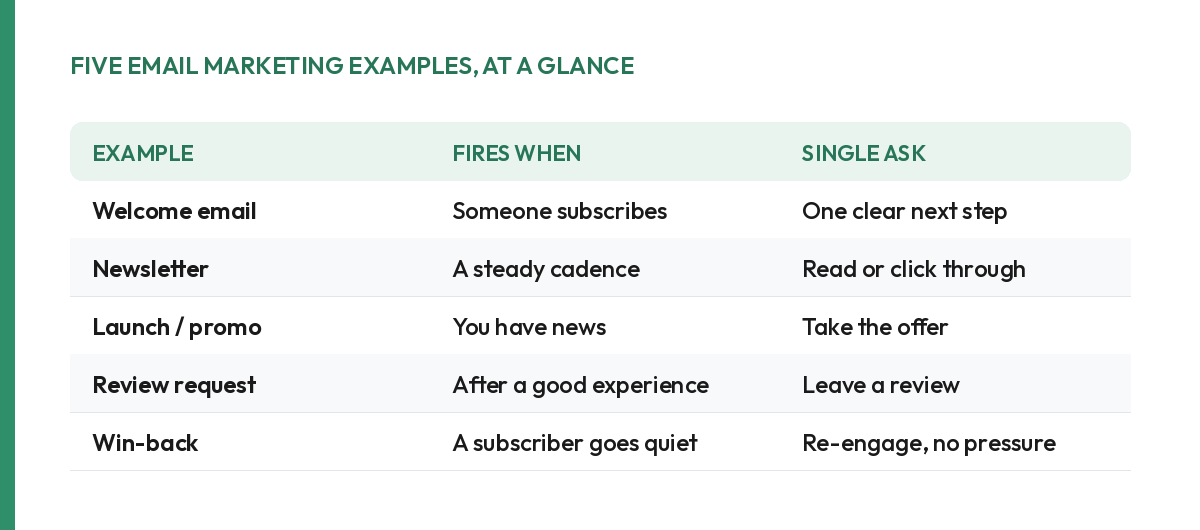
TL;DR: Almost every legitimate marketing email a small business sends falls into one of five shapes: a welcome email, a newsletter, a launch or promotional email, a review or referral request, and a win-back email. Each one has a job, a moment it fires at, and a single ask. Below is what each actually says, not just the label, so you can copy the structure rather than guess at it.
What is email marketing examples, in practice?
Most explanations of email marketing stop at the definition and never show you an actual email. That is the gap this post fills. Email marketing for a small business is simply using a small number of repeatable email shapes, sent to people who chose to hear from you, and each shape below is a real pattern you can copy today. For the fuller picture of why this channel is worth building before almost anything else, see our guide to email marketing for small business.
What does a welcome email actually say?
A welcome email fires the moment someone subscribes, and it does three things in a short space. It thanks them for signing up and confirms what they will get from being on the list. It gives them one useful thing right away, a tip, a short answer to a common question, or whatever you promised at signup. And it closes with one clear, low-pressure next step, usually a link to book a call or read one more piece of your best thinking.
A real subject line for this one might read “Thanks for joining, here’s where to start.” No hype, no exclamation mark, just the truth about what is inside. The body stays to two or three short paragraphs. Nobody reads a long email from a business they just met. For the full multi-email version of this idea, see our guide to writing a welcome email sequence.
What does a newsletter look like?
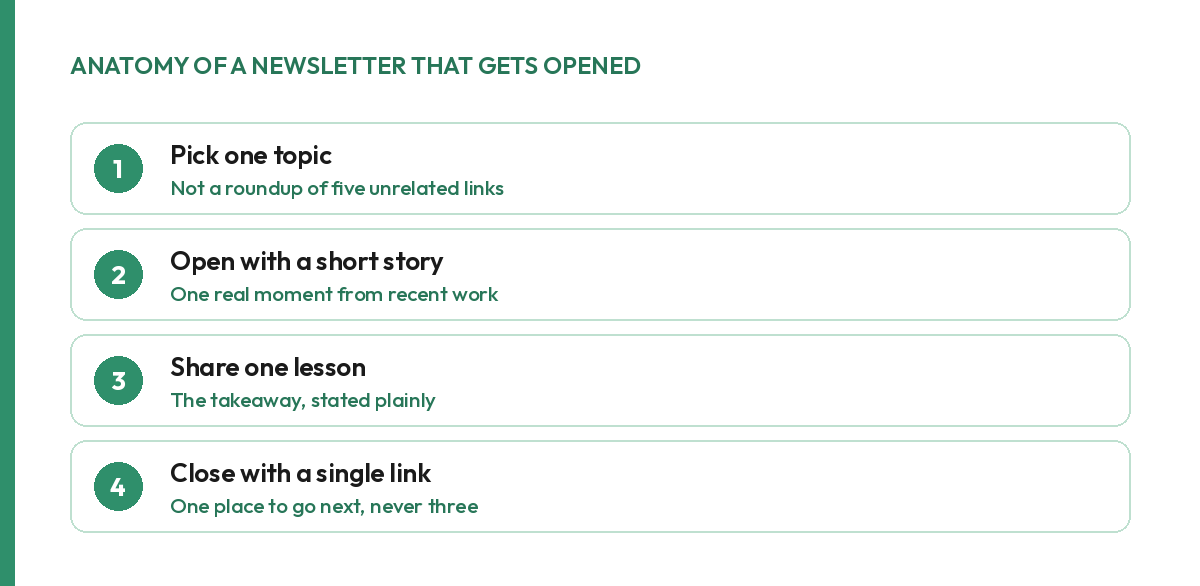
A newsletter is the email you send on a steady cadence, whether or not you are selling anything that week. The job is simple: stay in the inbox of people who already trust you, so you are the first call when they need what you offer. A good one picks one topic, not five, and treats it the way you would explain something to a client sitting across from you.
A real newsletter might open with a short story from recent work, one lesson worth passing on, then a single line pointing to a longer piece on the site if someone wants more. It skips the roundup of five unrelated links. A newsletter that tries to cover everything ends up being about nothing, and people stop opening it.
What does a launch or promotional email look like?
This is the one email that is allowed to be about you, because you have something specific and new to say: a new service, a new time slot, a seasonal offer. The pattern still holds though. Lead with what changed and why it matters to the reader, not with how excited you are. State the one thing you want them to do. Set a real deadline only if one genuinely exists, never an invented one just to create urgency.
A real example: “We just opened three new spots for [service] this month. If you have been meaning to start, here is the link to grab one.” Short, specific, and honest about scarcity that is actually true. If you are weighing whether this channel is worth the setup time against what it costs, our guide to how much email marketing actually costs walks through the real numbers.
What does a review or referral request look like?
This one is short on purpose. It goes out after a good experience, while it is still fresh, and it asks for exactly one thing: a review, or an introduction to one person who might need the same help. It never bundles the ask with anything else. “Loved working with you, would you mind leaving a quick review? Here is the link” does more work than a long email that buries the ask in paragraph three.
What does a win-back email say when someone goes quiet?
A win-back email reaches out to a subscriber who used to open your emails and has stopped. It is not a guilt trip. It simply notices the gap, offers one more piece of value, and gives an easy way to say “not right now” without unsubscribing entirely. A real line: “Haven’t heard from you in a while, still looking for help with [the thing you do]? No pressure either way, just wanted to check in.” That single sentence usually does more than a hard sell ever would.
Which example should you write first?
Start with the welcome email. It is the only one of the five that gets written once and then runs itself for every new person, at the moment they are paying the closest attention, which is exactly the return-on-effort a busy founder should chase first. Build the newsletter habit next, since it is what keeps the relationship warm between the moments you actually have something to launch. This holds whether you are selling a product or booking a call, which is the whole premise behind our work with coaches and practitioners.
Every one of these five examples works because it follows the same underlying rule: one clear point, one honest subject line, and one obvious next step. Skip the temptation to combine two of these into one longer email. A newsletter that also tries to launch something and also asks for a review is really three weak emails wearing one subject line.
If figuring out which of these to send, and when, is pulling you away from the work you are great at, that is exactly what we take off your plate. Book a free discovery call and we will map out your Growth Plan together, starting with the email that should be working hardest for your business right now.
Frequently asked questions
What is email marketing examples of, in one sentence?
A welcome email that greets a new subscriber, a newsletter that keeps a list warm, a launch email that announces something new, a review request that asks for one small favor, and a win-back email that reaches out when someone has gone quiet. Almost every legitimate email a small business sends is one of these five, written for a specific person at a specific moment rather than blasted at everyone at once.
What makes a good example of a marketing email?
One clear point and one clear next step, in language that sounds like a person wrote it to another person. The examples above all share that shape: a short subject line that tells the truth about what is inside, two or three short paragraphs, and a single link, never three competing calls to action fighting for the same click.
Which type of email should a small business write first?
The welcome email. It is written once and then greets every new subscriber automatically, at the exact moment they are paying the most attention, so the time you spend on it keeps paying off long after you have moved on to other work. See our full breakdown of what to say in it in our guide to a welcome email sequence.
Do these examples work for a service business, not just a store?
Yes. None of the five examples here depend on having products to sell. A welcome email can introduce your process, a newsletter can share a lesson from recent client work, a launch email can announce a new service or a new time slot, and a win-back email can simply ask if someone is still looking for help. The structure is the same whether you are selling a product or booking a call.
Want a clear roadmap for your own growth?
Every partnership with The Growth Project starts with a free Growth Plan. Book a discovery call and we'll map out yours together.