Why is my landing page not converting?
Why is my landing page not converting? The six real reasons visitors leave without booking, and which one to check first for your traffic.
Why is my landing page not converting is the question that follows a familiar pattern: the traffic is arriving, sometimes at a perfectly reasonable cost, and almost none of it turns into a booking. The page looks fine. Nothing is obviously broken. And yet the number that matters, visitors who actually take the next step, stays close to zero. If you would rather have someone look at your page directly and tell you what is actually costing you visitors, you can book a free discovery call. Otherwise, here are the six real reasons, roughly in the order worth checking them.
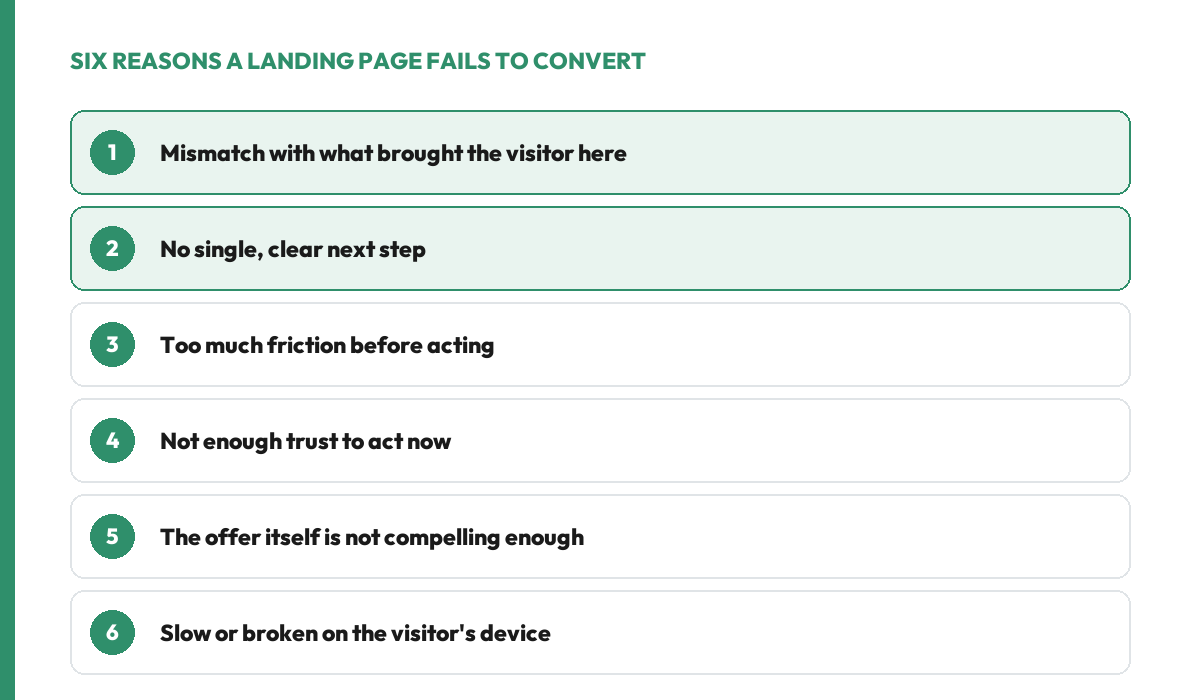
TL;DR: A landing page that gets traffic but no bookings almost always fails at one of six points: a mismatch with what brought the visitor there, no single clear next step, too much friction before acting, not enough trust to act now, an offer that is not compelling enough, or a page that is slow or broken on the device most visitors use. Check match and friction first. They are the most common causes and the fastest to verify.
Why is my landing page not converting?
Before touching a single word on the page, look at what brought the visitor there. An ad, a search result or a social post made a specific promise, and the page’s only job in that first moment is to confirm the visitor landed in the right place. A generic homepage pitch, or a headline about the business in general rather than the specific thing that was promised, loses most visitors before they read a second line. This is the most common failure on this list and the easiest one to fix, because it does not require redesigning anything, just rewriting the top of the page to match the promise that got the click.
It also explains why the same page can convert well from one traffic source and badly from another. A visitor arriving from a search for your exact service already knows roughly what they want, so a page that speaks directly to that service confirms they are in the right place. A visitor arriving from a broader social post is earlier in that process, and the same page can feel like a mismatch even though nothing on it actually changed. The fix is rarely a full rebuild. It is usually rewriting the first few lines so they speak to the promise that earned the click, whatever that promise was.
Reason two: there is no single, clear next step
A page that offers several things to do, book a call, download something, follow on social, read more, is asking the visitor to decide, and a visitor who has to decide usually leaves instead. One primary action, stated plainly and repeated a couple of times down the page, converts better than five reasonable-sounding options competing for the same click.
Reason three: too much friction between arriving and acting
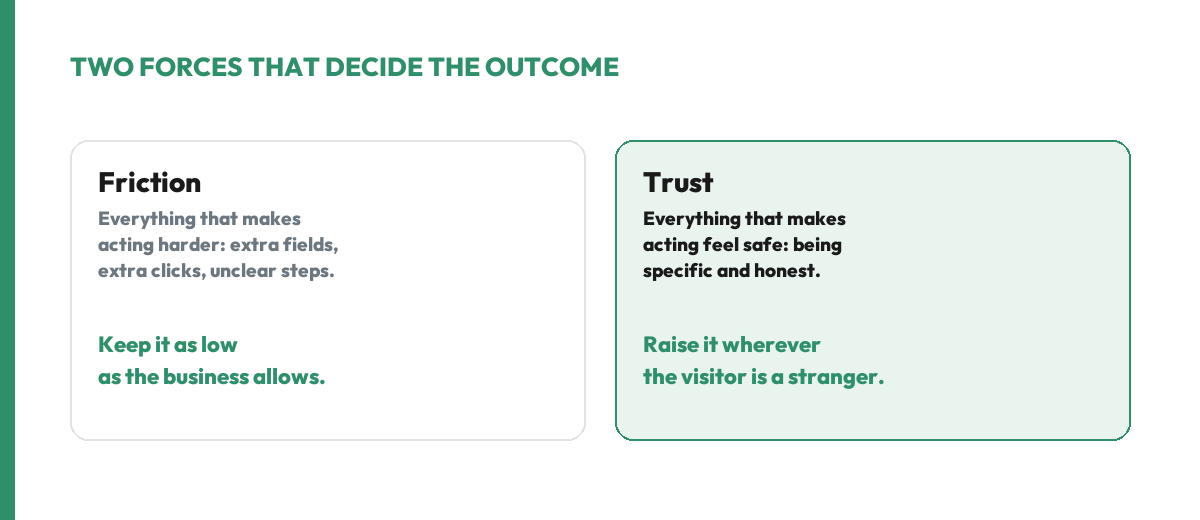
Every extra field on a form, every extra click before the actual ask, every piece of information requested that is not strictly needed yet, is a small reason to stop. A long form asking for company size, budget range and a phone number before anyone has spoken to you is friction stacked on friction. A name and a way to reach back is often enough to start the conversation, with everything else gathered on the call.
Reason four: nothing on the page builds enough trust to act now
Visitors who do not know your business yet are being asked to hand over their contact details or book time on a stranger’s calendar, and a page with nothing beyond a headline and a form gives them no reason to believe this is safe to do. This does not require invented numbers or fabricated testimonials. It means being specific and honest about who you are and what happens next, which lowers the perceived risk of the very next click.
Reason five: the offer itself is not compelling enough
Sometimes the page is well built and the traffic is well targeted, and the honest answer is that what is being offered simply is not attractive enough to act on right now. A free consultation is a weaker ask than a specific, tangible outcome stated plainly, such as a clear plan for the next quarter’s growth. If everything else on this list checks out and conversion is still weak, the offer itself is worth questioning before the page.
Reason six: the page is slow or broken on the device people actually use
A page that loads slowly, or renders awkwardly on a phone, loses visitors before the message above ever gets read, and most traffic to a small business landing page arrives on a phone. This is a purely technical check, and it is worth doing on an actual phone, not just a browser window resized to look like one.
How this connects to the traffic bringing people there
A landing page problem is often mistaken for an ad problem, because both show up as the same disappointing result: spend going out, bookings not coming in. We cover the ad side of this same symptom in why are my Facebook ads not converting, and the two are worth checking together, because fixing an ad that was never the real problem wastes time the page fix would have solved faster. Once you know which side is actually broken, how do I know if my Facebook ads are working walks through separating the two properly.
If the page itself is the issue, that is exactly where our website and landing page work starts, matching the page to the promise and stripping out the friction sitting between a visitor and a booking.
The honest summary
A landing page rarely fails to convert for one dramatic reason. It is usually a small mismatch between promise and page, a next step that is not obvious enough, or friction nobody removed because the page looked fine at a glance. Check the promise first, then friction, then trust, and most pages recover more conversions from those three than from a full redesign.
If you want a straight read on which of these is actually costing you visitors, book a free discovery call and we will map out your Growth Plan together.
Frequently asked questions
Why is my landing page not converting?
Usually one of six things: the page does not match what brought the visitor there, there is no single clear next step, there is too much friction between arriving and acting, nothing on the page builds enough trust to act now, the offer itself is not compelling enough, or the page is slow or broken on the device most visitors are actually using. Checking match and friction first finds the cause fastest, because they are the most common and the easiest to verify.
What is the single biggest reason landing pages fail to convert?
A mismatch between what brought someone to the page and what the page says once they arrive. If an ad, a post or a search result promised one specific thing and the page opens on a general pitch instead, most visitors leave within seconds, no matter how well the page is designed underneath that gap.
How many fields should a landing page form have?
As few as the business can actually work with. Every additional field is a small reason to stop filling it in, so a name and a way to reach back is often enough, with anything else gathered on the call instead of the form.
Should a landing page have more than one call to action?
No, or at most one primary action repeated a few times down the page. A page offering several different next steps, book a call, download a guide, follow on social, makes the visitor decide instead of act, and a visitor who has to decide usually leaves instead.
Want a clear roadmap for your own growth?
Every partnership with The Growth Project starts with a free Growth Plan. Book a discovery call and we'll map out yours together.