Gym Facebook Ads Examples: What Actually Fills Classes
Gym Facebook ads examples worth copying: the four formats gyms actually use to fill classes, what each one is built for, and why most gym ads fail.
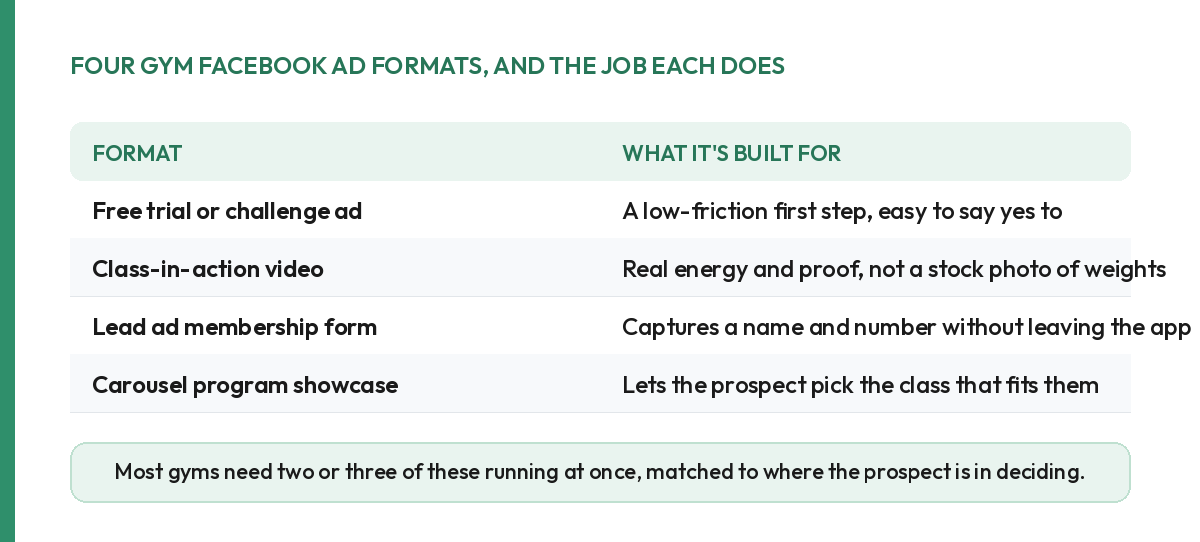
Gym Facebook ads examples are easy to find and hard to judge, because most roundups show you a screenshot without saying why it works. If you would rather have someone build and run this for your gym directly, you can book a free discovery call and we will map it out together. Otherwise, here are the four formats that actually fill classes, what each is built to do, and the one thing that separates an ad that works from one that doesn’t.
TL;DR: Four formats do almost all the work for gym Facebook ads: a free trial or challenge offer, a class-in-action video, a lead ad with an instant form, and a carousel showing multiple classes. The format matters less than specificity. An ad that names one offer, shows the real class, and sends the click to a page built for that exact offer beats a vague “join today” ad sent to the homepage almost every time.
Gym Facebook ads examples: what makes one actually work?
Before the examples, one distinction that decides whether any of them will work for you. A gym Facebook ad is not selling membership in the abstract, it is selling one specific next step: try a class, fill out a form, watch a video that shows the place is real. The ads that fill classes pick one of those steps and build the whole ad around it. The ads that don’t try to sell everything at once and end up selling nothing clearly.
The free trial or challenge offer ad
This is usually the highest-converting gym ad format, because it asks for the smallest possible commitment. “Try your first week free” or “join our 14-day challenge” gives a prospect a reason to act today instead of someday, without asking them to commit to a membership before they have even walked in the door.
The strongest version of this ad names the exact offer in the headline, not just in the fine print: “Free week at [gym name], starting this Monday” beats “Get fit with us” because it tells the reader precisely what happens if they click. It works because it moves the real decision, whether to join, from before the click to after the person has actually tried a class, which is a much easier decision to make once they have been in the room.
The class-in-action video ad
A short clip of a real class in progress, real members, real coaching, real energy, does something a still image cannot: it shows a prospect what it actually feels like to be there. This is the format most likely to overcome the biggest objection a gym faces, which is not price, it is intimidation. Seeing an ordinary-looking class full of ordinary people does more to remove that fear than any amount of copy.
The mistake to avoid is using stock footage of equipment or a generic model instead of the real gym. A prospect can tell the difference instantly, and a stock clip actively works against the ad’s one job, which is proving this specific place is worth showing up to.
The lead ad with an instant form
A lead ad keeps the whole exchange inside Facebook or Instagram: the person taps the ad, a short form opens without leaving the app, and their name and number are captured directly. This format tends to out-perform a normal ad that sends someone to an external website, because every extra step, every page load, every “wait for the site to open” moment is a chance for the person to change their mind or simply forget.
For a gym, this is the format to use when the goal is a specific number of leads for the front desk to call, rather than clicks or impressions. Keep the form itself short, name and phone number is usually enough, because a longer form undoes the exact friction this format exists to remove.
The carousel program showcase ad
Not every prospect wants the same thing. Some want strength training, some want a class format, some want early morning slots. A carousel ad, several cards a person can swipe through, lets you show your yoga class, your strength program and your open gym hours in one ad instead of forcing every prospect into the same single pitch.
This format works best as a second step, after a prospect has already shown some interest, because it assumes enough attention to swipe rather than trying to earn it cold. It answers “which of these is for me” rather than “should I care about this gym at all.”
What separates an ad that fills classes from one that doesn’t
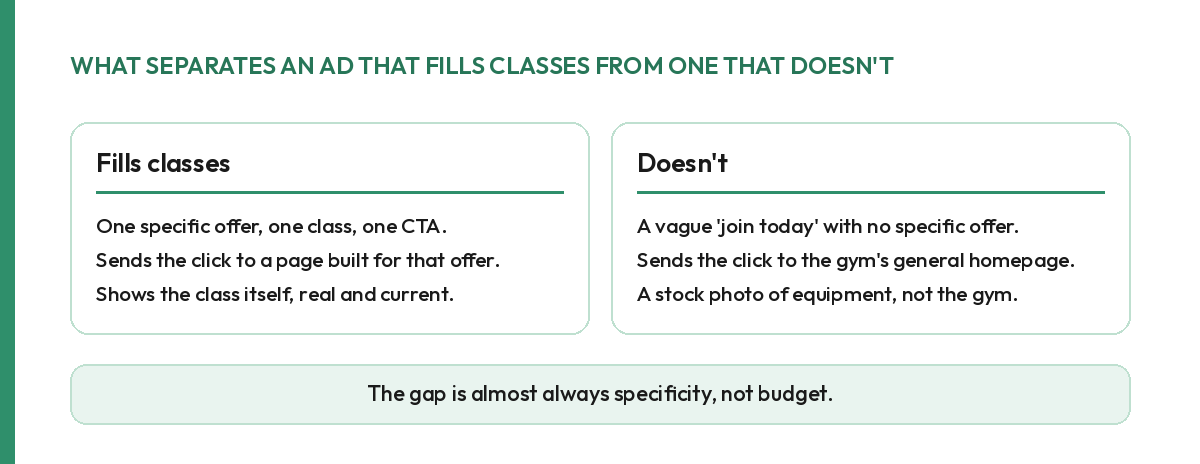
The format matters less than most gyms think. What actually separates a gym Facebook ad that fills classes from one that quietly drains budget is specificity, at every step. One offer, not a general pitch. One class or one action, not “check us out.” A landing page or form built for that exact offer, not a homepage the prospect has to dig through to find the same thing the ad promised.
This is also where paid acquisition as a discipline earns its keep over just boosting a post: a real campaign lets you test which offer, which format and which audience actually produces booked trials, rather than guessing once and hoping.
When a gym ad isn’t working
If your ads are running and classes still are not filling, the format is rarely the first thing to fix. Before changing the creative again, it is worth checking whether the campaign is actually being read correctly at all: our guide to knowing if your Facebook ads are working walks through the three numbers that tell you whether the problem is the ad, the offer, or what happens after the click.
Budget is usually not the issue either. A small, well-targeted budget behind a specific offer will out-perform a large one behind a vague pitch, which is the same principle we cover in how much a small business should spend on ads.
The honest summary
The best gym Facebook ads examples are not about clever creative, they are about specificity: one offer, one clear next step, real footage of the real class, and a landing page or form built for exactly what the ad promised. Pick the format that matches where your prospect actually is, free trial for someone who has never heard of you, carousel for someone already weighing their options, and the same budget starts filling more of the timetable.
If building a gym ad system that actually fills classes is pulling you away from coaching, running our paid acquisition work is exactly what we take off your plate. Book a free discovery call and we will map out your Growth Plan together.
Frequently asked questions
What are the best Facebook ad formats for a gym?
Four formats do most of the work: a free trial or challenge offer for a low-friction first step, a class-in-action video for proof, a lead ad with an instant form for capturing contact details without leaving the app, and a carousel showing several class types so a prospect can pick the one that fits them. Most gyms run two or three of these together rather than betting on one.
Why do most gym Facebook ads not work?
Almost always because they are too vague. A generic 'join today' ad, sent to every kind of prospect and pointed at the gym's homepage, gives nobody a specific reason to act right now. The gym ads that actually fill classes name one offer, one class, and send the click to a page built for that exact offer.
Should a gym use a stock photo or real footage in its Facebook ads?
Real footage, whenever possible. A stock photo of generic gym equipment tells a prospect nothing about what it's actually like to train there. A short clip of a real class, with real members and real energy, does the one thing a gym ad most needs to do: prove the place is worth showing up to.
What should a gym Facebook ad send people to?
A page built specifically for the offer in the ad, not the gym's general homepage. If the ad promises a free trial week, the click should land on a page about that trial, with one clear next step, not a homepage the prospect has to explore to find it.
Want a clear roadmap for your own growth?
Every partnership with The Growth Project starts with a free Growth Plan. Book a discovery call and we'll map out yours together.