What Is Paid Acquisition? The Digital Marketing Basics
What is paid acquisition? It means paying to win new customers, through ads, search or social, instead of waiting for them to find you.
What is paid acquisition? It is the plainest question in digital marketing and also the most useful one to actually answer, because most explanations either drown it in jargon or skip straight to which platform to use. If you would rather have someone map this out for your business specifically, you can book a free discovery call and we will walk through it together. Otherwise, here is the short, honest version.
TL;DR: Paid acquisition means paying, directly, to bring in a new customer, through search ads, social ads, marketplace ads or display and video. It is different from organic growth, which costs no money per visit but takes far longer to build. The real skill is not picking a channel, it is knowing what a lead or a booked client actually costs you, and only spending more once you know that number pays back.
What is paid acquisition?
Paid acquisition is any marketing where you pay, per click, per view or per placement, to put your business in front of someone who is not already looking for you on your own channels. You are buying attention directly, rather than earning it over time through content, reviews or word of mouth.
The word “acquisition” is doing real work in that phrase. It is not about awareness for its own sake. Paid acquisition is judged on whether it acquires something you actually wanted, usually a lead, a booking or a sale, not on how many people merely saw the ad.
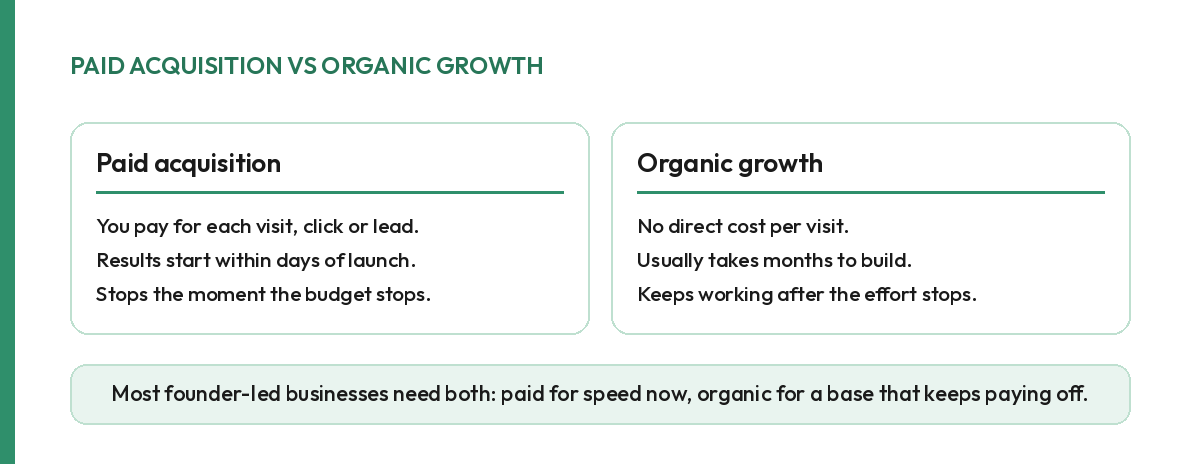
Paid acquisition vs organic growth
Every business eventually asks whether to pay for customers or earn them for free, and the honest answer is that the two do different jobs.
Paid acquisition is fast and finite. Launch a campaign and you can have visits within hours. Stop the campaign and the visits stop too, because you were renting attention, not owning it. That makes paid the right tool when you need results on a deadline, such as filling a new location’s calendar or testing whether an offer actually resonates.
Organic growth, whether that is search rankings, social following or referrals, has no direct cost per visit but is slow to build and slower to lose. A page that ranks well or a following that trusts you keeps sending you customers long after the work that built it is done. The tradeoff is patience: organic growth rarely shows real results for weeks or months.
Most founder-led businesses need both, in a specific order. Paid acquisition buys you speed and a fast read on whether an offer works. Organic growth builds the base that keeps the business running even in a month you cannot afford to spend on ads.
The channels paid acquisition covers
“Paid acquisition” is not one platform, it is a category that spans several, and the right one depends on what your customer is doing when you reach them.
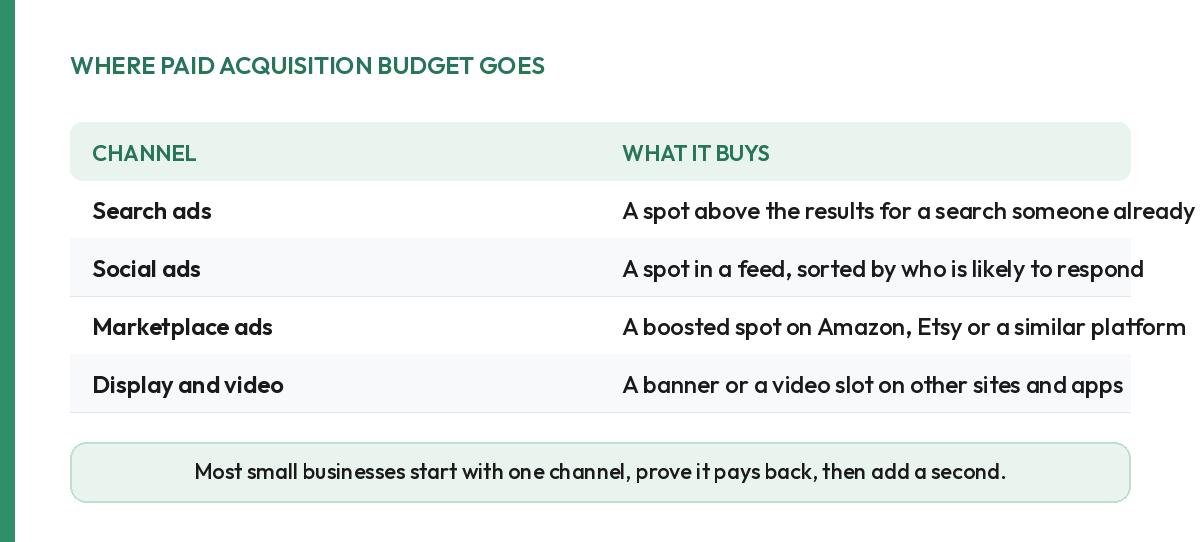
Search ads put you above the organic results for a search someone has already typed, which means you are meeting demand that already exists. This is usually the highest-intent, and often the most expensive, paid channel.
Social ads, on platforms like Meta and Instagram, work differently: social advertising reaches people based on who they are and what they engage with, not what they just searched, so it is better at creating demand than capturing it. Whether it actually works for a given business comes down to the setup, not the platform.
Marketplace ads, a boosted listing on Amazon, Etsy or a similar platform, buy visibility inside a space the customer is already shopping in, which is a different job again from search or social.
Display and video ads put a banner or a video in front of someone on another site or app. They are usually the cheapest per view and the hardest to tie to an actual booked client, which is why most small businesses use them last, if at all.
What does paid acquisition cost?
This is where most explanations of paid acquisition stop short, because the honest answer is that cost only means something once you tie it to a result. A click that costs two dollars is not expensive or cheap on its own; it depends entirely on how many clicks it takes to win a client and what that client is worth to you.
That is the whole method behind setting a sensible budget: work backward from what a new client is worth, not forward from a percentage of revenue you saw somewhere online. We cover the full, worked version of that math in how much a small business should spend on ads, including how to test small before you commit real money.
Is paid acquisition worth it for a small business?
Usually, yes, but only once it is set up to be measured. The businesses that lose money on paid acquisition are almost never spending too little. They are spending without a clear way to see whether a click ever turned into a client.
That measurement is the difference between paid acquisition that grows a business and paid acquisition that quietly drains it. If you are already running campaigns and are not sure the spend is paying off, how to know if your ads are actually working walks through the three numbers that actually answer the question, cost per click, cost per lead and cost per booked client, and why only the last one settles the argument.
The honest summary
Paid acquisition is simply paying to bring in a customer, directly and on a schedule you control, rather than waiting for organic growth to build. It spans search, social, marketplace and display, and the channel matters less than whether you can see what a result actually costs you. Get that measurement right and even a modest budget can grow a founder-led business steadily. Get it wrong and the spend disappears with nothing to show for it.
If figuring out where to start with paid acquisition is pulling you away from the work you do best, book a free discovery call and we will map out your Growth Plan together.
Frequently asked questions
What is paid acquisition in simple terms?
Paid acquisition is any marketing where you pay to bring in a new customer, rather than waiting for them to find you on their own. A search ad, a social media ad, a boosted marketplace listing and a banner ad are all paid acquisition. The common thread is that money buys the visibility directly, and the visibility stops the day the spending does.
Is paid acquisition the same as advertising?
Almost, with one distinction worth keeping. Advertising is the broader word and covers billboards, print and TV as well as anything online. Paid acquisition is usually used for the digital, trackable kind, where you can see what a click, a lead or a booked client actually cost you. That trackability is the whole reason the category exists as its own discipline.
What is the difference between paid acquisition and organic marketing?
Paid acquisition costs money for each visit, click or lead and can start working within days. Organic marketing, such as search rankings or a following built through content, has no direct cost per visit but usually takes months to build. Most founder-led businesses end up using both: paid for speed now, organic for a base that keeps paying off after the ad spend stops.
How much should a small business spend on paid acquisition?
Start from what one new client is worth to you, not from a percentage of revenue. Once you know that number, you know what you can afford to pay to win a client and still come out ahead. We walk through the full method, with a worked example, in our guide to how much a small business should spend on ads.
Want a clear roadmap for your own growth?
Every partnership with The Growth Project starts with a free Growth Plan. Book a discovery call and we'll map out yours together.