How much should a small business spend on Facebook ads?
How much should a small business spend on Facebook ads? There is no fixed number. Here is how to set a testing budget, then a scaling one, from your numbers.
How much should a small business spend on Facebook ads is one of the first questions every founder asks, and it is also the question that sends most of them looking for a number that does not exist. If you want to work through your own version of this with someone rather than guess, you can book a free discovery call and we will go through it together. Otherwise, here is how to set a number that actually fits your business.
TL;DR: There is no fixed Facebook ads budget that fits every small business, because the right number depends entirely on what one new client is worth to you. Start with a small, steady testing budget held for a few weeks so you can see a real pattern rather than a lucky or unlucky day. Once you know your real cost per booked client, raise the budget only as far as what that client is worth allows, and let the result decide the pace, not a guess or a published average.
How much should a small business spend on Facebook ads?
The honest answer is that it depends on one number you already have somewhere in your business: what a new client is worth to you. Not the sale price of one product or one session, but roughly what that person earns you over the whole time they stay a client, once repeat visits, referrals and average order size are folded in.
Once you know that figure, the ads budget question turns from a guess into arithmetic. You decide what share of a new client’s value you are willing to spend to win one, and that share sets your ceiling. A business where a client is worth very little over time has to be far more careful with a Facebook ads budget than one where a single client is worth thousands over the years, even if both businesses have identical revenue this month.
For how the platform itself prices what you are bidding for, see our fuller answer to how much Facebook ads actually cost, and for the same question outside Facebook specifically, see how much a small business should spend on ads in general.
Two different budgets: testing and scaling
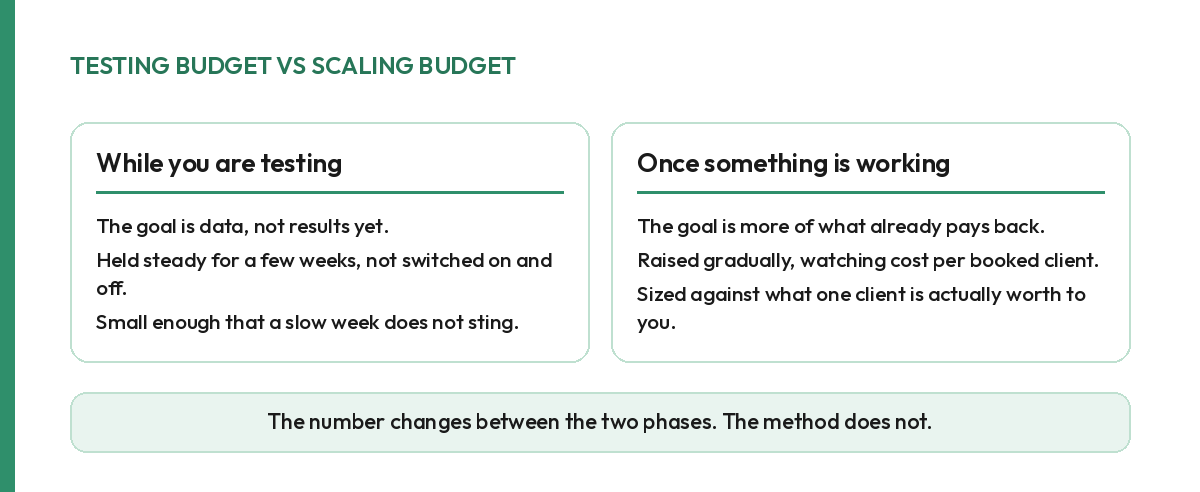
Most of the anxiety around this question comes from treating it as one number, when it is really two, used at different points.
The testing budget is small on purpose. Its job is not to produce a flood of clients, it is to produce information: which audience responds, which offer lands, what a result actually costs you right now. Held steady for a few weeks, even a modest amount will show you a real pattern. Switched on for two days and off for a week whenever the results feel disappointing, even a generous amount will show you nothing, because the platform never gets the stable signal it needs to find the right people.
The scaling budget only exists once the testing budget has told you something is working. At that point the question changes from “can this work” to “how much more of this can I afford”, and that is answered by the same client-value arithmetic from before, applied to a number you now trust because you measured it, not because you estimated it.
Seasons move both budgets too, in a direction most founders do not expect. A number that worked comfortably a few months ago can quietly stop being enough once every other business in your category is bidding for the same audience at the same time, and a testing budget that felt generous in a quiet month can start behaving like a starved one in a busy one. This is not a sign the earlier number was wrong. It is a reason to revisit the client-value math on a schedule, rather than setting it once and assuming it holds forever.
Why a flat daily amount from a blog post is the wrong starting point
Any post, including this one, that hands you a specific dollar figure as the right Facebook ads budget for a small business is quietly averaging together businesses that have nothing to do with yours. A local service business where one client is worth a few hundred dollars a year and a business where one client is worth a few thousand cannot sensibly run the same daily budget, even if their monthly revenue looks similar on paper today.
That is also why two businesses that ask us this exact question, in the same week, in the same city, often walk away with completely different numbers. For businesses that lean on a physical location and local reach, our page on how we work with beauty and wellness studios covers how that client-value math tends to play out for an appointment-based business specifically, which behaves differently from a business selling a one-time product.
Setting your own number
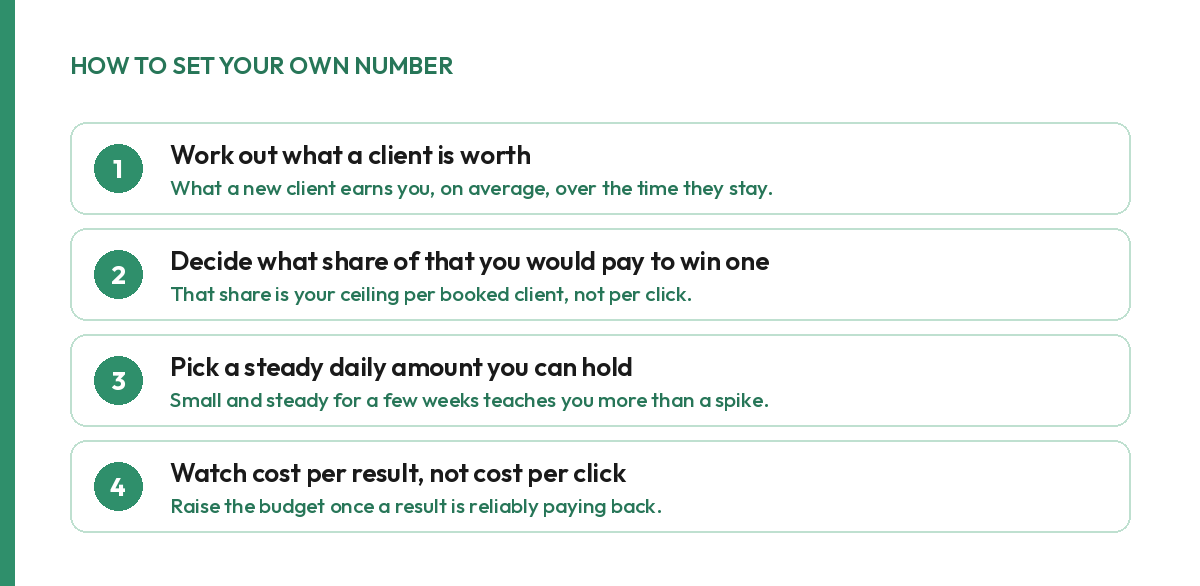
Work out roughly what a new client is worth to you over time, not just on the first purchase or booking. Decide what share of that value you would happily pay to win one client, and treat that as your ceiling, per client, not per click or per day. Pick a steady daily amount you can hold for a few weeks without stress, and resist the urge to pause it the moment a day looks quiet. Then watch cost per booked result rather than cost per click, because a cheap click that never becomes a client is not actually cheap.
Once that real number exists, raising the budget stops being a guess and starts being simple math: you keep putting more in for as long as what comes out is worth more than what went in. That “cost per booked result” figure has a proper name, cost per acquisition, and tracking it by channel is what turns this from a one-time budget decision into an ongoing comparison. If your ads are not converting once the budget is in place, that is usually a different problem from the budget itself, and it is worth reading why Facebook ads sometimes stop converting before assuming the number was wrong.
If figuring out the right budget, audience and offer is pulling you away from the work you are great at, that is exactly what we take off your plate. Book a free discovery call and we will map out your Growth Plan together, starting with what a client is actually worth to your business.
Frequently asked questions
Is there a standard Facebook ads budget for a small business?
No, and any answer that gives you one figure is guessing on your behalf. A budget that makes sense for a clinic booking appointments makes no sense for a shop selling a twenty dollar product, because the two businesses can afford wildly different amounts to win one client. The only standard part is the method: work out what a client is worth to you, decide what share of that you would pay to win one, and let that number, not a published average, set your ceiling.
How much should I spend testing Facebook ads before I know if they work?
Enough to hold a steady daily amount for a few weeks without it hurting if the first attempts do not convert. The exact figure depends on your margins, but the shape is the same for everyone: small and steady beats large and switched on and off, because a campaign needs time and a stable budget to show you a real pattern rather than a lucky day or an unlucky one.
When should a small business increase its Facebook ads budget?
Once you can see, reliably, that a booked client is costing you less than that client is worth. That is the only signal worth acting on. Raising the budget before you have that signal just makes an unproven campaign more expensive faster. Raising it after you have that signal is the entire point of testing in the first place, because you are now putting more into something that is already paying you back.
Should the Facebook ads budget be a percentage of revenue or a flat amount?
Neither, on its own. A percentage of revenue tells you what you can afford in general, but it says nothing about whether Facebook ads specifically are working for your business. Start from what one client is worth, set a budget you can hold steady while you find out, and only once you have a real cost-per-client number does it make sense to talk about how that fits your wider revenue. Skipping straight to a percentage is how businesses end up either underfunding a channel that was about to work, or overfunding one that never will.
Want a clear roadmap for your own growth?
Every partnership with The Growth Project starts with a free Growth Plan. Book a discovery call and we'll map out yours together.