What is cost per acquisition in marketing?
What is cost per acquisition in marketing? It is what one paying client actually costs you, not a click or a lead. Here is how to calculate and use it.
What is cost per acquisition in marketing is one of those questions that sounds technical but turns out to be the single most useful number a small business owner can track, because it is the one metric that actually connects your marketing spend to real revenue. If you would rather have us set this up inside your own numbers, you can book a free discovery call and we will walk through it together. Otherwise, here is the plain version.
TL;DR: Cost per acquisition is what it actually costs you, in total, to win one paying client, not one click and not one lead. You calculate it by dividing what you spent by the number of new clients that spending produced. There is no universal good number. It is only meaningful next to what a client is actually worth to your business, and tracking it stops you from celebrating a cheap click that never turns into revenue.
What is cost per acquisition in marketing?
Cost per acquisition, often written as CPA, is the total cost of winning one new paying client through a specific marketing effort. Not a click on an ad. Not someone filling out a form. A client who actually booked, bought, or signed up and is now paying you. It is the number that tells you whether your paid acquisition is actually working, whichever channel it runs through.
That distinction matters more than it sounds like it should. A lot of marketing reporting stops one step too early, celebrating a low cost per click or a flood of cheap leads, without ever checking whether those clicks and leads turned into anything. Cost per acquisition forces the question all the way through to the end: after everything, what did a real client actually cost?
How to calculate your cost per acquisition
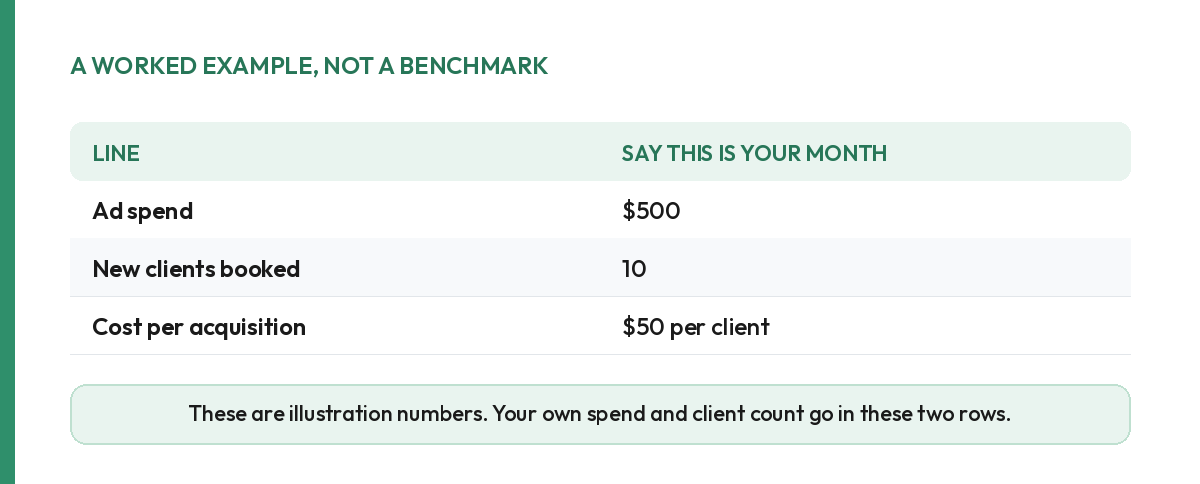
The formula itself is simple: take everything spent on a channel or campaign over a period, and divide it by the number of new paying clients that channel produced over the same period. If a month of Facebook ads cost five hundred dollars and produced ten new booked clients, the cost per acquisition for that channel that month was fifty dollars per client.
The two numbers you need already exist somewhere in your business. Your spend is in the ad account. Your new clients are in your booking system, your point of sale, or however you track who actually became a paying customer. The only work is connecting the two, ideally by channel, so you can see which source of clients is actually affordable and which one only looks cheap upstream.
For how this fits alongside the budget question itself, see our guide to how much a small business should spend on Facebook ads, which walks through setting the spend side of this equation.
CPA is not the same as cost per click or cost per lead
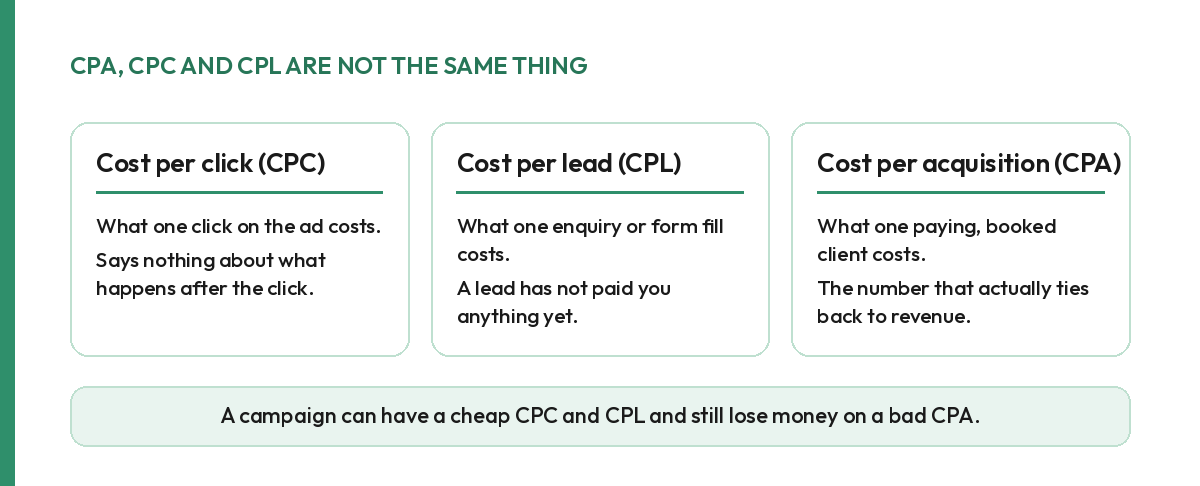
These three metrics get used loosely and interchangeably, and that looseness costs businesses money. Cost per click tells you what one click cost, and nothing about what happened after it. Cost per lead tells you what one enquiry cost, and a lead has not paid you a cent yet. Only cost per acquisition tells you what an actual, paying client cost, which is the number that ties directly back to whether the marketing made or lost money.
A campaign can post an excellent cost per click and an excellent cost per lead and still be quietly unprofitable, if very few of those cheap leads ever close. That gap is exactly why cost per acquisition is worth tracking on its own rather than assuming a good early number means a good outcome. For a closer look at why the clicks and leads sometimes do not convert at all, see why Facebook ads are not converting.
What counts as a good cost per acquisition?
There is no fixed number that counts as good across every business, and treating one like a universal benchmark misses the point of the metric entirely. Fifty dollars to acquire a client is excellent if that client is worth two hundred dollars to your business over time, and a real problem if that client is only worth sixty. The number only means something once you put it next to what a client is actually worth to you, which is why we always look at cost per acquisition and client lifetime value together rather than either one alone.
This is also why a business like a health clinic or a coaching practice, where one client often stays for months or years, can reasonably afford a much higher cost per acquisition than a business selling a single low-cost item once. If that describes your business, our page on how we work with coaches and practitioners covers how that client-value math tends to play out for a relationship-based practice specifically.
Once you are tracking cost per acquisition by channel, the decision about where to spend the next dollar stops being a feeling and becomes a comparison: which channel is bringing in clients for less than they are worth, and by how much. That comparison, kept up over time, is what actually grows a marketing budget responsibly instead of guessing.
It also changes how you react to a bad month. Without cost per acquisition, a quiet month on one channel looks like a reason to panic or to abandon it. With it, you can see whether the channel is actually broken or whether it simply had fewer conversions than usual while still costing a reasonable amount per client. That difference decides whether the right move is to fix something or to hold steady and let a normal month follow a slow one, which is a far calmer way to run a marketing budget than reacting to every dip in isolation.
If figuring out your own numbers, and turning them into a real marketing plan, is pulling you away from the work you are great at, that is exactly what we take off your plate. Book a free discovery call and we will map out your Growth Plan together, starting with what a client is really costing and earning you.
Frequently asked questions
What is a simple definition of cost per acquisition?
Cost per acquisition is the total amount you spent on a marketing effort, divided by the number of paying clients or customers that effort actually produced. It answers one specific question: what did each new client cost you to win, all in. It is not the cost of a click and not the cost of a lead. It is the cost of the whole journey ending in someone becoming a client.
How do you calculate cost per acquisition?
Add up everything spent on a specific campaign or channel over a period, then divide by the number of new paying clients that channel produced in the same period. If you spent five hundred dollars on ads in a month and those ads led to ten new clients, your cost per acquisition for that channel that month was fifty dollars. The two things you need are already in your ad account and your booking or sales records, you are just dividing one by the other.
What is a good cost per acquisition for a small business?
There is no fixed good number, because it only means something next to what a client is worth to you. Fifty dollars to acquire a client worth two hundred dollars over their lifetime is a strong result. Fifty dollars to acquire a client worth sixty dollars is a loss once you account for delivering the work itself. The useful comparison is always cost per acquisition against client lifetime value, never cost per acquisition against another business's number.
What is the difference between cost per acquisition and cost per lead?
A lead is someone who showed interest, an enquiry, a form fill, a message. A lead has not paid you anything and may never become a client. Cost per acquisition only counts the leads that actually converted into a paying, booked client. A channel can produce very cheap leads and still have an expensive cost per acquisition if most of those leads never close, which is why watching leads alone can be misleading.
Want a clear roadmap for your own growth?
Every partnership with The Growth Project starts with a free Growth Plan. Book a discovery call and we'll map out yours together.