How often should email marketing be sent? A simple cadence
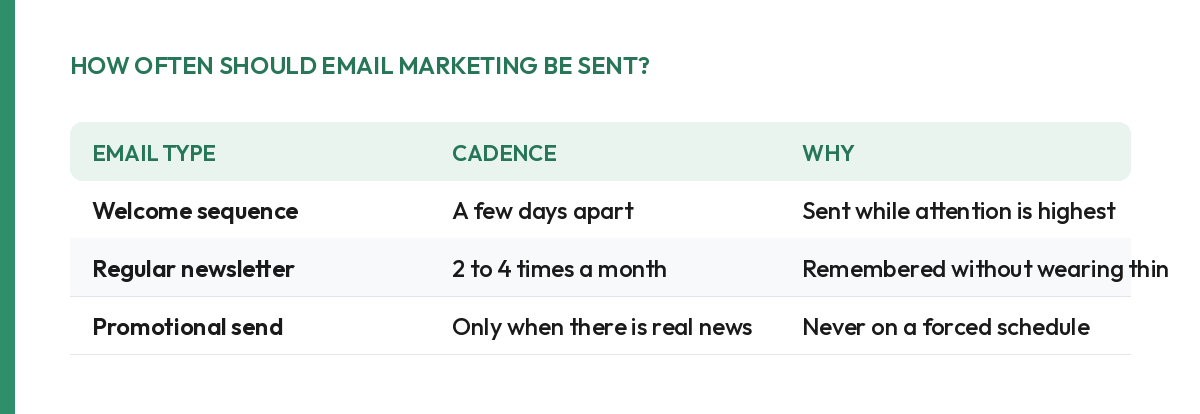
How often should email marketing be sent? Often enough to be remembered, rarely enough to always have something worth saying. Usually two to four times a month.
How often should email marketing be sent so that it helps rather than annoys? If you would rather have a cadence built around your own business than guess at a number, you can book a free discovery call and we will set one up together. Here is the short answer, and the reasoning behind it.
TL;DR: How often should email marketing be sent? For most founder-led businesses, two to four times a month for the regular newsletter is a workable range, often enough to be remembered, rarely enough that every email still has something worth saying. The welcome sequence runs on its own faster schedule, a few days apart, because it greets someone at the moment they are paying the most attention. Consistency matters more than the exact number: a steady cadence you can actually keep beats an ambitious one you abandon after six weeks.
How often should email marketing be sent, and why is there no single right number?
There is no universal answer because the right cadence depends on how much genuinely useful material your business generates and how much time you have to write it well. What holds across every founder-led business is the underlying rule: send often enough that people remember you exist, and rarely enough that you are never scraping for something to say. Two to four times a month is the range that satisfies both sides of that rule for most small businesses starting out.
What happens if you send too rarely?
Too rarely is the mistake that does the most damage, because it is invisible while it happens. Nobody unsubscribes from an email they never receive. They simply forget your business exists, and by the time they need what you offer, a competitor who stayed in touch is the one they remember. A list that gets emailed once a quarter is barely a list at all, it is a set of cold contacts wearing a warm label. For the fuller case on why the channel is worth building consistently, see our guide to email marketing for small business.
What happens if you send too often?
Too often is the more visible mistake, and the one people worry about more, even though it usually does less long-term harm. The signal is obvious: rising unsubscribe rates, or worse, people marking your email as spam because unsubscribing feels like too much effort. If every send starts to feel like padding to hit a schedule, that is the signal to slow down, not push through it. Quality holding steady matters more than hitting a number on a calendar.
A useful gut check: read your last three sends back to back. If each one stands on its own, with a real reason to have been written, the cadence is fine. If two of the three feel like they exist only to fill a slot on the calendar, the cadence is ahead of what you actually have to say, and slowing down for a stretch will do more good than any subject-line trick.
Does the welcome sequence follow the same schedule?
No, and this is the part people most often get wrong. The welcome sequence runs on a faster, tighter schedule than the regular newsletter, usually a few days apart, because it greets someone right when they are most engaged, not weeks later when the moment has passed. Once that short sequence finishes, the subscriber moves onto the slower, steady newsletter cadence. See our guide to writing a welcome email sequence for exactly how those first few emails should be spaced.
How do you pick your own number?
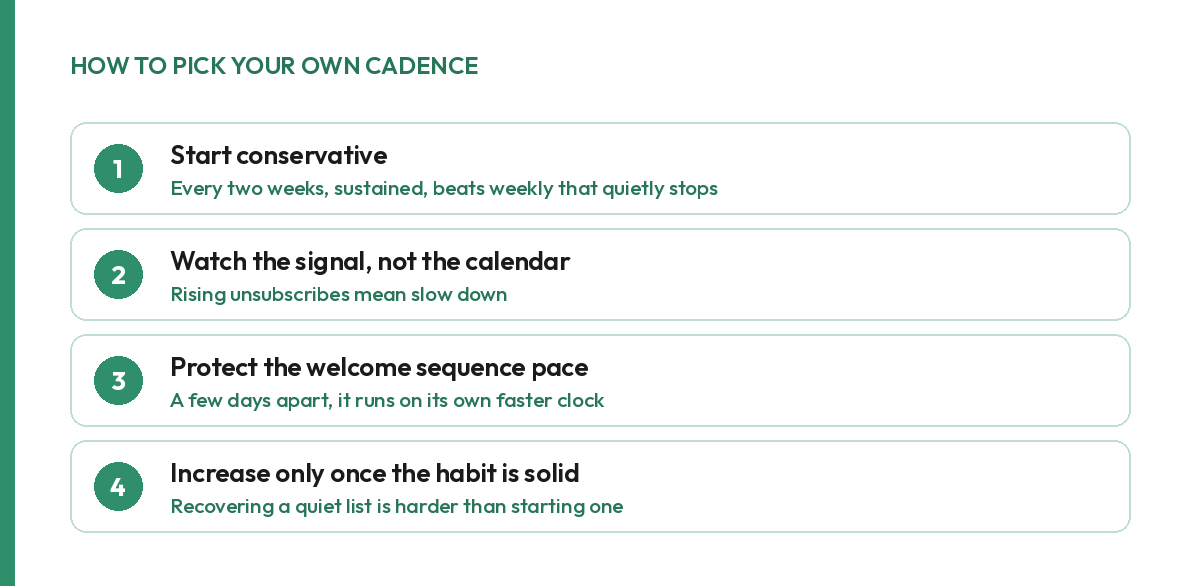
Start conservative. A steady email every two weeks that you can actually sustain for a year beats an ambitious weekly plan that quietly stops after six sends. That steady rhythm is specifically the newsletter’s job, not a launch or sale email’s; see email marketing campaign vs newsletter for why the two run on different schedules entirely. Once the habit is solid and you have a backlog of things worth saying, increasing the cadence is easy. Going the other direction, recovering a list that watched you go quiet, is much harder. If you are also weighing the cost of building this properly against the return, our breakdown of how much email marketing actually costs puts the time investment in context.
What if your cadence needs to change with the season?
A steady cadence does not mean a rigid one. A retail-adjacent business genuinely has more to say around a seasonal push, and a service business often has a quieter stretch where forcing a regular send produces filler nobody wanted. The rule still holds through both: never drop below the floor that keeps you remembered, and never pad a quiet month just to hit a number. A single honest email in a slow month beats two padded ones that both feel like nothing.
What should not change with the season is the welcome sequence. New subscribers keep arriving whether or not you are in a busy stretch, and every one of them deserves the same tight, fast greeting regardless of what the rest of the calendar looks like that month. Treat the welcome sequence as fixed infrastructure and the newsletter as the part that can flex.
Write the flexible newsletter cadence down somewhere you will actually see it, even if it is just a note on your calendar. A cadence that lives only in your head is the first thing to slip when the rest of the business gets busy, and a quiet month that was meant to be a one-off has a way of becoming three. A cadence you can see is a cadence you can protect.
The number that matters most is the one you can hold to without fail, not the one that looks most impressive on paper. Consistency is what compounds. A cadence you keep is worth more than a cadence you announce.
If building that rhythm and sticking to it is the part that keeps slipping, that is exactly what our email marketing service takes off your plate. Book a free discovery call and we will map out your Growth Plan together, including a cadence built around what your business can actually sustain.
Frequently asked questions
How often should email marketing be sent?
For most founder-led businesses, two to four times a month is a workable range: often enough that subscribers remember who you are, rarely enough that every send still has something worth saying. The exact number matters less than picking a cadence you can actually sustain and sticking to it.
Is it better to send email too often or not often enough?
Not often enough is the more common mistake, and the quieter one. A subscriber who never hears from you simply forgets you exist by the time they need what you offer. Sending too often is more visible, since people unsubscribe, but a slow trickle of silent forgetting does more damage over a year than the occasional unsubscribe does.
Should the welcome sequence follow a different schedule than the newsletter?
Yes. The welcome sequence runs faster and closer together, usually a few days apart, because the person just subscribed and is paying the most attention right then. The regular newsletter runs on a slower, steady beat, usually every one to two weeks, because it is a relationship you are maintaining over months, not a first impression you are making once.
What happens if I skip a month of sending?
Nothing dramatic happens after one skipped month, but the habit is the hard part to rebuild once it slips. A steady cadence, even a modest one, compounds because people come to expect you. An irregular one starts to feel like a stranger showing up again, and the first email back after a long gap has to work harder than any regular send would have.
Want a clear roadmap for your own growth?
Every partnership with The Growth Project starts with a free Growth Plan. Book a discovery call and we'll map out yours together.