Email marketing campaign vs newsletter
Email marketing campaign vs newsletter: what actually separates the two, when to send each one, and how founder-led businesses use both well.
If you have ever sat down to write an email and were not sure whether it should read like a newsletter or like an announcement, you have already found the real question behind email marketing campaign vs newsletter. They are not the same thing wearing two names, and mixing them up is one of the quieter reasons an email list stops converting. If you would rather have us look at your own list and sending habits together, you can book a free discovery call and we will walk through it. Otherwise, here is the plain version.
TL;DR: An email campaign is a short push built around one goal, a launch, a sale, a seat filling up, with a clear start and end. A newsletter is a steady, ongoing send on a fixed rhythm that keeps the relationship warm between the moments you have something to sell. Most founder-led businesses need both, and the confusion usually comes from treating one like the other, a sales pitch dressed as a newsletter, or a real deadline buried in a soft subject line.
Email marketing campaign vs newsletter: what’s the difference?
The difference is not the tool you send it from or the word your email platform uses. Both are marketing email, and plenty of tools happily label every send a campaign in the dashboard. The difference that actually matters is the job each one is doing.
A campaign exists to get one specific action taken by one specific point in time. A product launch, a seasonal sale, a webinar with seats running out, a limited-time offer. It has a beginning and an end, and once the window closes, the campaign is over. A newsletter has no end date. It is a habit you keep, issue after issue, whether or not you have anything to sell that particular week. Its job is not to close something today. Its job is to be the reason a subscriber still recognizes your name six months from now.
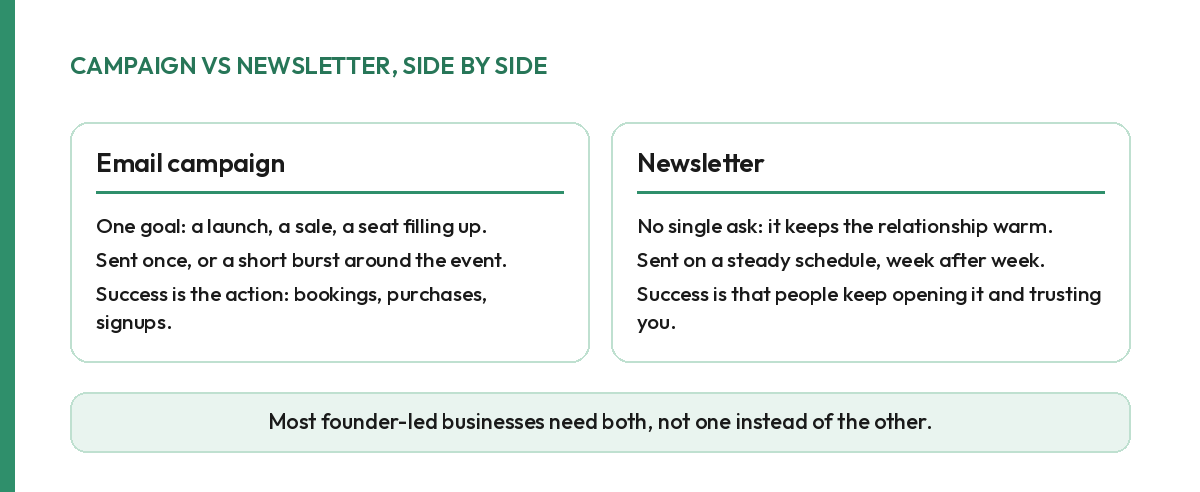
Think of it this way: a campaign is a single conversation with a purpose. A newsletter is an ongoing friendship. You would not turn every catch-up with a friend into a pitch, and you would not run a real sale as a vague, friendly check-in either. Founder-led businesses that get this right tend to send both, and keep them clearly different in tone.
Why founder-led businesses confuse the two
The confusion is understandable. Most small business owners set up one email tool, build one list, and send whatever they have to say into that same list without separating the two jobs mentally. Over time two failure patterns show up.
The first is the newsletter that quietly becomes a weekly sales pitch. Every issue pushes something, and subscribers learn to skim past it, because there is never a week where the email is just useful. Opens fall, and the list stops being an asset. The second failure runs the other way: a real campaign, with an actual deadline, gets written in the same soft, friendly voice as the newsletter, so the urgency never lands and the offer under-performs. A launch email should read differently from a monthly update, because it is asking for something different.
For the fundamentals of building the list both of these run on, see our guide to email marketing for small business, and for how the very first emails a new subscriber receives should work, see how many emails should be in a welcome sequence.
How to decide which one you are actually sending
Before you write, ask what this specific email is for. If the honest answer is “I want someone to do something specific by a certain date,” you are writing a campaign. If the honest answer is “I just want to stay in touch and share something useful,” you are writing a newsletter issue. That one question resolves most of the confusion before a single word gets typed.
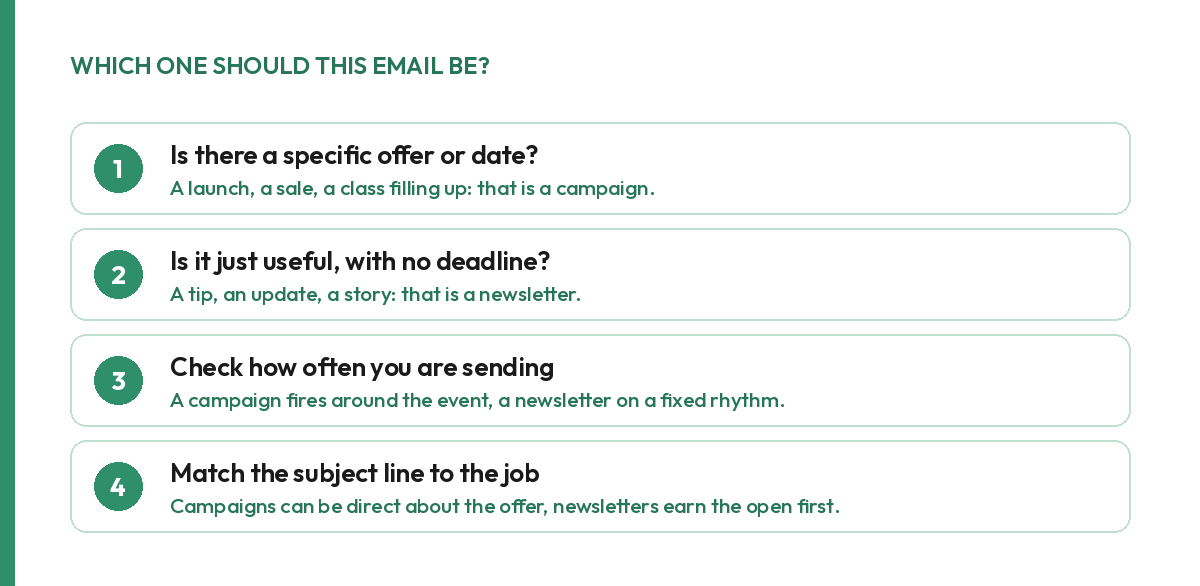
A useful test: if you deleted the deadline from the email, would the message still make sense? A newsletter issue survives that test fine, since nothing in it depended on a date. A campaign usually falls apart without its deadline, because the deadline is the entire reason to act now rather than later. If your “newsletter” keeps failing that test, it is not really a newsletter.
This matters even more for businesses that sell to a schedule rather than a single purchase, where campaigns tend to cluster around specific windows. If that describes your business, our page on how The Growth Project works with ecommerce brands covers how we plan campaign timing around those windows without letting the newsletter turn into background noise the rest of the year.
Building a rhythm that uses both well
The businesses that get the most out of email are not the ones sending the most. They are the ones who keep the two jobs distinct and let each one do its work. A newsletter on a steady, sustainable rhythm, often every two to four weeks, so it never feels like an obligation to write or to read. Campaigns layered on top only when there is a genuine reason: a launch, a seat count dropping, a window closing. For a closer look at how often that steady rhythm should actually run, see how often should email marketing be sent.
Kept separate, the newsletter builds the trust that makes the campaign convert when it finally arrives, and the campaign never has to apologize for asking for something, because it has not been asking every single week. That is the whole point of understanding email campaign vs newsletter as two different tools rather than one blurry habit.
If figuring out the digital side is pulling you away from the work you are great at, that is exactly what we take off your plate. Book a free discovery call and we will map out your Growth Plan together, starting with a look at your current list and sending habits.
Frequently asked questions
Is a newsletter a type of email campaign?
Loosely, yes: both are marketing emails, and some tools file every send under the word campaign. The useful distinction is not the tool's label, it is the job. A newsletter is a steady, ongoing habit with no single ask attached to any one issue. A campaign is a short push built around one goal with a start and an end. Treating a launch email like a newsletter issue, or treating a newsletter like a sales pitch every week, is usually where the confusion starts.
Should a small business send both a newsletter and campaigns?
Yes, and they do different work. The newsletter keeps the relationship going between the moments you actually have something to sell, so people do not forget who you are. The campaign is what you send when there is a real reason to act: a launch, a seat filling up, a limited window. A list that only ever gets campaigns starts to feel like a stranger asking for something. A list that only ever gets a newsletter never hears the actual offer.
How often should a newsletter go out compared to a campaign?
A newsletter works best on a fixed, predictable rhythm, often every two to four weeks, because the value is in the habit. A campaign has no fixed rhythm at all. It goes out when there is something to announce and stops when the window closes. If you notice every newsletter issue is secretly a sales pitch, that is a sign the campaign and the newsletter have blurred into one thing, and neither is doing its job well.
What should go in the subject line of each?
A newsletter subject line can be plain and a little curious, since the reader already expects a useful note from you and is not being asked for anything. A campaign subject line can be more direct about the offer, because the whole email exists to get a specific action taken before a deadline. Borrowing a newsletter's soft subject line for a campaign with a closing date is a common way to under-sell a real deadline.
Want a clear roadmap for your own growth?
Every partnership with The Growth Project starts with a free Growth Plan. Book a discovery call and we'll map out yours together.