Marketing: How Many Emails Should Be in a Welcome Sequence?
Three to five welcome emails is the honest answer for most founder-led businesses. Here is how to pick the right number and why more is not always better.
If you already have a welcome sequence, or you are about to build one, the question that stalls most founders is not what to say, it is how many emails to write. Send too few and you waste the moment a new subscriber cares the most. Send too many and you wear out a welcome before it has been earned. If you would rather have this mapped out for you, you can book a free discovery call. Otherwise, here is the honest answer to how many emails should be in a welcome sequence, and how to land on the right number for your own business.
TL;DR: Three to five emails is the right range for most founder-led businesses, and four is a dependable default: welcome and deliver, give a quick win, show you can help, then invite one next step. Fewer than three wastes the attention a new subscriber gives you; more than six or seven usually starts repeating itself. Start at four, watch what people actually open and click, and adjust from there.
How many emails should be in a welcome sequence?
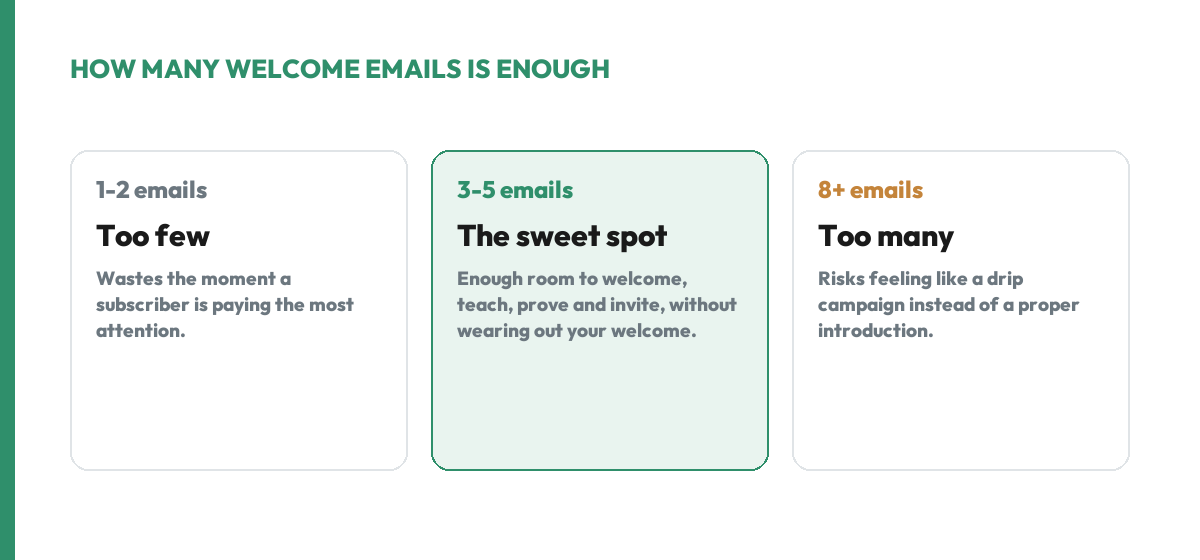
For most founder-led businesses, three to five emails is the sweet spot, and four is the number we recommend starting with. That is enough room to do four separate jobs properly: welcome the person and deliver on whatever got them to sign up, give them one quick and useful win, show them you can actually help with a short and honest example, and then make one clear invitation to take the next step with you.
This builds on the full setup we cover in how to write a welcome email sequence that converts, which walks through the four-email arc in detail. This post answers the narrower question founders ask first: not what to write, but how many emails to plan for before you start writing.
Why fewer than three emails usually falls short
A single welcome email can only do so much. It can say thanks and deliver whatever you promised at signup, but it rarely has room to also prove you can help and make a clean, single invitation without the message feeling crowded or salesy. Two emails is workable but tight.
The deeper reason to avoid going too short is timing, not word count. The days right after someone joins your list are the warmest they will ever be. A sequence that ends after one message uses only a sliver of that window. The subscriber’s curiosity is still there on day three and day five, and a short sequence leaves it unanswered.
Why more than six or seven emails usually backfires
Past six or seven emails, most small businesses run out of things worth saying and start padding. That shows. A subscriber can tell the difference between a message that earns its place and one that exists to fill a slot in a template, and the second kind trains people to stop opening your emails altogether.
There is also a practical ceiling: attention. A new subscriber’s interest is highest in the first week, not the first month. A long sequence spreads that early attention thin instead of using it while it is strongest. If you have more to say, a regular newsletter is the better home for it once the welcome sequence has done its job.
A default cadence that works for most businesses
Four emails, spaced roughly a day or two apart, closing within the first week to ten days, is the cadence we default to for founder-led businesses. The first email goes out immediately, while the signup is still fresh. The rest follow close enough behind that the sequence feels like one coherent introduction rather than four unrelated messages.
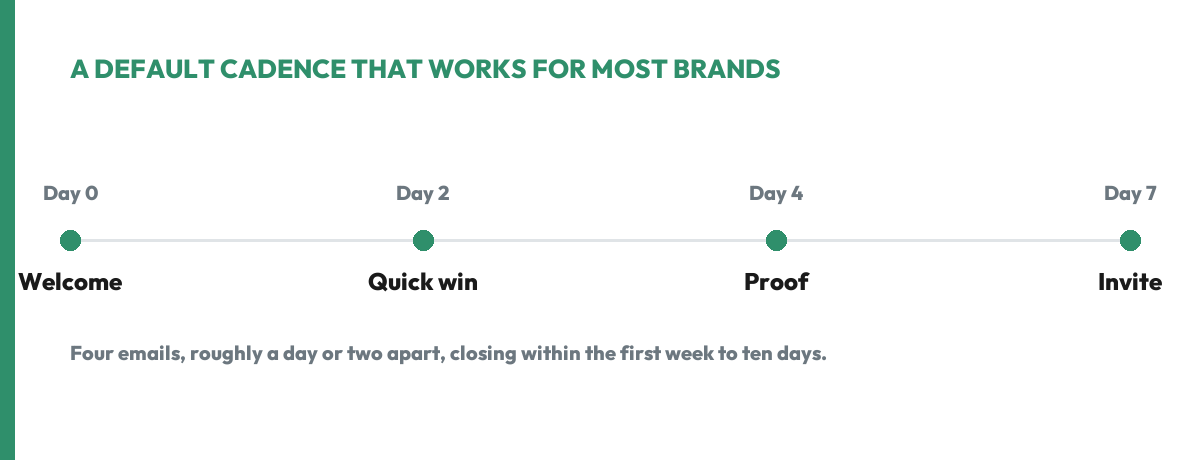
The exact spacing matters less than two things: that the first email sends immediately, and that the sequence actually finishes instead of trailing off. A sequence that starts strong and quietly stops after two emails does more damage than a shorter sequence that was planned to be short from the start.
Does the right number change by business type?
A little, though less than most founders expect. If your sales cycle is naturally longer (a service booked months in advance, for example) stretching to five or six emails spread a bit further apart can make sense, because there is more ground to cover before someone is ready to act. If what you sell is something a reader can act on right away, three emails is often enough.
Rather than solving this with a formula, start at four, which is the safest default for email marketing for a small business in general, and adjust from what you actually see. If people are still opening and clicking by email four, a fifth is worth testing. If opens are already dropping by email three, that is a clearer signal than any rule of thumb.
What this means for your setup
Pick four as your starting number unless you have a specific reason to go shorter or longer. Write each email to do one job: welcome, quick win, proof, invitation. Watch what happens after you launch it, and let real opens and clicks tell you whether to add a fifth email or trim to three. This is the same principle behind what email marketing actually means inside a digital marketing plan: the channel rewards attention to what is actually working over sticking to a fixed plan.
Getting the number right matters less than getting the sequence built and running at all. A four-email sequence that actually exists will always outperform a perfectly-numbered sequence that is still sitting in your drafts folder. If mapping this out and writing it in your own voice is the part that keeps getting pushed down your list, our email marketing work is exactly what we take off your plate. Book a free discovery call and we will map out your Growth Plan together, starting with the welcome sequence that should be greeting every new subscriber you get.
Frequently asked questions
How many emails should be in a welcome sequence?
Three to five is the honest answer for most founder-led businesses, and four is a reliable default. That is enough room to welcome the new subscriber, hand them a quick win, show you can actually help, and invite one clear next step, without wearing out your welcome before you have earned it.
Is one welcome email enough?
One email can work if it is genuinely excellent, but it usually leaves value on the table. A single email can welcome and deliver, but it rarely has room to also prove you can help and make a clean invitation. Two to three emails give you the space to do both without asking too much of a single message.
Can a welcome sequence have too many emails?
Yes. Past six or seven, most small businesses start repeating themselves or padding the sequence with content that does not earn its place. A new subscriber's attention is highest in the first few days, not the first few weeks, so a long sequence spends that attention slowly instead of using it well.
Does the right number of welcome emails depend on the business?
A little, but less than most founders assume. A business with a longer sales cycle, like a service that is booked months in advance, can stretch to five or six emails spread further apart. A business selling something the reader can act on immediately can often do it in three. Start at four and adjust from what you see, rather than picking a number from a formula.
Want a clear roadmap for your own growth?
Every partnership with The Growth Project starts with a free Growth Plan. Book a discovery call and we'll map out yours together.