How long should a marketing email be?
How long should a marketing email be? What a 2.1 million email study found about word count, line count and when a marketing email gets too long.
How long should a marketing email be is one of those questions that actually has an evidence-backed answer, not just a house opinion. If you have ever written half a newsletter, watched the word count climb, and wondered whether anyone will read to the bottom, there is real data on exactly that question. If you would rather have someone else write and run these for you while you get back to the work you are actually good at, you can book a free discovery call. Otherwise, here is what the evidence says.
TL;DR: Constant Contact’s study of over 2.1 million marketing emails found that click-through rate peaks around 20 lines of text, roughly 200 words, paired with three or fewer images. Shorter emails often read as too thin to act on, and length past that point tends to cost clicks rather than add them. The right number also shifts by industry and by sentence length, not just word count.
How long should a marketing email be?
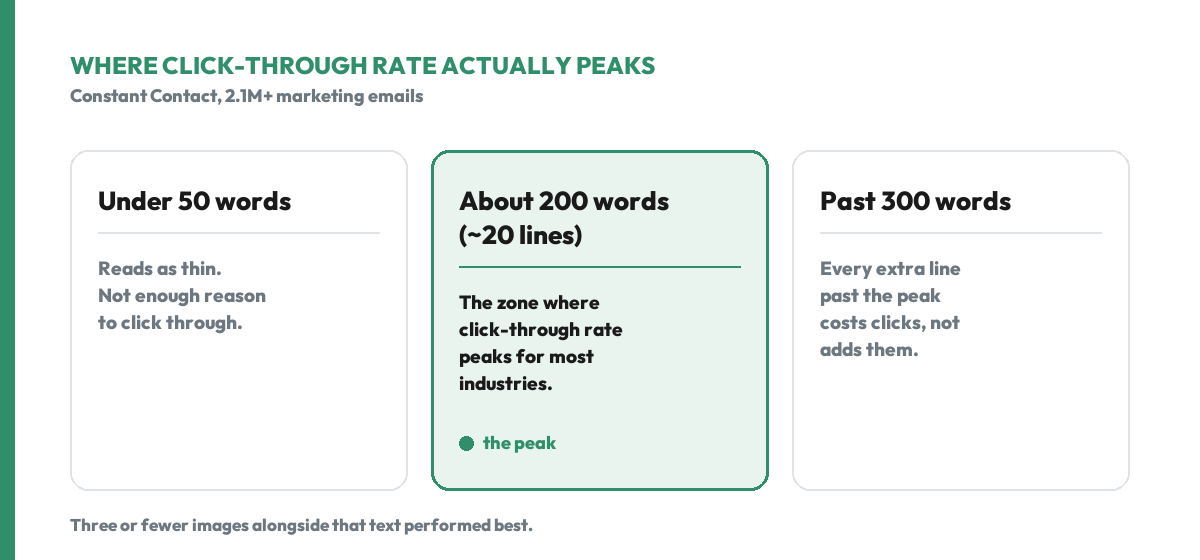
Constant Contact answered this with data rather than a rule of thumb. The company looked at more than 2.1 million emails sent by its own customers, each one going to over 100 recipients, tracked across 13 weeks. The pattern that came out of it was consistent: emails with three or fewer images and about 20 lines of text, which works out to roughly 200 words, produced the highest click-through rates across most industries.
That is a useful number precisely because it is a peak, not a floor. An email that stops at 50 words often has not said enough to earn a click. An email that runs past 300 words is usually not adding value with the extra length, it is adding scrolling. The 20-line mark is the point where most marketing emails have said enough to be worth acting on, without asking for more attention than the format can hold.
Does more images help, or just more words?
Length is not only about words. The same study measured images alongside text and found that three or fewer images, paired with that same 20-line range, produced the best results. Piling on a fourth or fifth image did not push click-through rate any higher. In one of the sharpest examples in the data, retail emails saw click-through rate jump by more than 50 percent between 17 and 19 lines of text, then drop by roughly half again between 19 and 21 lines. Two extra lines either side of the peak made that much difference.
The takeaway is not “fewer images always win.” It is that a marketing email has a narrow window where it is doing its job, and both the text and the images inside it are competing for the same small amount of attention. Past that window, more of either one is working against the email rather than for it.
Why we treat length as a decision, not a feeling
Most founders write a marketing email the way they would write a personal note, stopping when it feels done rather than when the data says it will convert best. That is understandable. It is also the reason a well-meaning email full of updates and asides can quietly underperform a much shorter one that says less but says it more clearly. Our email marketing work starts from numbers like the ones above rather than a feeling, because a subject line and an opening line only get a reader to open the email. Length, structure and sentence choice decide whether that reader actually clicks through once they are in it.
Sentence length matters as much as word count
A 200-word email written in long, stacked sentences can still feel harder to read than it should. Mailchimp’s own readability guidance for marketing email targets a 6th to 8th grade reading level, built from sentences of roughly 14 to 20 words, and it notes that engagement drops significantly once the writing reads above a 10th grade level. That is a separate lever from total word count, and it is one a lot of otherwise well-sized emails get wrong.
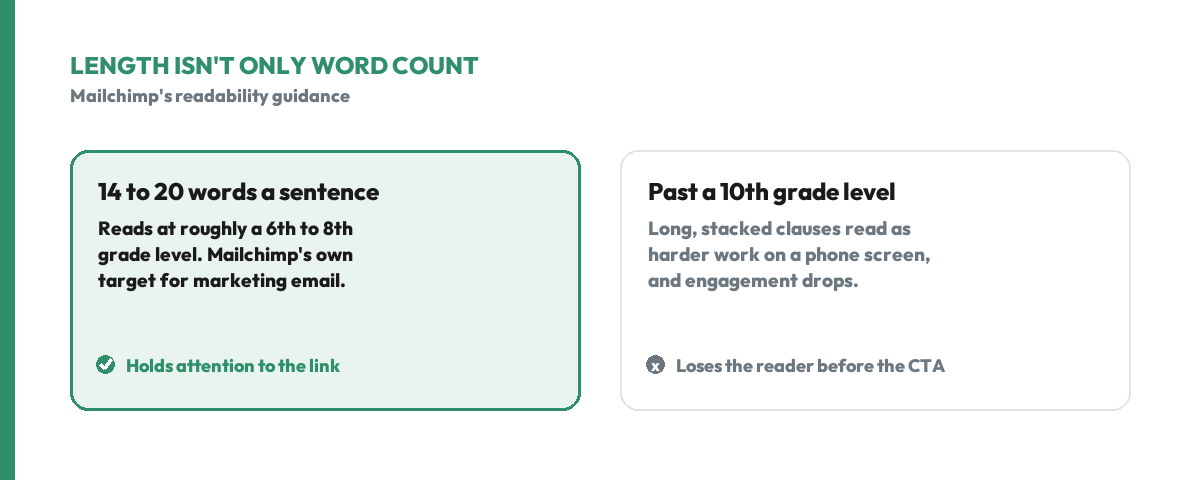
In practice this means reading a draft out loud before sending it. A sentence that needs a breath halfway through, or one stacked with three separate ideas joined by commas, is usually the sentence costing you the click, even if the email’s total word count looks fine on paper.
Does the type of email change the number?
The 20-line, three-image range is the average across industries, not a hard ceiling for every kind of email. Constant Contact’s data shows genuine variation by category. Associations kept a steady click-through rate anywhere from 20 to 30 lines of text. Membership organizations did the same across 15 to 30 lines. Real estate emails, which often need to describe a specific listing, peaked around 35 lines, well past what worked best for most other categories.
This is also where the type of send matters. A welcome email sequence introducing a new subscriber can usually run shorter and lighter than a full newsletter, because it only needs to earn one next step rather than cover several topics at once. See our breakdown of real email examples by type for how a welcome note, a newsletter and a launch email actually differ in length and shape, not just in name. If you are still deciding whether email deserves a dedicated line item at all, is email marketing worth it for a small business covers the independent research on the return before worrying about the exact word count of a single send.
The honest answer
There is no single correct length for every marketing email, but there is a number worth writing toward: about 200 words, roughly 20 lines, with three images or fewer, written in sentences short enough to read at a 6th to 8th grade level. That range is where the click-through data actually peaks, and it holds up as a starting point whether email is a small piece of your wider digital marketing plan or the channel doing most of the work. Test around it for your own list, but do not assume that a longer, more detailed email is automatically doing you any favors.
If getting the length, the sentence structure and the send cadence right is the part that keeps sliding down your list, that is exactly what we take off your plate. Book a free discovery call and we will map out your Growth Plan together, starting with the emails you are already sending.
Frequently asked questions
How long should a marketing email be?
Around 200 words, or about 20 lines of text, is where click-through rate peaks for most industries, according to Constant Contact's study of over 2.1 million marketing emails. Shorter emails often read as thin, and every line past that point tends to cost clicks rather than add them.
Does adding more images help a marketing email?
Not past a point. The same study found that three or fewer images alongside around 20 lines of text produced the highest click-through rates. Piling on more images did not improve results and often crowded out the message.
Is the ideal length the same for every kind of email?
No. The data shows real variation by industry. Associations kept a steady click-through rate between 20 and 30 lines, membership organizations between 15 and 30 lines, and real estate emails peaked around 35 lines, further out than most other categories.
Does sentence length matter as much as total word count?
Yes. Mailchimp's own readability guidance targets a 6th to 8th grade reading level, built from sentences of roughly 14 to 20 words, and notes that engagement drops significantly once content reads above a 10th grade level. A short email written in long, stacked sentences can still feel like a chore to read.
Want a clear roadmap for your own growth?
Every partnership with The Growth Project starts with a free Growth Plan. Book a discovery call and we'll map out yours together.