Is email marketing worth it for a small business?
Is email marketing worth it? Independent research puts its ROI well above paid ads and on par with SEO, at a fraction of the cost or wait time.
Is email marketing worth it, or is it one more channel competing for a small amount of marketing time that could go somewhere else? If you would rather have someone weigh that for your specific business than work through the numbers yourself, you can book a free discovery call and we will tell you honestly. Otherwise, here is what the independent research actually shows.
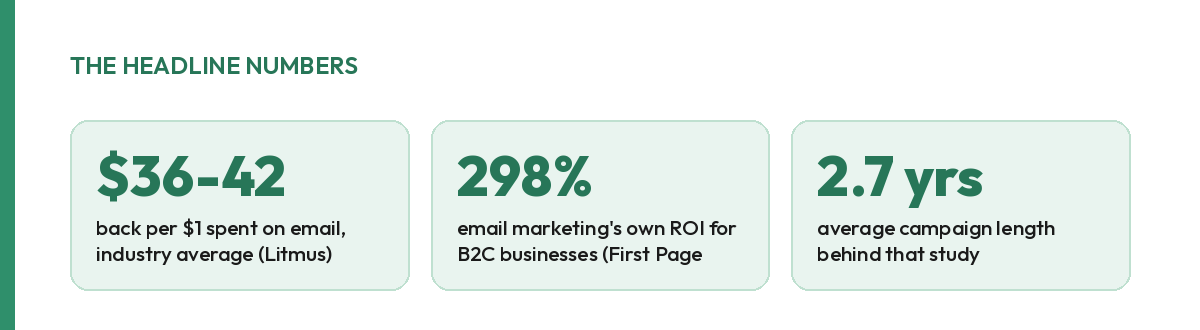
TL;DR: Yes, by a wide margin on the numbers. Litmus puts the industry-average return at $36 to $42 for every $1 spent. A separate study by First Page Sage, tracking 25-plus industries over roughly five years, measured email’s own ROI at 261% for B2B and 298% for B2C, ahead of PPC’s 24% to 36% in the same study. The one honest caveat: email largely monetizes a list you already have, so it works best alongside, not instead of, whatever channel brings people to you in the first place.
Is email marketing worth it for a small business?
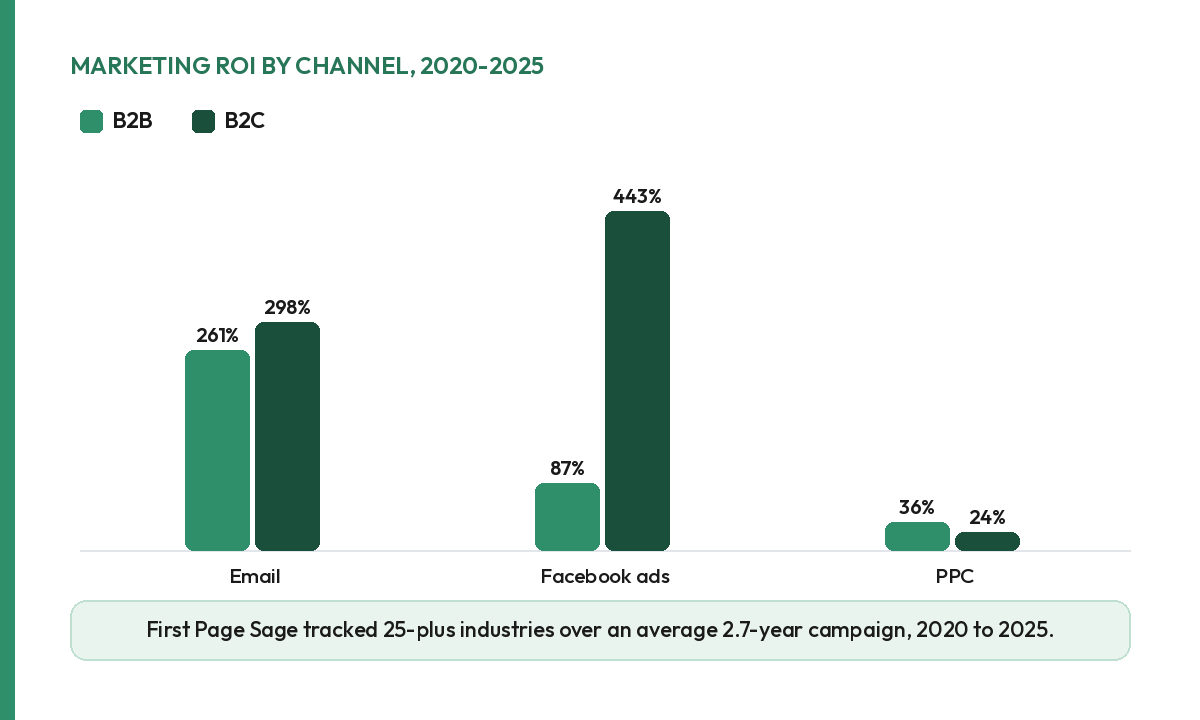
Yes, and the case does not rest on one favorable number. Litmus, which has tracked this for years, states the industry-average return on email marketing at $36 to $42 for every $1 spent, one of the highest of any channel measured. First Page Sage ran a separate, differently structured study: 25-plus B2B and B2C industries, a hybrid attribution model, and an average campaign length of 2.7 years between 2020 and 2025. It found email marketing itself returned 261% for B2B businesses and 298% for B2C, meaningfully ahead of PPC’s 24% to 36% in the same dataset. Two different methodologies, two different research groups, and both land on the same conclusion: email is not a channel you run because it feels productive, it is one that measurably pays back more than most alternatives.
How does email actually compare to other channels?
Facebook ads came out strong in the same First Page Sage study too, 87% for B2B and a striking 443% for B2C, so paid social is not a bad channel by any means. What separates it from email is durability. A Facebook campaign’s return exists only while the budget keeps flowing; stop paying and the return stops the same day. Email’s return sits on a list you own outright. Once someone subscribes, reaching them again costs almost nothing, so the channel keeps paying off the same list for months or years after the original signup, not just for as long as a budget lasts. If you are trying to work out what a channel like this should actually cost your business to run, how much email marketing costs breaks down the real number rather than a vague estimate.
Why the return holds up even on a small budget
The honest reason a small business benefits disproportionately from this is cost structure, not luck. Sending to five subscribers and sending to five thousand costs roughly the same on most platforms, so the return per dollar tends to improve as a list grows rather than flatten out the way ad spend does. That also means a small business does not need a big-brand budget for the channel to be worth running; it needs a list and a reason to email it, and for most businesses just starting out, the platform itself is still free. We cover the independent numbers behind the channel’s durability, and why it keeps performing as platforms change, in is email marketing still effective.
What makes it worth it, and what actually doesn’t
There is a real nuance here worth stating plainly rather than glossing over. First Page Sage’s own note on email is that it “is exceptionally low cost, but assembling a quality list of leads can take time,” meaning the channel largely monetizes people who already found you through something else, often SEO or paid traffic. That makes email the wrong channel to expect to replace how people discover your business in the first place. It is the right channel for what happens after they do: keeping them reachable, at almost no added cost, for as long as they stay subscribed. Worth it, in practice, means running it as a standing habit rather than a one-off campaign. Skip the welcome sequence a new subscriber should get, or let a list sit unemailed for months, and the return this research measured simply will not show up, because none of it comes from the platform itself, it comes from what you actually send.
Does it still work if you’re just getting started with a small list?
Yes, and arguably it matters more at that stage, not less. A new subscriber who never receives a proper welcome sequence forgets why they signed up within days, while one greeted well is primed to stay engaged for the life of the relationship. We cover exactly how many of those first emails a small list actually needs in how many emails should be in a welcome sequence, which matters more when your list is small and every subscriber counts, than it ever will once a list is large enough to absorb a few disengaged names.
The honest answer
Is email marketing worth it? On two independently run pieces of research, yes, by a wide enough margin that the real question is not whether to run it, but whether you are running it consistently enough to see the return it is capable of. Litmus measures the return at $36 to $42 for every $1. First Page Sage measures email’s own ROI at 261% to 298%, ahead of PPC in the same study. Neither number arrives on its own, it arrives from a welcome sequence that actually welcomes people and a list that actually gets emailed.
If getting that consistency right is the part that keeps sliding down your list, how we build email into a founder-led business’s growth is exactly what we take off your plate. Book a free discovery call and we will map out your Growth Plan together, starting with whether email is even the right next step for where your business is today.
Frequently asked questions
Is email marketing worth it for a small business?
Yes, on the numbers. Litmus puts the industry-average return at $36 to $42 for every $1 spent, and a separate multi-year study by First Page Sage measured email marketing's own ROI at 261% for B2B and 298% for B2C, both well ahead of PPC in the same study. The catch is that the return depends on you actually running it: a list nobody emails returns nothing.
How does email marketing's ROI compare to Facebook ads or Google ads?
In the First Page Sage study, which tracked 25-plus B2B and B2C industries from 2020 to 2025, email returned 261% to 298%, Facebook ads returned 87% to 443% depending on B2B or B2C, and PPC returned only 24% to 36%. Paid ads can work well for B2C specifically, but they stop producing anything the day you stop paying. Email keeps paying off the list you already built.
Does email marketing still work if I don't have a big list yet?
Yes. The return is driven by how relevant and well-timed the emails are, not by list size. A small, genuinely engaged list that gets a proper welcome sequence will outperform a large, ignored one. What a small list changes is the total dollar amount, not whether the channel is worth running.
What makes email marketing not worth it?
Treating it as a one-off rather than a standing channel. The First Page Sage research notes that email largely depends on a list you already have, usually built through another channel like SEO or paid traffic, so it is not a total replacement for those, it is the highest-return way to keep monetizing the people they bring you. Skip the welcome sequence, send inconsistently, or never grow the list, and the return collapses regardless of the channel's average.
Want a clear roadmap for your own growth?
Every partnership with The Growth Project starts with a free Growth Plan. Book a discovery call and we'll map out yours together.