Is email marketing still effective in 2026?
Is email marketing still effective in 2026? Litmus puts the average return at $36 for every $1 spent, and the reasons behind that have not changed.
Is email marketing still effective in 2026 gets asked a lot, usually by someone who has watched a social platform’s reach quietly drop and is wondering whether email is next, or who has heard the broader claim that email marketing is dead and wants to check it against real numbers. If you would rather have someone set this up properly for your business than read the case for it, you can book a free discovery call. Otherwise, here is the honest answer with the numbers behind it.
TL;DR: Yes. Litmus puts the average return on email marketing at $36 for every $1 spent, one of the highest of any channel, and that is not a new or inflated figure: Litmus measured a 38:1 return as far back as 2018 in a survey of nearly 400 marketers. The reasons behind that return have not changed either. You own the list, the message lands directly in an inbox rather than a filtered feed, and the cost barely rises as the list grows.
Is email marketing still effective in 2026?
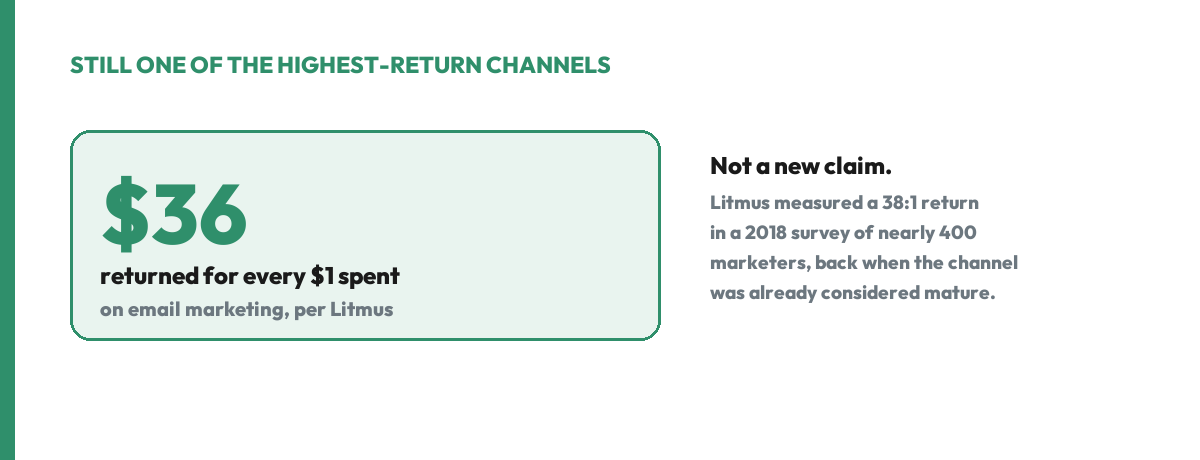
The clearest answer is a number. Litmus, which has run an annual research series on the channel for years, states that email marketing returns an average of $36 for every $1 spent, higher than most other channels a small business would consider. That is not a brand-new or convenient figure either. Litmus measured a 38:1 return all the way back in 2018, from a survey of nearly 400 marketers, at a time the channel was already considered mature rather than trendy. A channel that was already delivering that kind of return years ago, and still is now, is not a fad wearing off.
Why the return has held up while other channels shifted
The reason email keeps producing that kind of number is structural, not a passing trend. You own the list, which means no platform algorithm decides who gets to see your message this week. If someone subscribed, your email reaches them, full stop. A social post reaches whatever slice of your following the platform chooses to show it, and that slice shifts every time the platform changes how its feed works. Email never had that layer standing between you and the person you are trying to reach, so it never had that layer to lose.
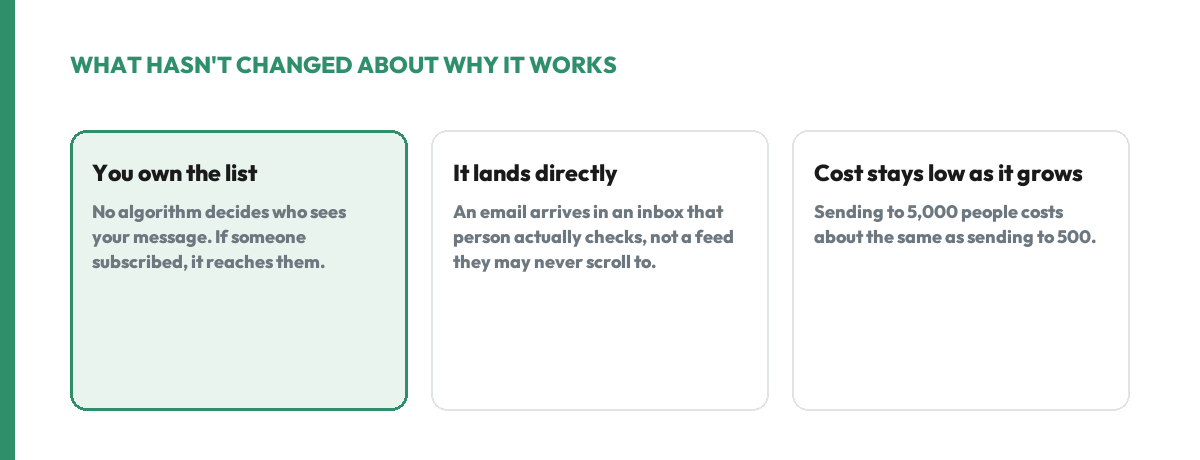
It also lands directly. An email arrives in an inbox a person actually checks, rather than a feed they may scroll past entirely. And the economics scale in your favor: sending to five thousand subscribers costs about the same as sending to five hundred, so as a list grows, the return on each send tends to improve rather than flatten out.
Does it still work if your list is small?
Yes, and a small list is not the disadvantage it looks like. A genuinely engaged list of a few hundred people, greeted properly and sent something worth reading, regularly outperforms a much larger list nobody bothered to nurture. We cover the mechanics of getting those first subscribers actually engaged in how many emails should be in a welcome sequence, which matters more for a small list than volume ever will. If you are still weighing whether the setup and monthly effort are worth it at your size, what email marketing actually costs breaks down the real numbers rather than a vague estimate.
When email marketing actually stops working
The channel’s average return holds up. What varies enormously is how well any individual business runs it. A list nobody has emailed in months goes cold. A new subscriber who never gets a proper welcome sequence forgets why they signed up within days. A newsletter that asks for something in every single send trains people to stop opening it. None of that is the channel failing, it is neglect, and it is also the most fixable problem in this entire list, because unlike a platform algorithm change, it is entirely within your control. For where email fits alongside your other channels rather than as an isolated tactic, what email marketing actually means inside a wider digital marketing plan is worth reading next.
How email compares to the channel it usually gets measured against
The comparison people actually want to make is not email versus doing nothing, it is email versus whatever social platform is currently getting the most attention. That comparison misses the point a little, because the two are not really substitutes for each other. A social post can reach someone who has never heard of you before, which email cannot do on its own. Email, in turn, keeps the person who has already shown interest reachable for as long as they stay subscribed, without needing a fresh piece of content to earn their attention again every single time. Losing either one costs you something different: skip social and you struggle to meet new people; skip email and you lose the people you already met.
That is also why the “still” in the question matters. Plenty of channels genuinely have gotten less effective as platforms changed their algorithms, tightened organic reach, or got more crowded with paid competition. Email has largely sat outside that pressure, because the mechanism that makes it work, a direct list you own, was never something a platform could quietly turn down. The one dependency worth watching is inbox providers themselves getting stricter about spam and unwanted mail, which rewards a business that sends genuinely useful email to people who asked for it, and penalizes one that treats its list as a place to dump promotions nobody wanted. For the authentication checks behind that enforcement, what is email marketing and how does it work walks through SPF, DKIM and DMARC and why skipping them hurts inbox placement.
The honest answer
Email marketing is still effective in 2026, by a real, independently measured margin, and the structural reasons behind that return have not changed: you own the list, delivery is direct, and the economics improve as the list grows. Where businesses lose that return, it is almost always neglect rather than the channel itself aging out.
If keeping a list actually engaged is the part that keeps sliding down your list, our email marketing work is exactly what we take off your plate. Book a free discovery call and we will map out your Growth Plan together, starting with the list you already have.
Frequently asked questions
Is email marketing still effective in 2026?
Yes. Litmus, which runs an ongoing research series on the channel, states that email marketing returns an average of $36 for every $1 spent, among the highest of any marketing channel. That is not a new or inflated number either. Litmus measured a 38:1 return as far back as 2018, in a survey of nearly 400 marketers, so this has been one of the strongest-performing channels for years, not a recent spike.
Why does email marketing keep working when social platforms keep changing?
Because the reach is not filtered by an algorithm. If someone subscribes to your list, your message reaches their inbox, full stop. A social post reaches whatever slice of your following the platform decides to show it that day, and that slice shifts constantly. Email does not have that layer between you and the person you are trying to reach.
Does email marketing still work for a small business with a small list?
Yes, and arguably better relatively speaking. Sending to a genuinely engaged list of a few hundred people can outperform a much larger but disengaged one, and the cost of sending barely changes as a small list grows. Small businesses do not need the scale a big brand has for email to be worth running.
What actually makes an email marketing program stop working?
Usually neglect rather than the channel itself failing: a list nobody has emailed in months, no welcome sequence greeting new subscribers, or sends that ask for something every time instead of teaching something first. The channel's return holds up; what varies enormously is how well any given business is actually running it.
Want a clear roadmap for your own growth?
Every partnership with The Growth Project starts with a free Growth Plan. Book a discovery call and we'll map out yours together.