What is email marketing and how does it work?
What is email marketing and how does it work? The mechanics: opt-in, an ESP, required SPF, DKIM and DMARC authentication, then send.
What is email marketing and how does it work, mechanically, once you get past the marketing language? If you would rather have someone set the whole thing up correctly than learn the plumbing yourself, you can book a free discovery call. Otherwise, here is what actually happens between you writing a message and someone reading it.
TL;DR: Email marketing is sending planned messages, mainly a welcome sequence and a steady newsletter, to people who opted in, through a dedicated platform rather than your personal inbox. Mechanically, a message passes through that platform, through authentication checks (SPF, DKIM, DMARC) that inboxes increasingly require, and into a subscriber’s inbox. Google’s own sender guidelines mandate all three for anyone sending close to 5,000 messages a day to personal Gmail accounts, along with an easy one-click unsubscribe.
What is email marketing and how does it work?
Email marketing is the practice of sending planned, permission-based messages to people who chose to hear from you, almost always through a dedicated platform built for the job rather than your own inbox. That distinction matters more than it sounds like it should. A personal email account can send a message to one person perfectly well and will get flagged, throttled or blocked the moment you try to send the same message to a list, because inboxes are built to treat bulk sending from a personal account as a spam signal. A proper email platform exists specifically to send that same message correctly, at scale, without tripping that signal.
“Permission-based” is doing real work in that definition too, not just a compliance footnote. Every legitimate list is built from people who actively chose to join it, through a signup form, a checkout, or a similar clear action, never a list bought, scraped or assembled from business cards nobody agreed to. Inboxes and regulators both treat that distinction as the difference between marketing and spam, and it shapes everything downstream: how a message gets authenticated, how it gets treated on arrival, and whether the list keeps performing over time.
The mechanism: how a message actually gets to an inbox
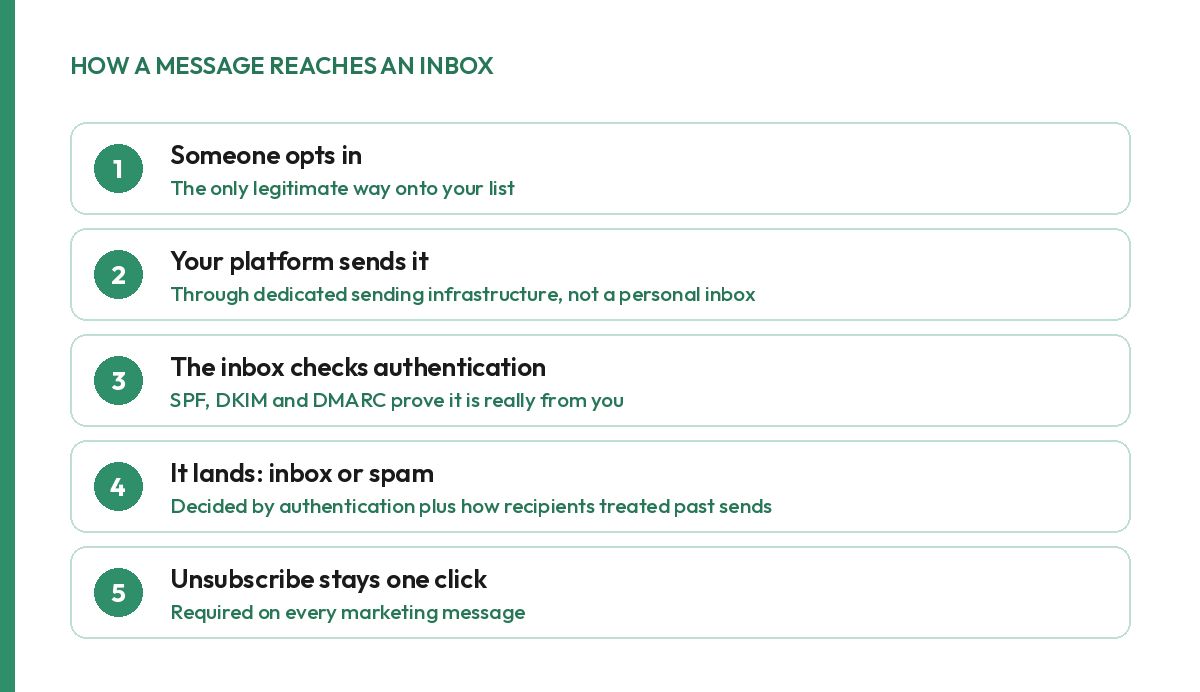
Start to finish, five things happen. Someone opts in, which is the only legitimate way a person ends up on your list. Your platform sends the message on your behalf, through its own sending infrastructure rather than a personal mail server. The receiving inbox, Gmail among them, checks that message against authentication records, SPF, DKIM and DMARC, that prove it genuinely came from your domain and was not spoofed by someone else. The inbox decides, based partly on that authentication and partly on how recipients have treated your past messages, whether to place it in the inbox or in spam. And somewhere in every message, a working one-click unsubscribe has to exist, because losing that step costs you both compliance and trust.
Why authentication is not optional anymore
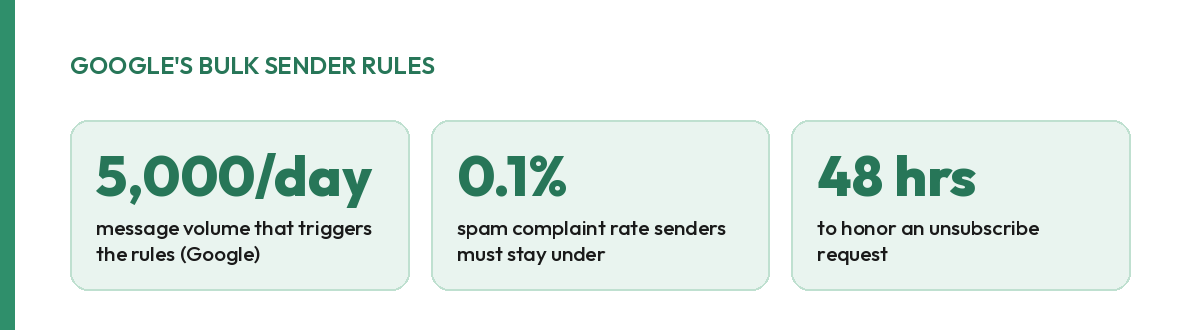
Google’s own sender guidelines spell this out precisely: anyone sending close to 5,000 messages or more a day to personal Gmail accounts must have SPF, DKIM and a DMARC record in place, must keep spam complaints under 0.1% of messages sent, and must honor an unsubscribe request within 48 hours. Miss those and Google states plainly that non-compliant mail gets rejected outright, not quietly filtered to spam. Most founder-led businesses never reach that daily volume, so the rule itself does not bind them yet. The mechanics behind it still do: a message without proper authentication lands worse than one with it, at any list size, because the same signals inform inbox placement below the threshold too.
The two things you actually have to write
None of that infrastructure writes your emails for you, and the mechanics only matter once there is something worth sending through them. In practice, almost everything comes down to two pieces: a welcome sequence that greets a new subscriber properly, which we cover in detail in how many emails should be in a welcome sequence and welcome email sequence, and a steady newsletter that keeps the list warm between whatever prompted someone to subscribe in the first place. Those two are really just the start of what email marketing is actually used for, since promotions, win-backs, reminders and review requests round out the rest. The platform and the authentication just make sure both of those actually arrive.
Most of the platform side is a one-time setup, not an ongoing job. You connect a domain, the platform generates the SPF and DKIM records for you to add, and a DMARC record goes in once alongside them. After that, writing the welcome sequence is also a one-time job, since it runs automatically for every new subscriber from then on. What is left, week to week or month to month, is the newsletter itself, which is the only piece of this that genuinely needs your ongoing attention rather than a setup you do once and leave alone.
Does any of this change if you’re small?
Not the mechanics, only the enforcement. A business sending a few hundred emails a month sits nowhere near Google’s 5,000-a-day threshold, so the hard rule does not apply yet. What changes at small scale is mostly cost and complexity, which how much email marketing costs breaks down properly. The underlying mechanism, permission, a real platform, authentication and an honest unsubscribe, is the same whether you are sending to twenty people or twenty thousand, because it is what keeps a message out of spam at any size, not just past a threshold.
The honest answer
What is email marketing and how does it work? It is permission-based messages sent through a dedicated platform, authenticated so inboxes trust them, and built around two things you actually write: a welcome sequence and a steady newsletter. The mechanics exist to get your message delivered. What you put in it is still entirely up to you.
If getting that mechanism set up correctly the first time is the part you would rather not learn yourself, our email marketing work is exactly what we take off your plate. Book a free discovery call and we will map out your Growth Plan together.
Frequently asked questions
What is email marketing and how does it work?
Email marketing is sending planned messages, mainly a welcome sequence and a steady newsletter, to people who chose to hear from you, through a dedicated platform rather than your own inbox. Mechanically, a message goes from you, through that platform, past authentication checks Google and other inboxes require, into a subscriber's inbox. Skip a step, and the message either never sends properly or never arrives.
Do I need special software, or can I send emails myself?
You need a dedicated platform once you are sending to more than a handful of people, because personal email accounts are not built for bulk sending and will get flagged for it. A proper email platform handles the sending infrastructure, the required authentication, and the unsubscribe mechanism your personal inbox cannot.
What is SPF, DKIM and DMARC, and do I actually need them?
They are authentication records that prove a message claiming to be from your domain is genuinely from you, not someone spoofing it. Google's own sender guidelines require all three for anyone sending close to 5,000 messages a day or more to personal Gmail accounts, and most reputable email platforms set them up for you. Below that volume they are not strictly mandated, but skipping them still hurts inbox placement, so there is little reason to.
Does this apply to a small business sending a few hundred emails?
The strict Google requirements apply once you are near 5,000 messages a day, which most small businesses never reach. The underlying mechanics still apply at any size: a legitimate platform, proper authentication and an easy unsubscribe are what keep a message out of spam regardless of your volume, they are just enforced as a hard rule only past that threshold.
Want a clear roadmap for your own growth?
Every partnership with The Growth Project starts with a free Growth Plan. Book a discovery call and we'll map out yours together.