What is email marketing used for?
What is email marketing used for? Six real uses, from the welcome sequence to win-back sends, and why the automated ones earn far more.
What is email marketing used for, beyond the vague idea of “sending newsletters”? If you would rather have someone map out the right mix for your business than guess, you can book a free discovery call. Otherwise, here are the six real uses, and which one actually earns the most.
TL;DR: Email marketing covers six recurring jobs: a welcome sequence for new subscribers, a steady newsletter, promotional or launch announcements, win-back messages for people who went quiet, booking or event reminders, and review or referral requests. The automated ones, welcome sequences and reminders especially, earn far more per send: Omnisend’s analysis across 150,000 ecommerce brands found automated emails earn $2.87 per send versus $0.18 for a scheduled campaign, 16 times more.
What is email marketing used for?
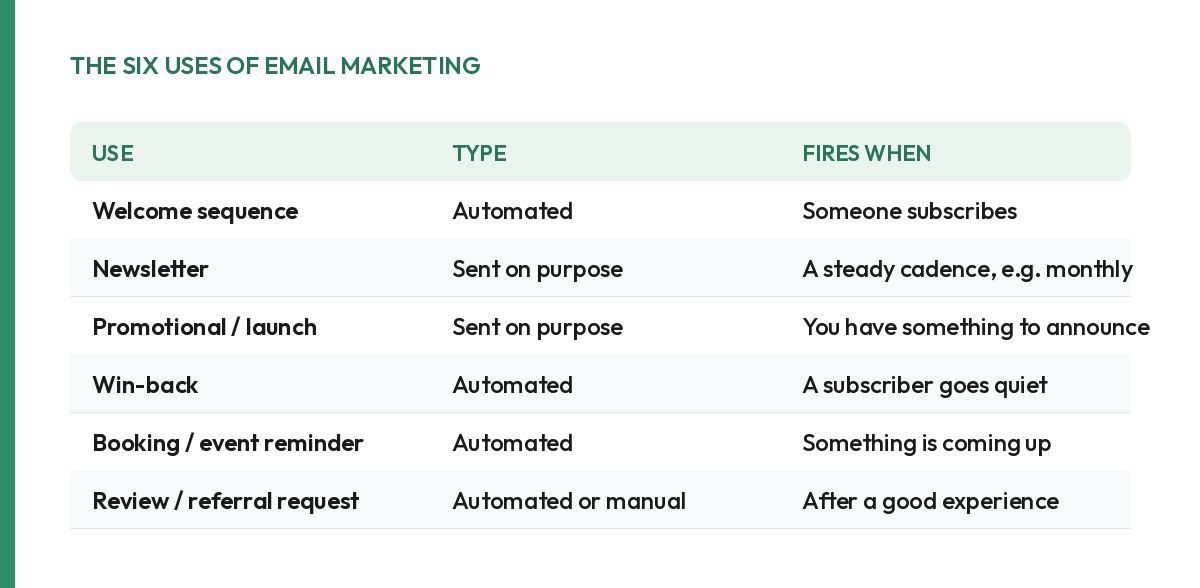
In practice, almost every legitimate email a business sends falls into one of six jobs. A welcome sequence greets someone the moment they subscribe. A newsletter keeps a list warm on a steady cadence, whether or not anything is being sold that week. A promotional send announces a specific offer, launch or seasonal push. A win-back message reaches out to people who have gone quiet, before you write them off entirely. A reminder confirms or nudges around a booking, appointment or event. And a review or referral request asks a happy client for exactly one small favor, at the moment they are most likely to say yes.
The messages that run themselves
Three of those six, the welcome sequence, booking reminders, and often the win-back send, are triggered by something a specific person did: they subscribed, they booked something, or they went quiet after being active. Written once, each one keeps running on its own for every person who meets that trigger, without you touching it again. That is also, per the data below, where almost all of the return in email marketing actually sits.
A welcome sequence is usually two to five messages that introduce your business, set expectations, and make one clear first ask, sent automatically the moment someone subscribes. A booking or event reminder confirms the details and cuts down on no-shows, sent a fixed amount of time before the appointment. A win-back message notices that someone who used to open your emails has stopped, and makes one more attempt to re-engage them before you quietly let the relationship go cold. None of the three need you to remember they exist once they are built.
The messages you send on purpose
The other three, a newsletter, a promotional announcement, and a review or referral request, need a person to decide to send them, at least most of the time. A newsletter works because it shows up on a rhythm your subscribers come to expect, sharing something useful rather than always asking for something. A promotional send exists for a genuine reason to reach out: a launch, a seasonal offer, a limited window, and it works best used sparingly enough that it still feels like news rather than routine noise. A review or referral request is the smallest of the six and often the easiest to skip, but asking a genuinely happy client for one specific favor, right after a good experience, converts far better than a generic request sent to everyone regardless of how their experience actually went.
Why the automated ones matter most
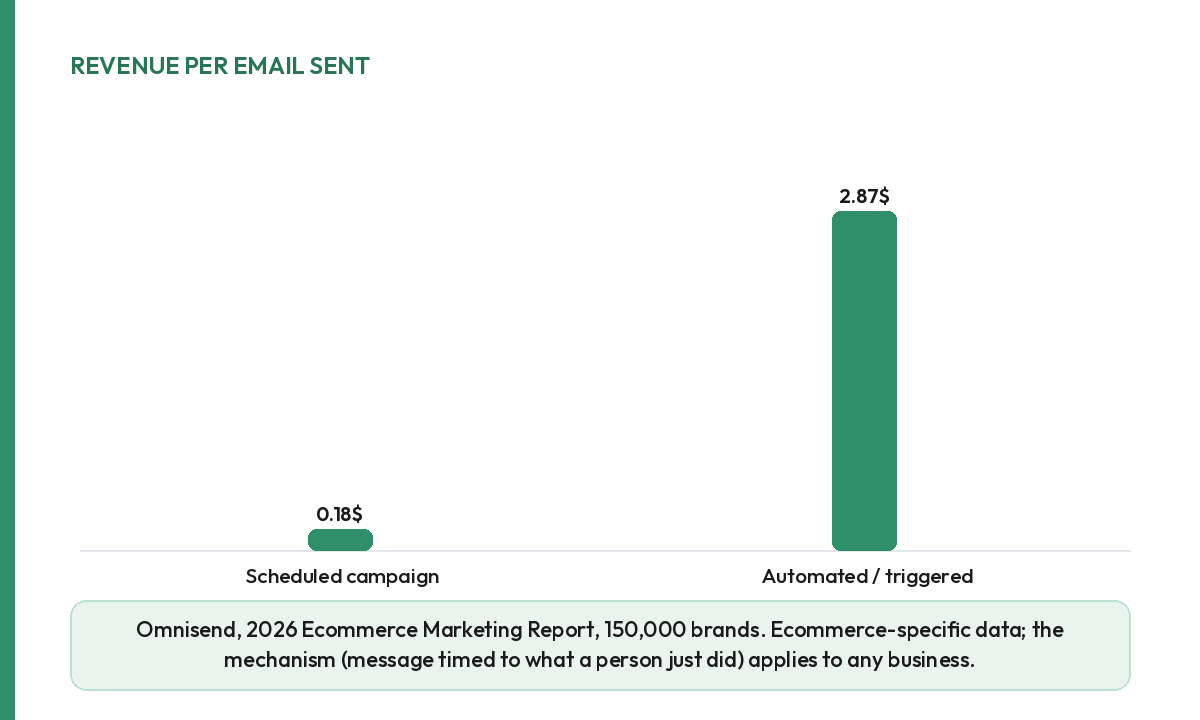
Omnisend’s analysis of sending across 150,000 brands found automated emails earn $2.87 per send, against $0.18 for a scheduled campaign sent to everyone at once, a roughly 16 times gap. That specific figure comes from ecommerce sending, so treat the exact dollar amount as directional rather than universal for a founder-led service business. The mechanism behind it is not ecommerce-specific at all: a message that reaches someone at the exact moment something happened, they just subscribed, they just booked, they just went quiet, will always outperform a message sent to everyone on the same day regardless of where any individual person actually is.
Which of these should a small business actually start with?
The welcome sequence, ahead of a newsletter, precisely because it is one of the automated jobs above. You write it once and it keeps greeting every new subscriber at their most engaged moment indefinitely, while a newsletter needs fresh writing time every single time it goes out. We cover exactly how to build that first sequence in welcome email sequence and how many messages it should actually contain in how many emails should be in a welcome sequence. Once that is running, a newsletter is the natural next use to add, since it is what keeps the relationship going between whatever triggered someone’s original interest. If building and sequencing all six of these is pulling you away from the work you are actually great at, our email marketing work is exactly what we take off your plate.
Booking reminders are worth building third if your business runs on appointments at all, because they solve a problem that costs real money on their own: a no-show. They take little writing, since the content is mostly the same details every time, and the return shows up as fewer empty slots rather than as a dollar figure in an email report, which is easy to undercount if you are only looking at email metrics. Promotions, a newsletter’s occasional cousin, and review requests come last, once the automated foundation is actually running and there is a steady list to send either one to.
The honest answer
What is email marketing used for? Six jobs, not one: welcoming, nurturing, announcing, winning back, reminding, and asking. They are not equally valuable. The ones that fire automatically at the right moment consistently outearn the ones sent to everyone on the same day, by a wide enough margin that it is usually the first thing worth building properly.
If figuring out which of these six your business actually needs first is the part that keeps stalling, our email marketing work is exactly what we take off your plate. Book a free discovery call and we will map out your Growth Plan together.
Frequently asked questions
What is email marketing used for?
Six recurring jobs cover almost every legitimate use: welcoming a new subscriber, keeping a list warm with a regular newsletter, announcing a promotion or launch, winning back people who have gone quiet, reminding someone about a booking or event, and asking a happy client for a review or referral. The first and the last two are usually automated; the newsletter and promotions are usually sent on purpose.
What is the single most valuable use of email marketing?
The automated, triggered messages, not the ones you write and send by hand. Omnisend's analysis of ecommerce sending across 150,000 brands found automated emails earn $2.87 per send versus $0.18 for a scheduled campaign, a 16 times difference, because they reach someone at the exact moment something happened rather than whenever a calendar says to send.
Should a small business start with a newsletter or a welcome sequence?
The welcome sequence first. It runs automatically once written, so the setup cost is paid once, and it catches every new subscriber at the moment they are most engaged. A newsletter is valuable too, but it needs ongoing writing time, so it earns a lower return on the same hour spent than a welcome sequence that keeps paying off for every new person indefinitely.
Is email marketing only for selling things?
No. Reminders, receipts-adjacent updates, review requests and simple relationship-keeping messages are all legitimate uses that have nothing to do with an immediate sale. Treating every email as a pitch is one of the fastest ways to make people stop opening them, which then hurts the sends that are actually trying to sell something.
Want a clear roadmap for your own growth?
Every partnership with The Growth Project starts with a free Growth Plan. Book a discovery call and we'll map out yours together.