Is Instagram worth it for small business? How to tell
Is Instagram worth it for small business? How to tell whether the hours you spend posting are paying you back, and when the honest answer is no.
Is Instagram worth it for small business? It is one of the questions we hear most, and it usually arrives with a note of resentment, because the person asking has been posting for a year and cannot name one client who came from it. If you would rather just talk your own situation through with someone, you can book a free discovery call. Otherwise, here is the honest version, which is neither the cheerful yes you get from marketing blogs nor the flat no you get from a forum thread at midnight.
TL;DR: Instagram can do two very different jobs, and almost every disappointed owner has been judging it by the wrong one. The discovery job, where strangers find you through a post, is hard and slow for a small account. The proof job, where someone who already heard your name checks your profile before booking, is quick to win and is where most founder-led businesses actually get paid back. Decide which job you are hiring it for, ignore followers and likes, and watch profile visits, link taps or new conversations, and booked enquiries instead. Give it ninety honest days, then keep it, change it, or stop.
Is Instagram worth it for small business?
Usually yes, but for a much smaller reason than the one you were sold, and for a much smaller amount of effort than you are probably putting in.
The reason people end up frustrated is that they are running an unwinnable test. They post three times a week hoping strangers will discover them, see the follower count barely move, and conclude the whole thing is useless. What they miss is that the profile has probably been doing a different job the entire time, quietly, without ever showing up as a follower.
The two jobs Instagram can do, and only one is discovery
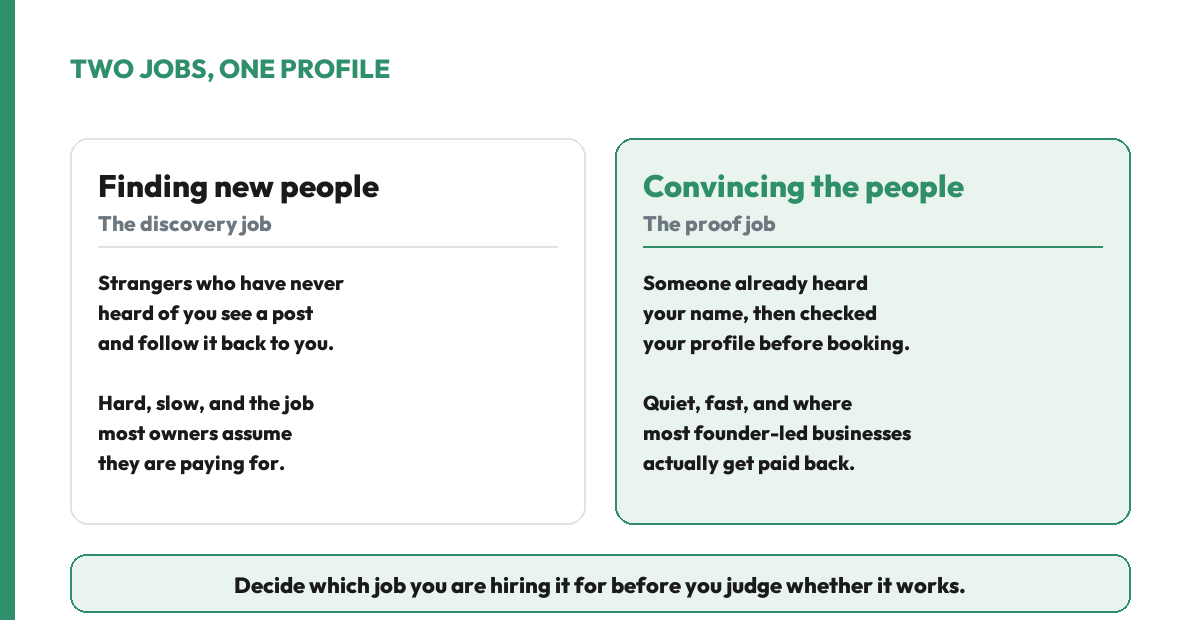
The discovery job is the one everybody pictures. A stranger who has never heard of you sees your post, likes what they see, follows you back to your business, and eventually becomes a client. It happens. It is also the hardest thing the platform can be asked to do from a standing start, because you are competing for attention with everyone else that person could be watching instead.
The proof job is the one that quietly pays. Someone gets your name from a friend, or a listing, or a search result. Before they contact you, they look you up. They land on your profile, scroll for about fifteen seconds, and make a judgement about whether you are real, whether you are still trading, and whether you look like someone who does this well. Then they either message you or they do not.
That second job is not glamorous and it will never show up as a spike in followers. It is also the reason a plain, current, honest profile is worth keeping even for a business that gets every client by referral. If you want the fuller version of that argument, we wrote about whether you need a website or just a profile, and the two questions are cousins.
Here is the part worth sitting with. If your business is winning the proof job, Instagram is already working and you have been marking it as a failure because you were grading the discovery job.
How do you tell if Instagram is paying you back?
Followers and likes are the two numbers the app puts in front of you, and they are close to useless for answering this. A like costs a stranger nothing and tells you nothing about whether they would ever pay you.
Watch three things instead.
Profile visits. How many people were curious enough to stop scrolling and look at you properly. This is the number that tells you whether your posts are doing anything at all, and it moves long before followers do.
Link taps and new conversations. Of the people who looked, how many took the one action you asked for. That might be tapping the link in your bio, sending a message, or replying to a story. This is the moment interest turns into contact.
Booked enquiries. How many real enquiries arrived that mention Instagram or that landed right after someone viewed your profile. This is the only one that touches your bank account, and it is the one almost nobody tracks.
Then add the habit that beats every dashboard: ask every new client where they first heard of you, and write the answer down somewhere you will actually look. Three months of that will teach you more about which channels deserve your time than any report will.
When Instagram is not worth it
There are businesses for which the honest answer is no, or at least not yet, and pretending otherwise wastes real hours.
When your clients search rather than browse. If people only think about your service the moment something breaks, they type it into Google instead of scrolling for it. A plumber, a locksmith, an accountant in tax season. In those businesses being easy to find in local search beats being interesting on a feed, and it is not close.
When the work is genuinely not visual and you have no way in. Some work photographs beautifully. Some does not, and forcing it produces the stiff, generic posts that make an account feel like an obligation. If you cannot find an angle you would enjoy for a year, that is useful information rather than a personal failure.
When almost all your work comes from referrals. If your clients already come from people who know you, the fastest growth usually comes from staying in touch with that group rather than shouting at strangers. Email to the people who already know you tends to pay back sooner, because you are not paying to reach anyone new at all.
When you know you will not keep it up. A profile with three posts from two years ago is worse than no profile. It fails the proof job in the most damaging way possible, because the visitor concludes you may have quietly closed.
One more, because it comes up constantly: paying to boost your way out of a quiet account rarely fixes anything. Advertising amplifies an offer that is already landing, it does not invent one. We went through that in detail in whether social media advertising actually works.
A ninety day test that settles it
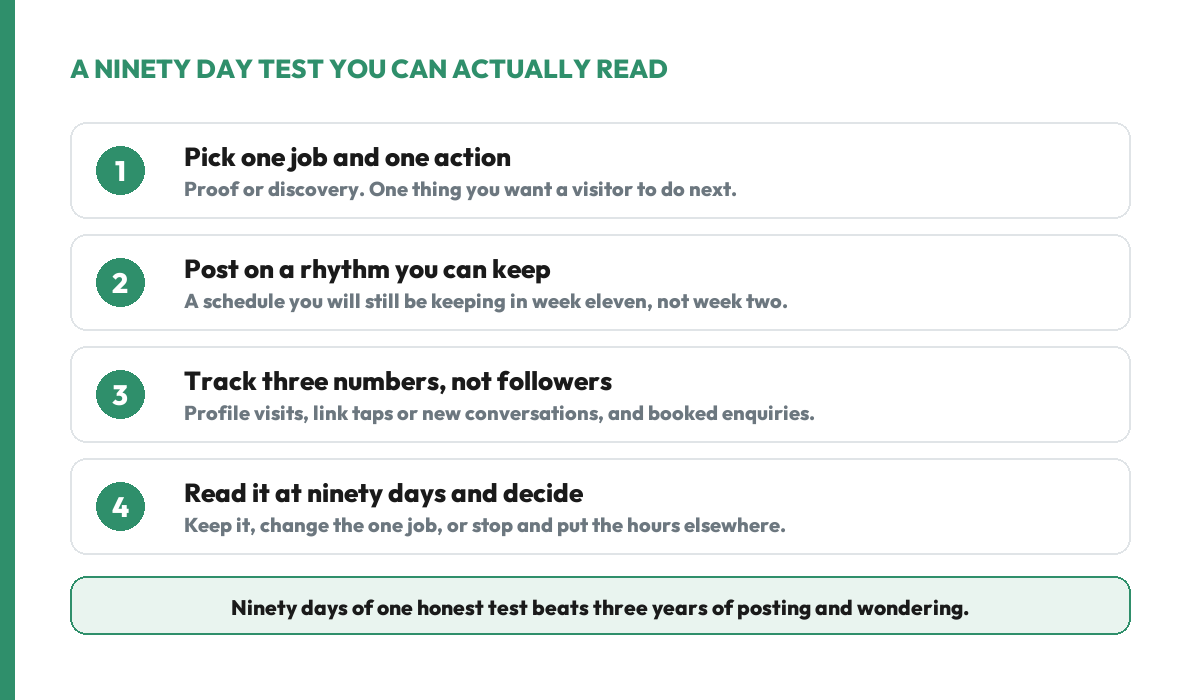
Most owners never actually decide about Instagram. They drift, feel guilty, post in bursts, and carry the question around for years. A short, honest test ends that.
Pick one job and one action. Proof or discovery, not both. Then name the single thing you want a visitor to do next, whether that is booking, messaging, or joining your list. If your profile asks for four things it will get none of them.
Post on a rhythm you can genuinely keep. Twice a week for twelve straight weeks beats daily for nine days and then silence. Choose the schedule you will still be keeping in week eleven, when you are busy and tired and it is raining.
Track your three numbers. Profile visits, link taps or new conversations, and booked enquiries. Write them down once a week. It takes two minutes and it turns a feeling into evidence.
Read it at ninety days and make a call. Keep going if the numbers are climbing. Change the job you are aiming at if the profile is getting visits but nobody is taking the action. Stop and move those hours somewhere else if nothing moved at all. Stopping is a legitimate outcome, and it is far better than another year of quiet resentment.
What a sensible amount of effort looks like
For most founder-led businesses, the right answer is not a content strategy. It is a profile that passes the fifteen second test and a modest rhythm you can sustain.
Make sure the bio says what you do and who you do it for, in the words a client would use rather than industry language. Make sure there is one clear way to contact you or book you. Make sure the most recent posts show real work, real results, and a real person, because the visitor is checking whether you exist and whether you are any good, not whether you understand trends.
That is a couple of hours a month, not a second job. If Instagram is currently eating a day a week and you cannot point at what it is returning, the problem is almost never that you need to post more. It is worth stepping back and asking where Instagram actually sits in the wider mix, which is the question we work through in social media marketing vs digital marketing.
So, is Instagram worth it?
For most small businesses, yes, at a level of effort far below what the internet implies, and aimed at the proof job rather than the discovery job. It is worth having a current profile that reassures the people who are already checking you out. It is rarely worth grinding for reach you cannot sustain, and it is genuinely not worth it when your clients search instead of scroll, when you will not keep it up, or when the same hours would earn more somewhere else.
Decide which job you are hiring it for, judge it by the three numbers that touch your calendar, and give it ninety days rather than another undecided year.
If figuring out which channels actually deserve your time is pulling you away from the work you are great at, running organic social is exactly what we take off your plate. When you want a straight answer on where your next ten clients are most likely to come from, book a free discovery call and we will map out your Growth Plan together, starting with the one change that will win you the most clients for the least effort.
Frequently asked questions
Is Instagram worth it for small business?
It is worth it when you are clear about which of two jobs you are hiring it for, and it is a waste of your evenings when you are not. The first job is discovery, meaning strangers who have never heard of you find you through a post. That job is genuinely hard for a small account and it is the one most owners assume they are paying for. The second job is proof, meaning someone who already heard your name checks your profile before they decide to book. That job is much easier to win, it happens quietly, and for most founder-led service businesses it is where Instagram actually earns its keep. So the honest answer is that Instagram is usually worth a modest, sustainable amount of effort aimed at the proof job, and rarely worth an exhausting amount of effort aimed at the discovery job.
How do I know if Instagram is working for my business?
Stop looking at followers and likes, because neither one tells you whether anybody moved toward buying. Watch three things instead. Profile visits tell you how many people were curious enough to look at you properly. Link taps and new conversations tell you how many of those took the one action you asked for. Booked enquiries that mention Instagram, or that arrive right after someone viewed your profile, tell you whether any of it reached your calendar. Ask every new client where they first heard of you and write the answer down, because that one habit will teach you more about your marketing in three months than any dashboard.
How long should I give Instagram before deciding?
Give it ninety days of consistent, honest effort, then read the result and make a decision. Ninety days is long enough that a slow start is not fatal and short enough that you are not sinking another year into something that is not working. Pick one job and one action you want people to take, post on a rhythm you can genuinely sustain, track your three numbers, and at the end either keep going, change the one job you are aiming at, or stop and move those hours to a channel that suits your business better.
When is Instagram not worth it for a small business?
When your clients search for what you sell rather than browse for it, Instagram will always be the slower road, and being findable in search deserves your attention first. When your work is not visual and you have no realistic way to make it look interesting, you are fighting the platform rather than using it. When your business runs almost entirely on referrals and repeat clients, a simple way to stay in touch with the people who already know you will usually pay back faster. And when you are honest that you will not keep it up, an abandoned profile is worse than no profile, because it tells anyone who checks that you may have quietly closed.
Want a clear roadmap for your own growth?
Every partnership with The Growth Project starts with a free Growth Plan. Book a discovery call and we'll map out yours together.