What is a growth plan, and does your business have one?
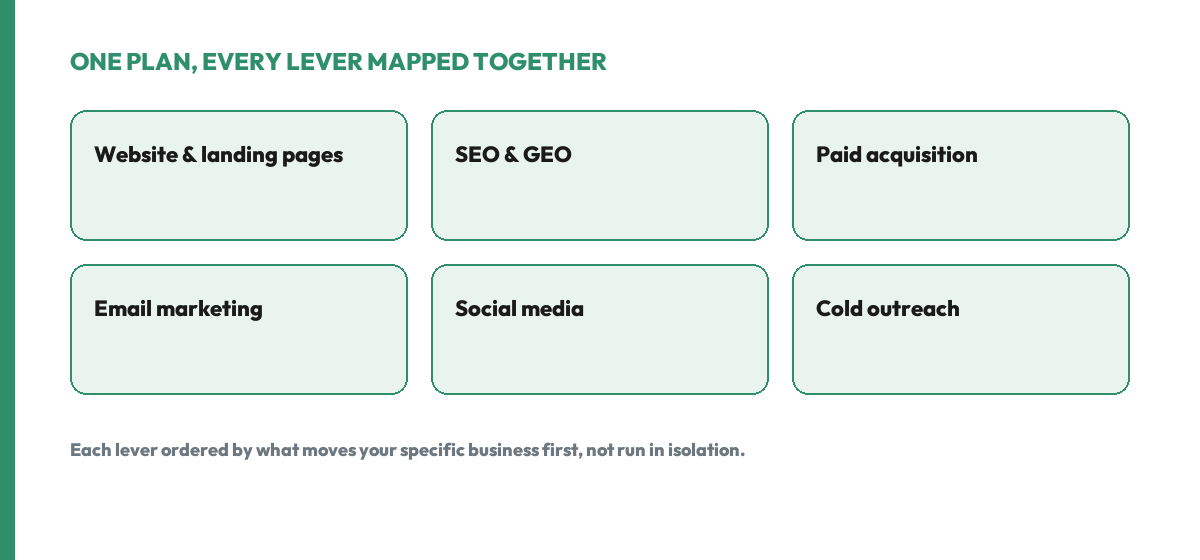
What is a growth plan? A single map of every marketing lever your business has, ordered by what actually pays back first, not a list of separate services.
What is a growth plan is a fair question to ask before agreeing to one, since the phrase gets used loosely across the industry. If you would rather see your own laid out than read the general version, you can book a free discovery call and we will build it with you for free. Otherwise, here is what the phrase actually means and why the order matters more than the list.
TL;DR: A growth plan is a single map of every marketing lever a business has, website, SEO, paid ads, email, social and outreach, ordered by what will actually move that specific business first. It is not a menu of services bought separately. The sequence is the point, because most businesses do not need all six levers running at once, they need the right one or two done properly before the rest matter.
What is a growth plan?
A growth plan starts from the business, not from a service catalogue. Instead of asking which channel to sell you, it asks what is actually stopping this specific business from growing right now, and works outward from that answer. For one business the honest answer is that the website is not converting the traffic it already gets. For another, the traffic itself is the gap. For a third, the systems behind the scenes are the bottleneck, not anything customer-facing at all. The plan looks different every time because the business does.
That is the part most marketing engagements skip. A business hires an ads specialist because ads are the service on offer, not because ads are what that business actually needed first. A growth plan reverses the order: figure out the actual gap, then pick the lever that closes it, then sequence whatever comes after that. The service being sold should never be the reason it gets picked.
Why the order matters more than the list
Every lever on that list can help a business. Almost none of them help in isolation, and none of them help in the wrong order. Paid ads sending traffic to a landing page that does not convert just make the leak more expensive. A beautiful website with no way to capture and follow up with visitors who are not ready to buy today loses most of the value a good ad campaign would have created. Email marketing with nobody yet on the actual list has nothing real to send to.
A growth plan is the discipline of picking the first domino rather than trying to push all of them at once, on purpose, in a specific order. For most founder-led businesses, that means one or two levers done properly for a stretch, proven out, and only then does the next one get added. This is also why should you hire a marketing agency is a harder question than it looks: an agency built around one channel cannot sequence a plan across channels it does not sell, even when it is genuinely good at the one it does.
One team with context, not six agencies re-learning your business
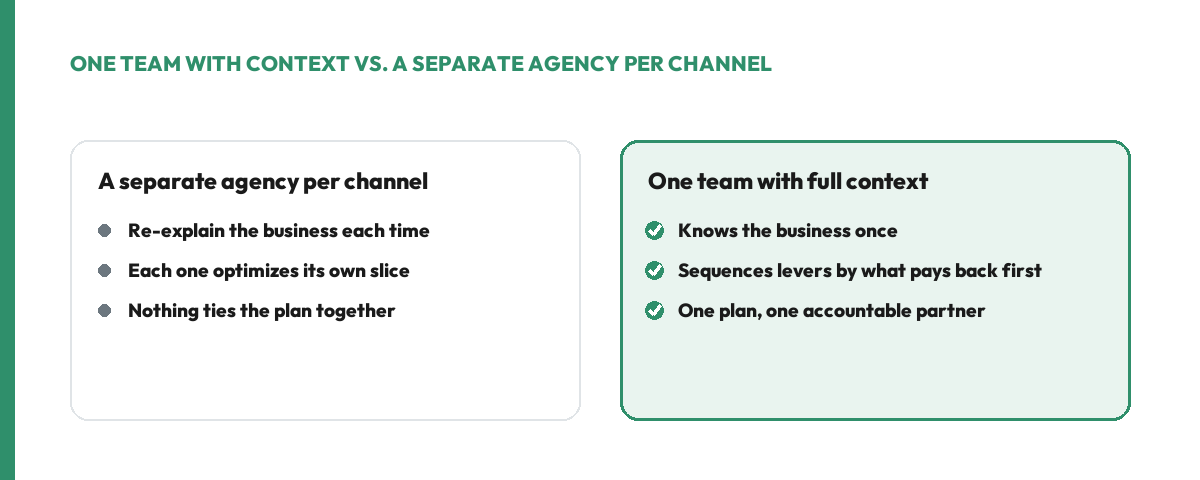
The other half of what makes a growth plan work is who holds it. Split across a separate agency per channel, each one optimizes its own slice without seeing the whole picture, and every new agency starts by re-learning the business from scratch. A single team holding the whole plan can move a budget from one lever to another the moment the data says to, without a meeting to align three separate contracts first.
This is the same reason how to get more clients without burning out keeps coming back to sequencing rather than doing more of everything at once. Founders already stretched thin do not have the bandwidth to be the one connecting six separate agencies’ work into a coherent plan themselves. That coordination has to live somewhere, and a growth plan is what happens when it lives in one place instead of nowhere.
What actually goes into building one
A real growth plan starts with a plain look at where the business stands today: what is already working, what traffic exists and where it goes, what the website or landing pages currently do with it, and what budget or time is realistically available. From there, it names the one or two levers most likely to move a real number for that business first, states plainly why the others wait, and sets a clear point where the next lever gets added. It should not cost you to have this conversation, because the honest version of a plan sometimes concludes that the cheapest fix, like what SEO for your business actually costs versus a rushed ad campaign, is smaller than expected. You can see what this looks like once it is actually running in our work, rather than taking the idea on faith.
The honest answer
A growth plan is one map of every lever a business could pull, built around that business specifically and ordered by what will actually pay back first, held by one team rather than split across several who never talk to each other. It is not a bigger word for a service package, and it is not something a business needs redone from scratch every time a new channel gets tried. It is also not a document you sign once and forget. A plan that never gets revisited against real numbers is just a guess with better formatting, and the businesses that get the most out of one treat it as the thing every new decision checks against, not a poster on the wall from the kickoff call.
If you want to see what this looks like for your own business rather than in the abstract, book a free discovery call and we will map out your Growth Plan together, at no cost, starting with the one thing most likely to move a real number for you first.
Frequently asked questions
What is a growth plan?
A single map of every marketing lever a business has, its website, SEO, paid ads, email, social and outreach, ordered by which one will actually move that specific business first. It is not a list of separate services bought one at a time from different providers. It is one plan, built once, that everything else follows.
How is a growth plan different from just hiring a marketing agency?
A typical agency engagement usually covers one channel: run the ads, or manage the social accounts, or handle SEO. A growth plan starts from the whole business first and decides which lever deserves attention before any channel gets picked, so the channels chosen are the ones that actually fit that business, not whichever service the agency happens to sell.
Does every business need every lever in the plan at once?
No, and this is one of the most common mistakes. A business with no email list does not need an expensive ad campaign before it has anywhere to send that traffic once it leaves the ad. A plan sequences levers by what pays back first for that specific business, which is often one or two channels done properly, not six channels done thinly.
Is a growth plan a one-time document or an ongoing process?
Both. It starts as a real plan you can read and react to, built from your specific business rather than a template. Then it becomes the thing everything else checks against: a new campaign, a new page, a new email either fits the plan's sequence or it does not get prioritized yet.
Want a clear roadmap for your own growth?
Every partnership with The Growth Project starts with a free Growth Plan. Book a discovery call and we'll map out yours together.