What makes a good marketing email? The real checklist
What makes a good marketing email? One clear point, an honest subject line, one link, and a voice that sounds human. Here is the real checklist to run.
What makes a good marketing email, beyond vague advice like “write with personality” or “keep it short”? If you would rather have someone review your own drafts against a real standard than guess, you can book a free discovery call and we will work through it together. Here is the checklist we actually use.
TL;DR: What makes a good marketing email? Five things, checkable in a minute before you send: one clear point, not three competing ones. An honest subject line that matches what is actually inside. Short paragraphs built for a phone screen. A single obvious next step. And a voice that sounds like a person wrote it to one other person, not a brochure addressing a crowd.
What makes a good marketing email, checked in order?
Run any draft through these five checks before you send it, in this order, because each one catches a different failure mode and fixing them out of order wastes time. Most weak marketing emails fail one or two of these, not all five, which is exactly why a checklist works better than a vague feeling that something is “off.”
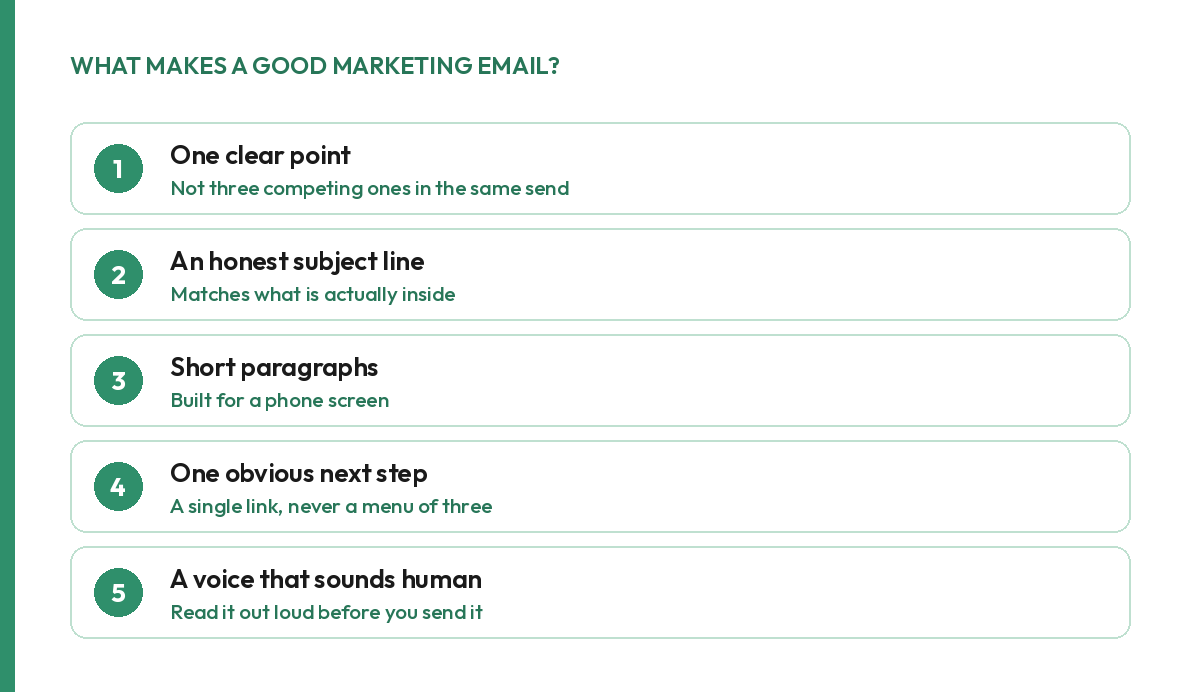
Check one: does it make exactly one point?
A good marketing email argues for one idea and stops. A weak one tries to update the reader on three things at once, a new offer, a reminder about an event, and a request to follow you somewhere else, and ends up doing none of the three well. If you catch yourself writing “also” or “one more thing” in a draft, that is usually the sign a second email is trying to hide inside the first one. Split it.
Check two: does the subject line tell the truth?
The subject line has one job, earning the open honestly. “You won’t believe this” earns opens the first time and trains people to ignore you every time after, because the email never delivers on the tease. A subject line that plainly states what is inside, “Three spots left this month” or “A short answer to a question we get a lot”, earns fewer curiosity clicks but far more trust over a year of sending. For the deeper comparison of format and cadence, see our guide to email marketing for small business.
Check three: is it built for a phone screen?
Most marketing emails are opened on a phone, glanced at for a few seconds before a decision gets made to read on or delete. Short paragraphs, two to four sentences at most, are not a style choice, they are a readability requirement for that screen. A dense wall of text reads as work before the reader has decided you are worth the effort, and most will not give you that benefit of the doubt.
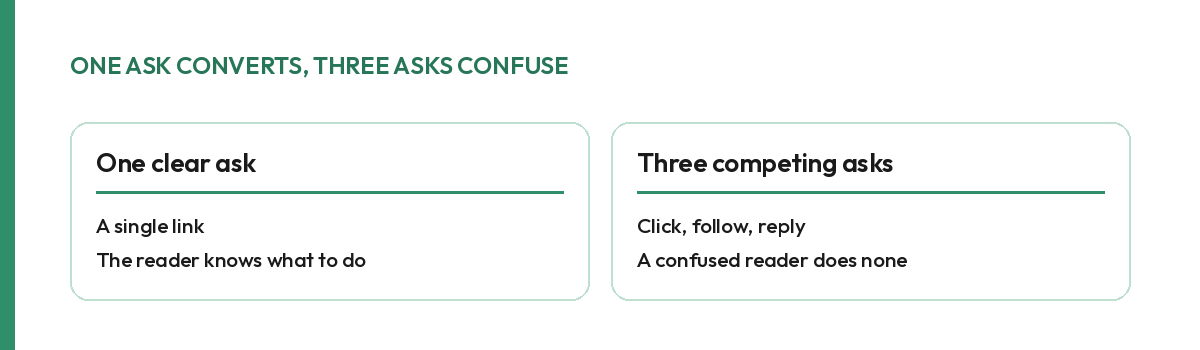
Check four: is there exactly one next step?
A good marketing email makes one ask and repeats it, at most, in one other spot. It does not offer a menu of three links competing for the same click. A confused reader with three options usually picks none of them, so narrowing to one obvious next step is not limiting the email, it is what makes the email actually work. If you are unsure how often to be making that ask at all, our breakdown of how often email marketing should be sent covers the cadence side of the same discipline.
Check five: does it sound like a person?
Read the draft out loud. If it sounds like something you would actually say to a client sitting across from you, it passes. If it sounds like a brochure, cut the adjectives and the hype and say the plain version instead. This is the check most businesses skip, and it is usually the one that matters most, because a reader can tell the difference between a real voice and a marketing voice within the first sentence, often without being able to say exactly why.
What a good marketing email is not
It is not the same as a good piece of writing in the abstract. A beautifully written email that buries its one point under three paragraphs of setup fails the checklist just as surely as a lazy one, because the reader’s attention runs out before the point arrives. Clever wordplay in a subject line that obscures what is actually inside also fails, even when it is genuinely funny, because the job of the subject line is clarity first and personality second, not the other way around.
It is also not the same as a long, detailed email packed with useful information. More detail is not automatically more valuable if it comes at the cost of the one clear point getting lost in the middle of it. A shorter email that lands its single idea cleanly will outperform a longer one that tries to be thorough and ends up being neither focused nor memorable.
Putting the checklist to work
None of these five checks take more than a few seconds once you know to look for them, and running all five together takes less time than writing the email itself. The habit is what matters. A founder who checks these five things on every send, even quickly, ends up with a noticeably stronger list over a year than one who writes on instinct and hopes it lands. For the fuller welcome sequence version of this discipline applied end to end, see our guide to writing a welcome email sequence that converts.
Keep a copy of this checklist somewhere you will actually see it before you hit send, a sticky note on the monitor works as well as anything fancier. The businesses that write consistently good marketing emails are rarely the most naturally gifted writers. They are the ones who check the same five things every single time, until it stops being a checklist and becomes how they write without thinking about it. If none of this sounds like something you have time to run on every send, that is the exact gap our email marketing service closes, someone else holding the checklist so you do not have to.
If reviewing every draft against a real standard is the part that keeps slipping, that is exactly what we take off your plate. Book a free discovery call and we will map out your Growth Plan together, including the emails that actually get read.
Frequently asked questions
What makes a good marketing email?
One clear point, an honest subject line that matches what is actually inside, short paragraphs a person can read on their phone in ten seconds, one obvious next step, and a voice that sounds like a person wrote it to another person. Every one of those is checkable in a minute before you press send.
What is the most common mistake in a marketing email?
Asking for more than one thing. An email that wants the reader to click a link, follow a social account, and reply with feedback all in the same send usually gets none of the three, because a confused reader does nothing. One email, one ask, every time.
Does a good marketing email need to be long?
No, and most of the time shorter is better. A good marketing email says one thing clearly and gets out of the way. Length should follow from how much genuinely needs saying, never from a sense that a real email has to look substantial.
How do you know if your subject line is good?
It tells the truth about what is inside, in a way specific enough that a stranger could not have written it about a different email. A vague, curiosity-baiting subject line might earn the open, but it teaches people that your emails do not deliver what they promise, and that costs you every open after the first one.
Want a clear roadmap for your own growth?
Every partnership with The Growth Project starts with a free Growth Plan. Book a discovery call and we'll map out yours together.