Why email marketing is better than social media for clients
Why email marketing is better than social media for booking clients: you own the list, the algorithm never decides who sees you, and the CTA is one click.
Why email marketing is better than social media for a founder-led business trying to book real clients, not just collect likes? If you want both channels working together rather than guessing which one deserves your time, you can book a free discovery call and we will map it out. Here is the honest comparison.
TL;DR: Why email marketing is better than social media, for the specific job of booking clients: you own the list outright instead of renting attention from a platform, the message reaches every subscriber’s inbox instead of a fraction of your followers, and the call to action is one click instead of three separate hurdles. Social media still matters for discovery and trust. Email is where that trust actually turns into a booked call.
Why email marketing is better than social media, in one sentence
You own an email list. You do not own a social following. That single difference explains almost everything else in this comparison. A platform can change its algorithm overnight and quietly halve how many of your followers ever see your posts again, and there is nothing you can do about it. An email list keeps reaching every subscriber’s inbox on your own terms, unaffected by whatever any platform decides this week. For the fuller argument on why the list is worth building early, see our guide to email marketing for small business.
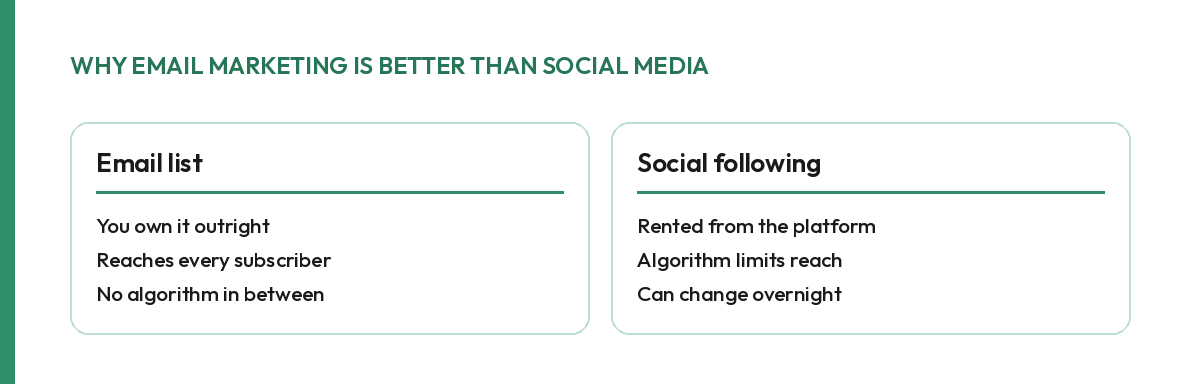
The algorithm decides who sees your social post. Nobody decides who sees your email.
Post on social media and a platform’s algorithm quietly decides how many of your own followers actually see it, often a small fraction, based on factors you do not control and cannot see. Send an email and it lands in every subscriber’s inbox, full stop. There is no invisible gatekeeper deciding your message is not interesting enough to show. That single structural difference is why an email list of a hundred genuinely interested people can outperform a social following ten times its size for anything that requires a direct response.
The call to action is shorter on email
Booking a call from a social post asks someone to notice it mid-scroll, stop, tap through, and then usually leave the platform entirely to reach your site. Each of those steps loses people. An email that lands in someone’s inbox already has their attention in a focused, one-to-one space, and the link to book a free discovery call or read more is right there, one click away, with none of the platform’s own distractions competing for the same screen. That focused attention is also why the email itself has to earn it; see what makes a good marketing email for the checklist worth running before you send.
So is social media not worth it?
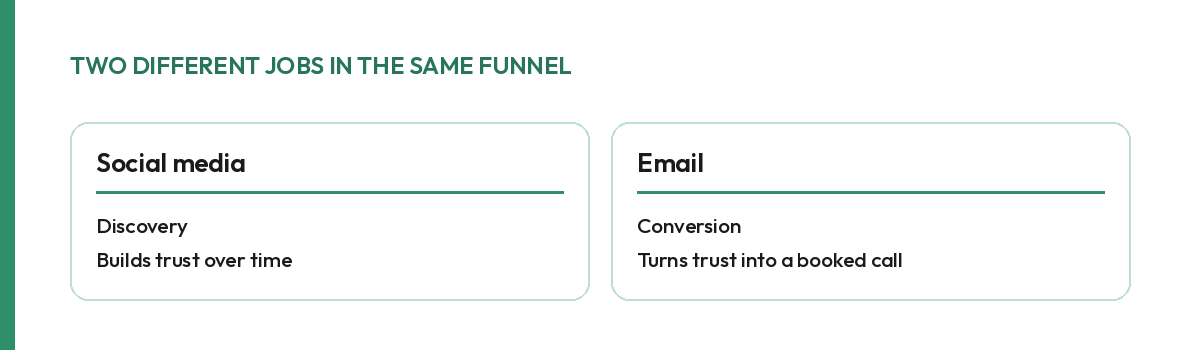
It is worth it, for a different job. Social media is where people discover a founder-led business and start to build trust before they know your name, through consistent, useful posts over time. Email is where that trust becomes an action, a booked call, a purchase, a signed-up client. Treating them as competitors misses the point. They are two stages of the same funnel, and skipping either one leaves a gap: no social presence means nobody discovers you, and no email list means the people who did discover you have no direct path back to booking with you.
How much of each should a founder-led business actually do?
Early on, when the list is small, social media naturally carries more of the discovery work simply because there are not yet many subscribers to email. As the list grows, the balance should shift: every social follower who shows real interest is a candidate for the list, and every list member should be getting the steady, useful newsletter that keeps them warm between social posts. Our guide to writing a welcome email sequence that converts is the fastest way to make sure that shift actually happens instead of staying a good intention.
The businesses that get this wrong usually put all their energy into social media because it feels more active and more visible, and build no list at all. A year later they have thousands of followers and no reliable way to reach any of them directly when it matters. Building the list alongside the social presence, from day one, is what prevents that gap from ever opening.
What this looks like in practice for one post
Take a single piece of content, a short lesson worth sharing about your work. Posted on social, it competes with everything else in the feed, gets a burst of attention for a day, and then effectively disappears, resurfaced only if someone happens to scroll back far enough. Sent as an email, the same lesson reaches every subscriber directly, with nothing to compete against inside their inbox in that moment, and it stays searchable in their history indefinitely. The content did not change. The channel changed how reliably it reached the people who mattered.
This is also why repurposing works so well in one direction and poorly in the other. A newsletter idea usually makes a fine social post, since it is short and can be trimmed to fit a feed. A social post rarely makes a full newsletter on its own, since it was written for a few seconds of attention, not a few minutes of focused reading. If you are only going to build the habit of writing consistently in one channel first, email is the one that teaches you to write with more depth, and that depth then repurposes downward far more easily than a caption repurposes upward.
A simple test settles which channel deserves the next hour of your time: if the goal is to get in front of new people who have never heard of you, that is social media’s job. If the goal is to move someone who already knows you toward booking, that is email’s job. Most founders default to social because it feels more urgent, when the higher-return work is often sitting quietly in the list they already have and rarely email.
If figuring out how to split your time between the two is the part that keeps stalling, that is exactly what we take off your plate. Building and running the email marketing side properly is one of the fastest ways to see the shift pay off. Book a free discovery call and we will map out your Growth Plan together, with both channels doing the job they are actually good at.
Frequently asked questions
Why is email marketing better than social media for booking clients?
Because an email lands directly in front of the person who chose to hear from you, while a social post has to survive an algorithm deciding whether to show it at all. Email also carries a single, obvious next step, a link to book or buy, while social media asks someone to stop scrolling, notice your post, and then leave the platform entirely to take action, three separate hurdles instead of one.
Does this mean small businesses should drop social media entirely?
No. Social media is where people discover you and start to trust you before they know your name. Email is where that trust turns into a booked call. The two do different jobs in the same funnel, discovery on social, conversion by email, and a founder-led business needs both, just not in equal proportion once real income is on the line.
Why does an owned list matter so much?
Because a social following is rented from the platform and can lose reach overnight when an algorithm changes, while an email list is yours outright and reaches every subscriber's inbox regardless of what any platform decides to show that week. The list is the one channel where the audience you built stays reachable on your terms.
Is email actually more likely to get a response than a social post?
For a direct ask like booking a call, yes, because the person is already in a focused, one-to-one space, their inbox, rather than a feed built to keep them scrolling past everything including your post. Social is built for glancing. Email is built for reading.
Want a clear roadmap for your own growth?
Every partnership with The Growth Project starts with a free Growth Plan. Book a discovery call and we'll map out yours together.