Email marketing vs direct marketing: the real difference
Email marketing vs direct marketing: what actually separates the two, and why the difference changes what a founder-led business should send.
Email marketing vs direct marketing is a comparison that trips people up because it is not really a comparison between two separate things. One is a category, and the other is a channel that lives inside it, and most of the confusion clears up the moment that relationship is clear. If working out where your own outreach budget should actually go is the real question behind this, book a free discovery call and we will map it out together. Otherwise, here is the honest breakdown.
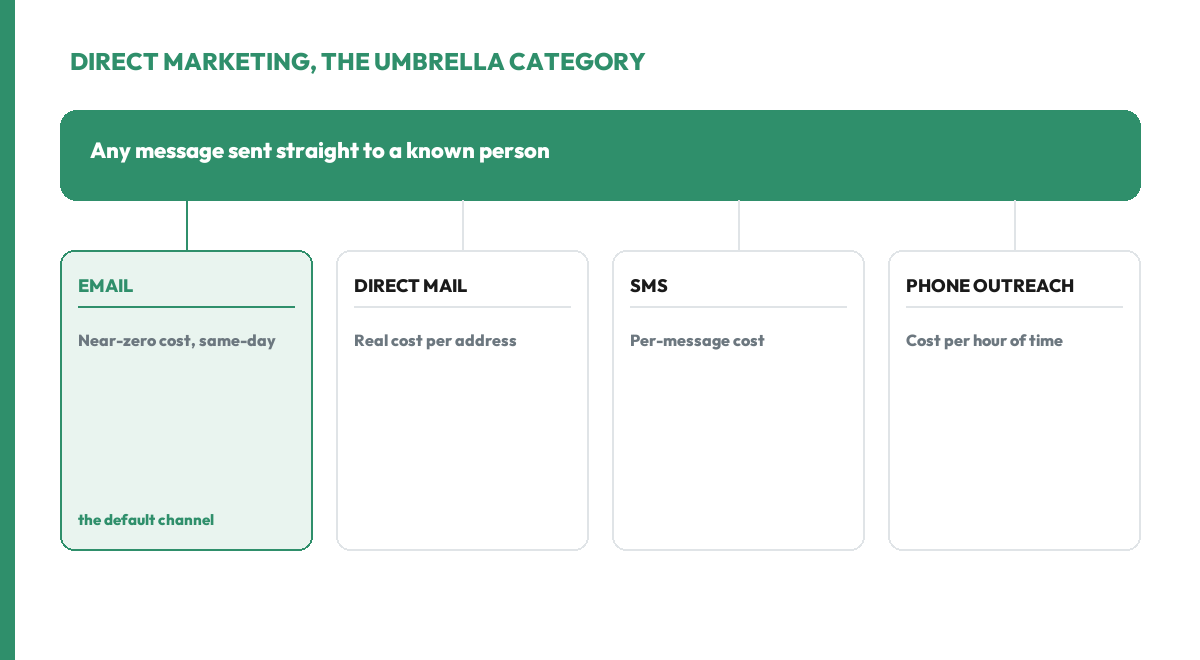
TL;DR: Direct marketing is the umbrella term for any message sent straight to a specific person rather than broadcast to a general audience, and it covers mail, text, phone outreach and email. Email marketing is one channel inside that umbrella. What actually separates email from the rest of direct marketing is cost and speed, not the underlying idea, which is the same everywhere: reach a known person directly.
Email marketing vs direct marketing: what’s the real difference?
Direct marketing describes the approach, not a specific channel. It means sending a message straight to an identified person or household rather than putting an ad in front of a general audience and hoping the right people notice. A mailed postcard to a list of local addresses, a text campaign to past customers, and a round of outbound calls to warm leads are all direct marketing, because each one targets a known contact directly.
Email marketing is one of the channels that fits inside that definition. It shares the same underlying idea, reach a specific person rather than a general audience, and adds its own particular shape on top: near-zero cost per send, immediate delivery, and none of the production lead time that mail or print carries. That is the actual comparison. Not two competing strategies, but a category and one of the tools that lives inside it.
Where the other direct channels still earn their place
None of this makes the rest of direct marketing obsolete. A mailed piece still lands somewhere an inbox cannot, on a physical desk or kitchen counter, and a phone call still carries a kind of attention and immediacy that no written message reaches. For a founder-led business with a small, high-value client base, a handwritten note or a personal call to a handful of past clients can outperform any email a much larger list would receive.
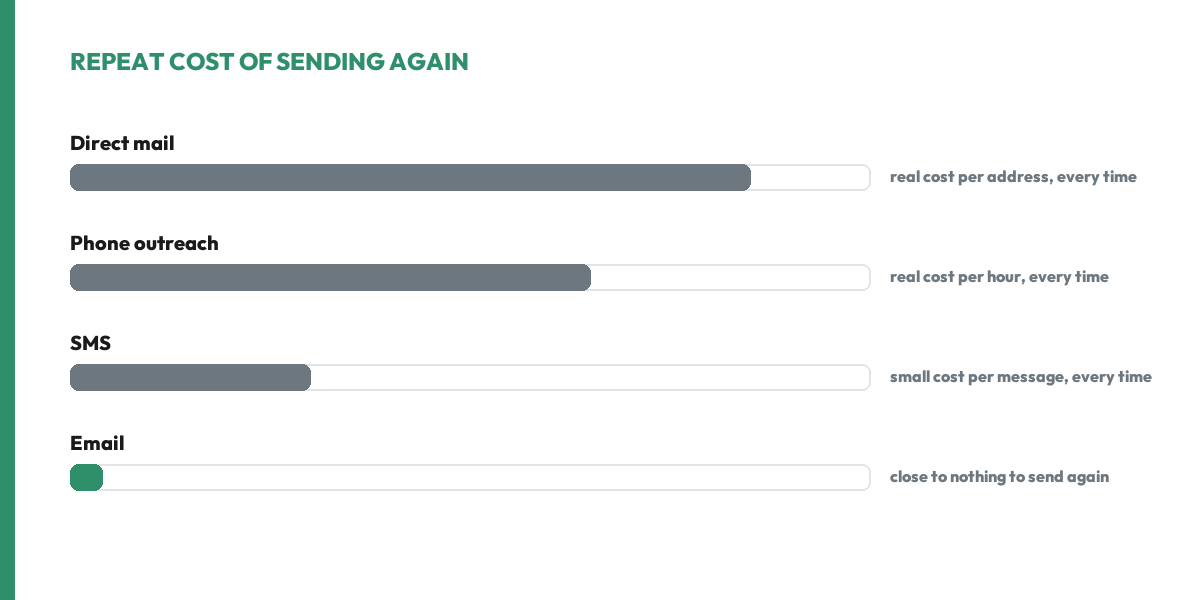
What changes the calculation is scale and cost. A mailed campaign to five hundred addresses carries a real production and postage bill that repeats every time you send it again. A phone campaign carries a real cost in someone’s hours. Email to that same list costs close to nothing to send a second or third time, which is why it tends to become the default channel for anything sent regularly rather than occasionally, and the independent research on that return is covered in is email marketing worth it for a small business.
The cost and speed gap, in practical terms
This is really the whole difference once you set the shared idea aside. Email can be written in the morning and reaching every contact on a list by the afternoon, tested against a smaller segment first, and adjusted before the rest goes out, all without a second production cost. A direct mail piece has to be designed, printed and posted well ahead of when it needs to land, and once it is in the mail there is no editing it. That speed advantage only pays off if the email itself is short enough to actually get written and sent the same day; see how long a marketing email should be for the length where click-through rate actually peaks.
That gap matters most for a business that wants to send something regularly rather than as a one-off campaign. A monthly newsletter, a post-purchase follow-up, or a re-engagement message to people who inquired and never booked are all far more practical to run through email than through mail or phone outreach, purely because the cost of sending them again and again stays close to zero. Our guide to a proper welcome email sequence covers exactly this kind of recurring message, built once and sent automatically from then on.
Which one should a founder-led business actually use
For most founder-led businesses, the honest answer is email as the default channel for anything sent regularly, with the other direct channels kept for the moments where a physical or personal touch genuinely earns its extra cost, a handwritten note to a long-standing client, or a phone call to someone who has gone quiet after showing real interest. Treating direct mail and phone outreach as the exception rather than the default is usually the more sustainable setup for a business without a marketing team behind it.
There is also a practical reason this matters beyond cost. A founder running the business alone, or with a small team, has limited hours to spend on outreach in any given week. A phone campaign to a hundred contacts eats an entire week of calls before a single reply comes back. The same hundred contacts can receive a well-written email in minutes, and the time that would have gone into dialling can go into the calls that actually come in as replies. The channel with the lowest cost per send is usually also the channel with the lowest time cost, and for a founder-led business, time is often the scarcer resource of the two.
None of this means email always wins on quality of attention. A phone call or a handwritten note still lands with a weight that an email cannot match, precisely because it costs more to send and the recipient knows it. The right read is not “email is better” but “email is cheaper to run often,” which is why it tends to become the channel a business leans on weekly or monthly, while the higher-cost, higher-attention channels get saved for the handful of relationships where that extra weight actually changes the outcome.
This is also a budget question as much as a channel question, and it sits right next to how much a founder-led business should actually be spending on ads, since the two usually come out of the same marketing budget and email is almost always the cheaper of the two to run well. If you already have a website collecting inquiries, pairing that with work that turns those inquiries into bookings is usually the more direct route than adding a mail or phone campaign on top.
The honest summary
Email marketing is not competing with direct marketing. It is one channel inside it, and the one that usually wins on cost and speed once a business needs to send something more than once. Keep the other direct channels for the moments a physical or personal touch is worth the extra cost, and let email carry everything you want to send regularly without a repeat bill each time.
If you want a clear read on where your own outreach budget should actually go, book a free discovery call and we will map out your Growth Plan together.
Frequently asked questions
Email marketing vs direct marketing: what's the real difference?
Direct marketing is the wider category, any message sent straight to a specific person rather than broadcast to everyone, and it includes mail, text and phone outreach alongside email. Email marketing is one channel inside that category. The practical difference for a founder-led business is cost and speed: email carries close to no per-send cost and can go out the same day, while the other direct channels usually carry a real cost per contact and a slower production cycle.
Is email marketing a form of direct marketing?
Yes. Email marketing sits inside direct marketing as one of its channels, alongside direct mail, SMS and outbound calling. What sets it apart from the others in that group is cost and turnaround, not the underlying idea, which is the same in all of them: a message sent to a known person rather than broadcast to an audience.
Why would a small business choose email over other direct marketing?
Mainly cost and control. A mailed piece has a real production and postage cost per address, and a phone campaign has a real cost per hour of a person's time. An email to the same list costs close to nothing to send again, so a small business can test, adjust and resend far more often than the cost of other direct channels normally allows.
Does direct marketing still work for a founder-led business?
Yes, particularly the channels that reach someone who has already shown interest, such as a past client or an inquiry that never booked. Direct marketing works worst as cold, unsolicited contact and best as a follow-up to someone who already knows the business, which is exactly the list email marketing is usually built from.
Want a clear roadmap for your own growth?
Every partnership with The Growth Project starts with a free Growth Plan. Book a discovery call and we'll map out yours together.