How long does it take for Facebook ads to work?
How long does it take for Facebook ads to work? Usually two to four weeks for a real read, and here is exactly why, stage by stage.
How long does it take for Facebook ads to work is one of the first questions worth asking honestly, because the honest answer is longer than most people budget for. If you would rather have someone read your account directly and tell you where it actually stands, you can book a free discovery call and we will look at it together. Otherwise, here is the real timeline and what happens at each stage of it.
TL;DR: Give a new Facebook ad campaign two to four weeks before judging it. Delivery is noisy for the first few days, the account then needs roughly fifty conversion events to leave its learning phase, and only after that does cost per result mean anything. Judging it sooner is judging noise, not performance.
How long does it take for Facebook ads to work?
The honest answer is two to four weeks for a first real read, and most of that time is not wasted, it is the system learning. A Facebook ad campaign does not start smart. It starts by testing a wide guess at who might convert, then narrows that guess using real conversion data from your own account. No data yet means no narrowing yet, and that stage takes real time to pass through, whatever the budget.
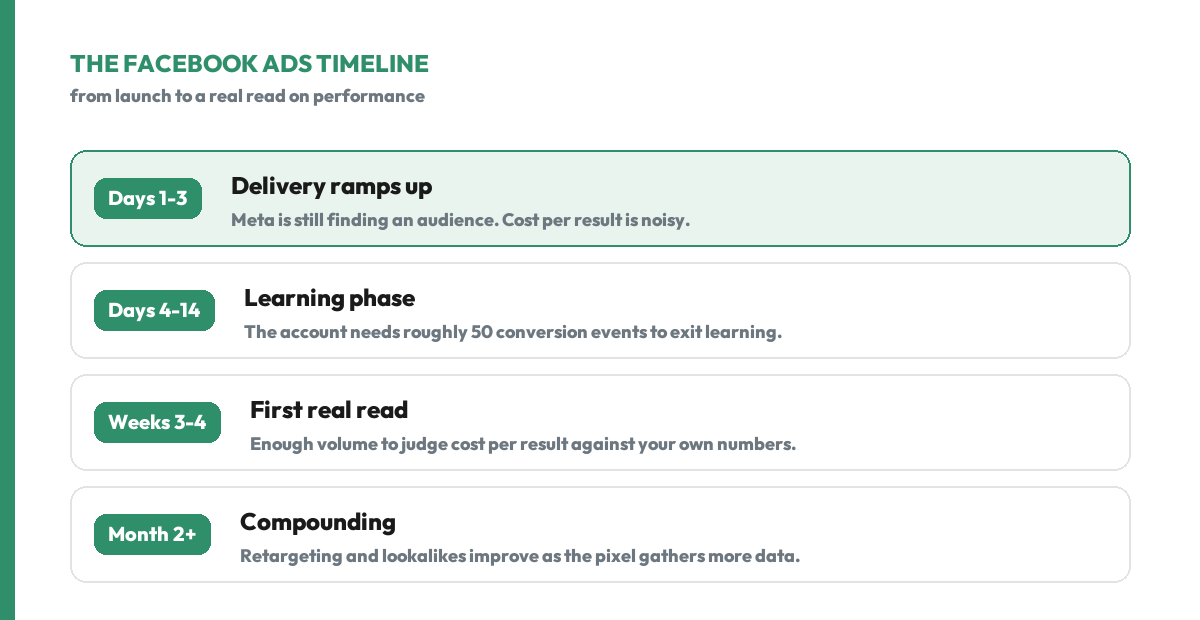
Days one to three: delivery is noisy on purpose
In the first few days, Meta is showing your ad to a broad slice of a rough audience while it waits for the first conversions to arrive. Cost per result during this window can look great or look terrible, and neither reading is reliable yet. This is the stage most campaigns get killed at, usually because a founder checking daily sees a bad number on day two and pulls the budget before the system has had a chance to correct.
Days four to fourteen: the learning phase
This is the stage that actually decides how long the wait is. Meta’s delivery system needs somewhere around fifty conversion events on the account before it can reliably say who is likely to convert next. A campaign spending enough to hit that number in a week clears the learning phase in a week. A campaign spending just enough to trickle in one or two conversions a day can take the better part of a month to clear it, and every day inside it is still a guess, not a read. If your daily budget is far from fifty conversions a week, the honest move is either raising it or accepting that the wait is longer, not restarting the campaign to try to force a faster answer.
Weeks three and four: the first real read
Once the account has cleared learning and run for a couple of weeks past that point, the cost per result you are seeing has finally had enough volume behind it to mean something. This is the earliest point where comparing that number against what a client is actually worth to you is a fair comparison rather than a guess. If the landing page is doing its job, this is also roughly when meta ads vs boosted post stops being an academic question, because a real campaign given real time will have pulled well ahead of a boosted post by now.
None of this timeline means much if the page after the click was never going to convert in the first place. This is where our paid acquisition work usually starts: not by changing the ad on day three, but by making sure the account, the budget, and the landing page are actually set up to reach that first real read instead of being judged and killed before they get there.
Month two and beyond: the timeline starts compounding
Past the first month, a campaign that has been left alone to run genuinely gets better on its own, not because anything was changed but because the pixel has more real data to retarget and build lookalike audiences from. This is the part of the timeline most founders never see, because most campaigns get abandoned or rebuilt from scratch well before reaching it. A campaign rebuilt every few weeks never accumulates the data that makes month two better than month one.
What actually speeds the timeline up
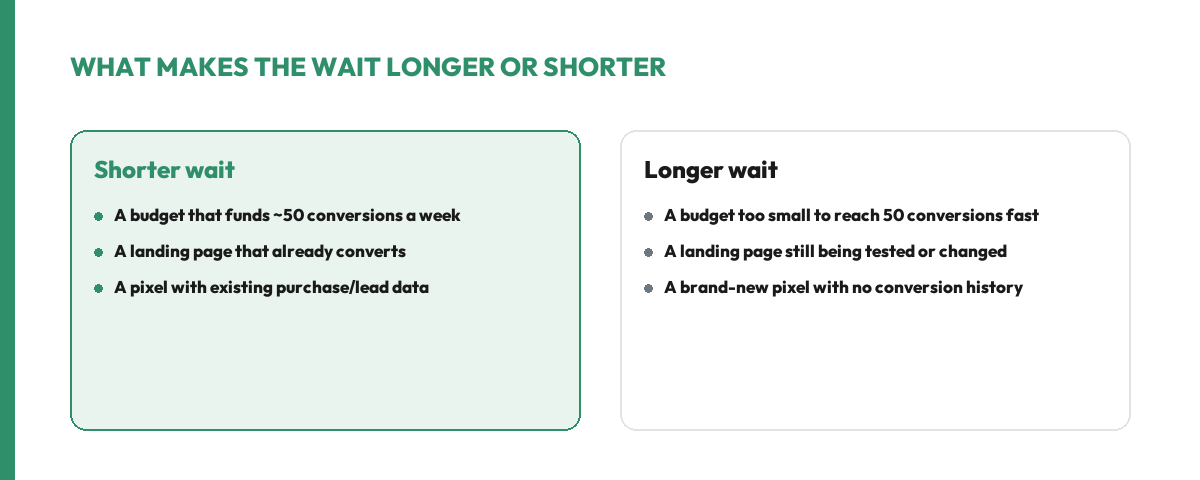
Three things shorten the wait for real, and none of them are about the ad’s copy or creative. A budget large enough to fund roughly fifty conversions a week clears the learning phase in days instead of weeks. A landing page that already converts means the conversions counted during learning are real ones, not near-misses. A pixel with existing purchase or lead history, from a past campaign or an installed tracking setup, gives the account a head start instead of starting from zero. If none of those three are true yet, the honest expectation is the longer end of the range, and that is a budget and setup question, not a patience problem.
It is worth saying plainly that none of these three levers are things you pull mid-flight without cost. Raising the budget partway through a campaign that is still learning resets some of that progress, because the delivery system treats a large enough change as a new signal to react to. Swapping the landing page while a campaign is still in its learning phase does the same thing to the conversion data it is trying to learn from. The founders who reach a real read fastest are usually the ones who set the budget, the page, and the tracking up properly before launch, then leave the account alone to do the learning it needs to do, rather than adjusting something new every few days out of understandable impatience.
The honest summary
Two to four weeks is the real timeline for a first honest read on a Facebook ad campaign, and almost all of that time is the system learning from your own data rather than wasted spend. Judging performance on day two or three is judging noise. If a campaign has actually cleared learning and run a couple of weeks past it and the numbers still do not work, the timeline has stopped being the explanation, and it is worth working through why aren’t my Facebook ads converting instead, since that is a different question with a different set of answers.
If you want someone to look at where your account actually sits on this timeline and whether it is set up to reach a real read at all, book a free discovery call and we will map out your Growth Plan together.
Frequently asked questions
How long does it take for Facebook ads to work?
Give a new campaign two to four weeks before judging it. The first few days are noisy while Meta ramps delivery, the account then needs roughly fifty conversion events to leave its learning phase, and only after that does the cost per result settle into a number worth trusting. A campaign judged on day three is being judged on noise, not performance.
Why do Facebook ads take so long to work?
Meta's delivery system learns who to show your ad to from real conversion data, not from the ad itself. Until it has collected enough of that data, roughly fifty conversion events, it is still guessing at the audience, so cost per result swings around before it settles.
Can Facebook ads work faster than a few weeks?
Sometimes, if the budget is large enough to reach fifty conversions quickly, the landing page already converts well, and the pixel already has purchase or lead history from past campaigns. Without those three things in place, a faster read is usually a false one, not a true speed-up.
What should I check if my ads still are not working after a month?
At that point the timeline has stopped being the explanation. Look at whether the landing page matches what the ad promised, whether the audience is a fit for what you sell, and whether tracking is even reporting correctly. We cover all three in why aren't my Facebook ads converting.
Want a clear roadmap for your own growth?
Every partnership with The Growth Project starts with a free Growth Plan. Book a discovery call and we'll map out yours together.