Why are my Facebook ads so expensive?
Why are my Facebook ads so expensive? Five real drivers of a rising cost per result, and the one comparison that actually tells you if it is a problem.
Why are my Facebook ads so expensive is usually asked while staring at a cost per click that feels high, without a clear sense of what it is actually being compared to. Facebook ads are one channel inside paid acquisition as a whole, and most of what drives the cost up is specific to how that one channel’s auction works rather than to paid acquisition generally. If you would rather have someone look at your account and tell you plainly whether the number is a real problem, you can book a free discovery call and we will go through it together. Otherwise, here are the five real drivers, checked in the order worth checking them.
TL;DR: A high cost per result on Facebook ads almost always comes from one of five places: a small, over-competed audience, an account still in its learning phase, weak ad relevance, budget on the wrong placements, or a genuine seasonal demand spike. The number that actually matters is not cost per click against a stranger’s benchmark, it is cost per result against what a client is worth to you.
Why are my Facebook ads so expensive?
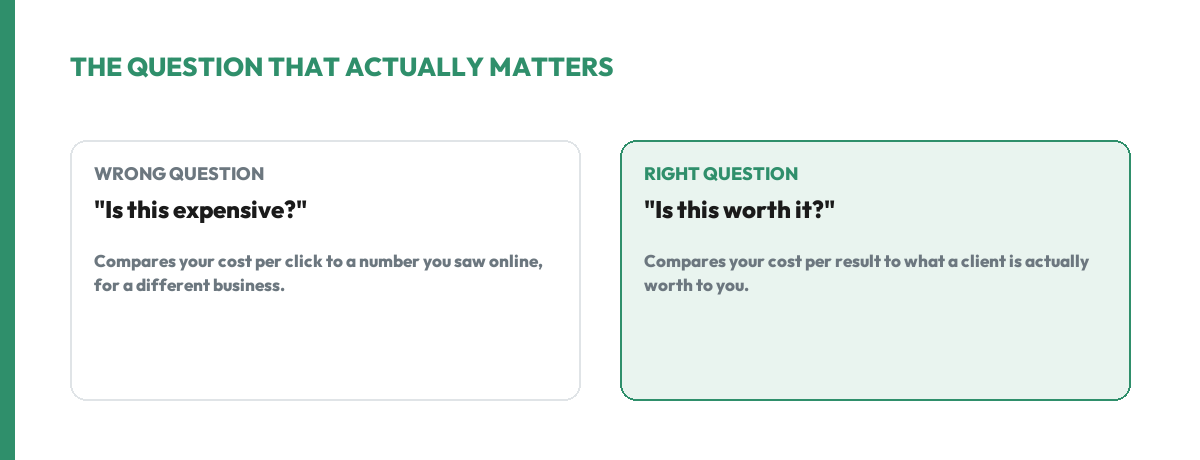
Before diagnosing anything, separate two very different questions that get treated as the same one. Is the cost per click or cost per result higher than you expected? And is that cost still profitable given what a client is worth to your business? The first is a number. The second is the only one that decides whether anything actually needs fixing. Most of what follows explains what drives the first number up, but the honest answer to whether it is a problem lives in the second.
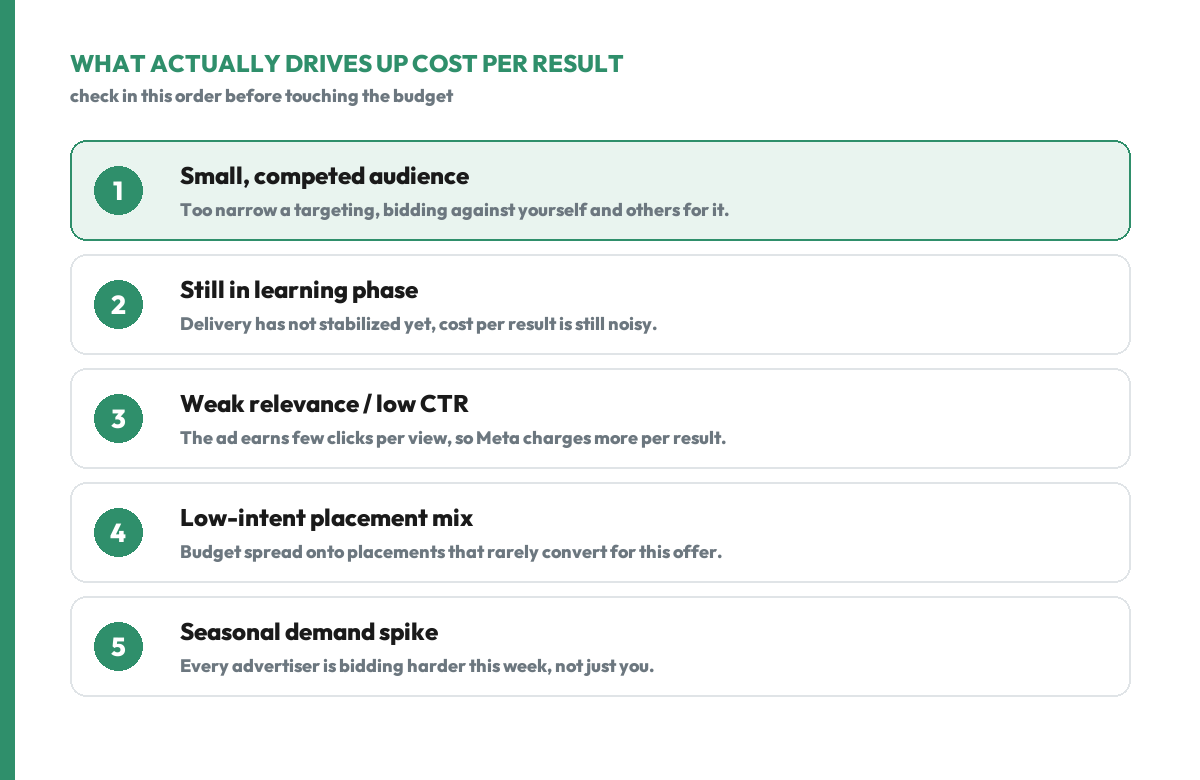
Driver one: the audience is small and heavily competed
Every advertiser targeting the same narrow slice of people is bidding against every other advertiser targeting that same slice, and Meta’s auction prices that competition into your cost per result directly. A very specific, high-intent audience can still be the right call strategically, but it will almost always cost more per result than a broader one, because there are fewer of those people and more businesses trying to reach them. This is not a fixable problem in the way the others are. It is closer to a tradeoff between precision and price that is worth making consciously rather than being surprised by, which is why the right ad format matters as much as the audience, something we break down with real gym Facebook ads examples.
Driver two: the account has not left its learning phase
Cost per result is at its least reliable and often its highest while an account is still collecting the roughly fifty conversion events Meta’s delivery system needs before it learns who to show your ad to efficiently. Judging the real cost of a campaign from its first week, especially a week with a modest daily budget, is judging a number that has not settled yet. We go through exactly how long that settling takes in how long does it take for Facebook ads to work, and it is worth reading before deciding the cost itself is the problem.
Driver three: weak relevance drags cost per result up
Meta charges less per result for ads it expects people to actually respond to, and more for ads with a weak click-through rate relative to what is shown. A generic image with generic copy earns fewer clicks per view than a specific, relevant one, and that gap shows up directly as a higher cost. This is one of the few drivers that is genuinely fixable by changing the ad itself rather than the targeting or the budget.
Driver four: budget is landing on low-intent placements
Meta spreads spend across several placements, feeds, stories, reels, and the audience network among them, and not every placement converts equally well for every offer. A placement mix left on its broadest automatic setting can quietly send a meaningful share of budget toward placements that rarely produce a real result for what you sell, which raises the average cost per result even though nothing about the audience or the ad itself changed.
Driver five: everyone’s cost is up this week, not just yours
Retail-heavy shopping periods and other seasonal spikes in advertiser demand raise the price of the auction for everyone at once, the same way airfare rises during a holiday week regardless of which airline you book. A cost per result that jumped sharply for a few weeks and then came back down on its own is very often this, not a problem with your account at all. Checking the calendar before rebuilding a campaign can save a lot of unnecessary work.
This driver is also the easiest to mistake for one of the other four, because the symptom on the dashboard looks identical: a number that used to be comfortable and suddenly is not. The difference is timing. A seasonal spike moves the whole market together and eases once the period passes, while a targeting, learning-phase, relevance, or placement problem stays elevated on its own until something about the account actually changes. Comparing this month’s cost against the same month a year earlier, where that history exists, separates the two faster than watching the number day to day.
What changing the ad can and cannot fix
It is tempting to treat every rise in cost as a signal to refresh the creative, and sometimes that is exactly right, particularly for driver three above. But a small competed audience stays expensive with a brand-new ad in it, an account still learning behaves the same way whatever the creative looks like, and a placement mix problem has nothing to do with the ad’s design at all. Knowing which of the five is actually happening before touching the ad saves the time spent rebuilding creative that was never the real cause.
The comparison that actually settles it
None of the five drivers above answer the real question on their own, because a genuinely expensive result and a genuinely profitable one can look identical on a cost-per-click dashboard. Take what a client is actually worth to your business, factoring in the full value of the relationship where that is fair, and compare it honestly to your cost per result. A number that felt high against a stranger’s benchmark online can be comfortably profitable against your own. If our paid acquisition work starts anywhere, it starts with getting that comparison right before touching the budget or the targeting at all.
The honest summary
A high-feeling cost per result on Facebook ads is almost always one of five things: a small competed audience, an account still learning, weak ad relevance, the wrong placement mix, or a temporary seasonal spike. None of those are answered by the number alone. The only comparison that tells you whether the cost is actually a problem is your own cost per result against what a client is genuinely worth to you, not a benchmark that belongs to somebody else’s business.
If the number checks out as genuinely too high once you have made that comparison, the fix is rarely a bigger budget. It is usually the audience, the learning phase, or the ad itself, in the order covered above, and why aren’t my Facebook ads converting is the next place to look if the clicks are arriving at a fair cost but still are not turning into clients.
If you want a straight read on whether your own numbers are actually a problem, book a free discovery call and we will map out your Growth Plan together.
Frequently asked questions
Why are my Facebook ads so expensive?
Usually one of five things: the audience is small and heavily competed, the account is still in its learning phase and has not stabilized, the ad's relevance and click-through rate are weak so Meta charges more per result, budget is spread across placements that rarely convert for the offer, or demand across the platform is temporarily up for everyone. Checking these in order, from targeting to timing, finds the real driver faster than cutting the budget.
Is my cost per click actually too high?
That question cannot be answered by comparing it to a number from another business or industry. The only comparison that matters is your own cost per result against what a client is genuinely worth to you. A high-looking cost per click can still be very profitable, and a low-looking one can still lose money, depending on that ratio.
Does a small budget make Facebook ads more expensive?
Indirectly, yes. A small budget takes longer to reach the roughly fifty conversion events Meta's delivery system needs to leave its learning phase, and cost per result is at its noisiest and often its highest during that stretch. This is different from the audience or relevance drivers, but it compounds with them.
Will Facebook ads get cheaper if I just wait?
Sometimes, once an account clears its learning phase, cost per result does settle lower. But waiting is not a fix for a genuinely small, over-competed audience or a weak ad, both of which stay expensive however long the campaign runs. We work through the difference in how long does it take for Facebook ads to work.
Want a clear roadmap for your own growth?
Every partnership with The Growth Project starts with a free Growth Plan. Book a discovery call and we'll map out yours together.