Meta ads vs boosted post: what actually earns your budget
Meta ads vs boosted post: which one actually earns your ad budget, and why the boost button rarely behaves like real advertising for a small business.
Meta ads vs boosted post is not really a fair fight, because most people who ask it have only ever pressed the blue “Boost post” button under something that did well on their Page. That is already a version of Meta advertising. The question worth asking before you spend any more is whether it is the right version for what you are trying to buy. If you would rather have someone look at your account and tell you straight, you can book a free discovery call and we will walk through it together. Otherwise, here is the honest comparison.
TL;DR: A boosted post pays to show something you already published to more people, using a short list of simple goals like reach or engagement. A real Meta ads campaign starts from the business result you actually want, usually leads or bookings, and builds targeting, creative tests and tracking around that result specifically. Boosting is fine for visibility. It is the wrong tool the moment you are paying to get clients rather than views.
Meta ads vs boosted post: what’s the real difference?
The two live in the same platform and spend the same currency, which is exactly why they get confused for each other. But they are built for different jobs.
Boosting takes a post that already exists on your Page and pays Meta to show it to more people, using one of a short list of objectives, usually post engagement, Page likes, or messages. You pick an audience from a simplified panel, set a budget and a duration, and Meta handles the rest. There is one piece of creative (the post itself), one audience, and one goal.
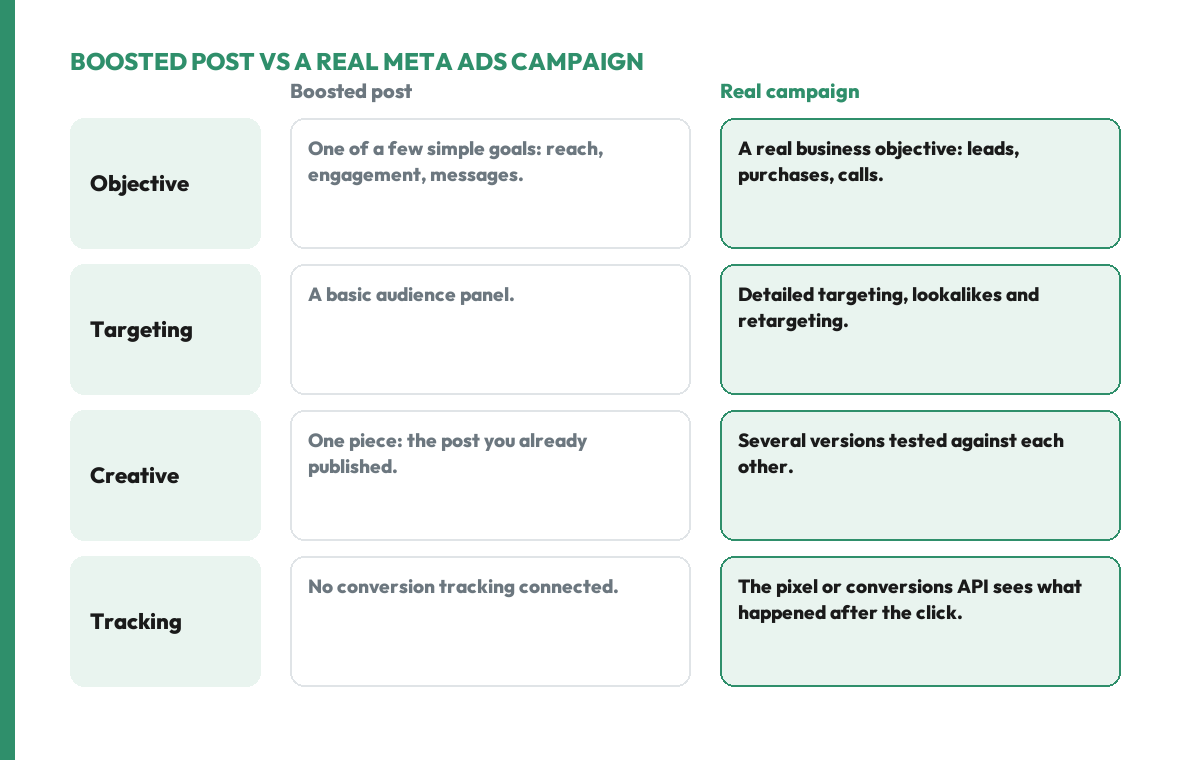
A campaign built in Ads Manager starts somewhere else entirely: with the actual outcome you are paying for. You choose a business objective, such as leads or purchases, not a vanity metric. You can build several ad sets against different audiences, run multiple pieces of creative against each other to see which one actually performs, choose where the ads show (Feed, Stories, Reels, Audience Network), and, most importantly, connect a way to measure what happened after someone clicked. That last part is the whole game, and it is the piece boosting does not have.
Why boosting feels like advertising, and usually isn’t
The boost button is built to feel like advertising because it uses the same auction and the same audience data as a full campaign. That is not an accident. It is the easiest entry point Meta offers, and it works well for what it is built to do.
The trouble is what it is built to do. Left to its simplified settings, a boosted post optimizes for cheap, plentiful actions like likes, comments and shares, because that is the objective you gave it. Meta’s delivery system is genuinely good at finding people likely to take that action. It has not been asked to find people likely to become a client, so nothing about the result tells you whether the spend earned you one.
This is the same discipline we cover in how do I know if my Facebook ads are working: the number that decides whether spend is working is cost per booked client, not cost per click or cost per like. A boosted post rarely gives you any way to see that number at all, because it was never built to track it.
What a real Meta ads campaign gets you that boosting can’t
Three things separate a real campaign from a boosted post, and all three exist because the campaign was built around an outcome instead of a post.
A business objective, not a popularity contest. Choosing “leads” or “purchases” as the objective tells Meta’s delivery system what a good result actually looks like, and it optimizes delivery toward people likely to take that specific action, not toward whoever is cheapest to entertain.
Creative testing. A campaign can run several versions of an ad against the same audience and let the data show which one earns a client at a lower cost. A boosted post is stuck with the one piece of content you already published, whether or not that content was ever written to convert.
Tracking that reaches past the click. With the pixel or the conversions API connected, a real campaign can see who booked a call or bought something after clicking, and Meta’s delivery improves over time because it is being told what actually mattered. Boosting almost never has this connected, so every boost restarts from zero with no memory of what worked.
If you have not set that measurement up yet, this is where our paid acquisition work usually starts, because a campaign built without it is guessing no matter how good the creative looks.
When boosting is actually the right call
None of this makes boosting wrong. It is the right tool for a narrower job than most people use it for.
A post is already doing well organically, and you simply want more of your existing audience, or people like them, to see it. You are not trying to generate a lead from this specific post, you are extending reach on something that is already working.
You are new to advertising on the platform and have no tracking connected yet. A small boost is a low-stakes way to get comfortable with the auction and the audience tools before committing real budget to a campaign you cannot yet measure properly.
The goal genuinely is visibility, not a transaction. Community building, event awareness, or simply staying present in front of past customers are all reasonable jobs for a boost.
How to know which one your business needs
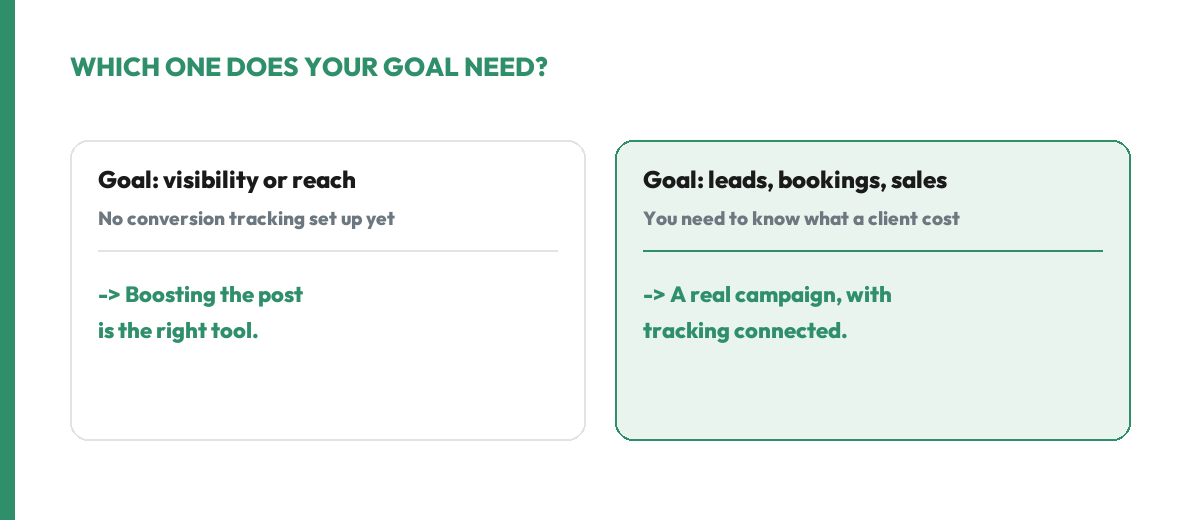
Ask what you are actually trying to buy. If the honest answer is more eyes on something you already made, boosting will do that job at a fair price. If the honest answer is more booked clients, boosting is the wrong tool no matter how good the post looks, because it was never built to find you a client. It was built to find you an audience.
This is the same distinction we walk through in does social media advertising work: the platform is not the variable that decides success, the setup is. And once you know a campaign is the right call, the next question is what to actually spend, which we cover in how much should I spend on ads.
The honest summary
A boosted post and a Meta ads campaign are not two versions of the same thing. One extends the reach of something you already made. The other is built, from the objective down to the tracking, around a result you are trying to buy. Confusing the two is how a business ends up with a Page full of likes and no way to say whether any of it paid for itself.
If you want a straight read on whether your current setup can actually tell you what is working, book a free discovery call and we will map out your Growth Plan together.
Frequently asked questions
Meta ads vs boosted post: what's the real difference?
A boosted post takes something you already published and pays to put it in front of more people, with a handful of settings and one of a few simple goals like reach or engagement. A real Meta ads campaign, built in Ads Manager, starts from a business outcome such as leads or bookings, then builds targeting, creative variations, placements and conversion tracking around that outcome specifically. Boosting is amplification. Advertising is a system aimed at a result.
Is boosting a post ever worth it?
Yes, for the right job. If a post is already doing well organically and you want more people to see it, or you are building visibility on a new page and have no conversion tracking set up yet, boosting is a cheap and simple way to add reach. It is the wrong tool the moment the goal is booked clients rather than views.
Why do boosted posts get cheap results that do not turn into clients?
Because the boost button optimizes for what it is built to optimize for, which is usually engagement or reach, not a purchase or a booking. Meta's delivery system is very good at finding people likely to like or comment. It is not being asked to find people likely to become a client, so it does not.
Do I need the Meta pixel for real ads to work?
You need some way to tell Meta what happened after the click, whether that is the pixel, the conversions API, or a simpler proxy like a lead form. Without it, a real campaign is optimizing on a guess, which puts it closer to a boosted post than you would want.
Want a clear roadmap for your own growth?
Every partnership with The Growth Project starts with a free Growth Plan. Book a discovery call and we'll map out yours together.