How long does SEO take to see results?
How long does SEO take to see results? Skip the vague ranges. Here are the five checkpoints, the window each one should arrive in, and how to read a miss.
How long does SEO take to see results is usually asked by someone who has already started paying for it, and every answer they find is a range. Three to six months. Six to twelve. Longer for a brand new site. Those ranges are not wrong. They are just no help while you are sitting inside one, because not a single one of them tells you whether your own SEO is quietly on track or quietly going nowhere. If you would rather have somebody look at your site and tell you which it is, you can book a free discovery call. Otherwise, here is a more useful way to think about the wait.
TL;DR: SEO does not run on one clock. It runs through five checkpoints that always arrive in the same order: your pages get stored by Google, your terms start collecting impressions, you appear but buried, you reach page one on the easier terms, and finally enquiries arrive steadily. Each checkpoint has its own window. Judge your progress by whether the next one arrived on time, not by whether you are ranking yet. A checkpoint that has not moved by the end of its window is information you can act on, and it is the difference between waiting patiently and being strung along.
So how long does SEO take to see results?
The reason nobody can answer this cleanly is that the question packs several different things into one word.
If you have already published pages and you are asking when Google will notice them, the answer is days. If you are asking when a phrase you care about will show your page to somebody, the answer is weeks. If you are asking when the phone rings because of it, the answer is months, and how many months depends almost entirely on what you targeted and what you already have.
There is a second reason the published ranges disagree with each other. As we covered in what SEO actually costs, three genuinely different things get sold under the same name: fixing the foundations you have, a one off project, and ongoing monthly work. They have different timelines. Averaging them produces a number that describes nobody.
So instead of one duration, use a sequence.
The five checkpoints, and when each should arrive
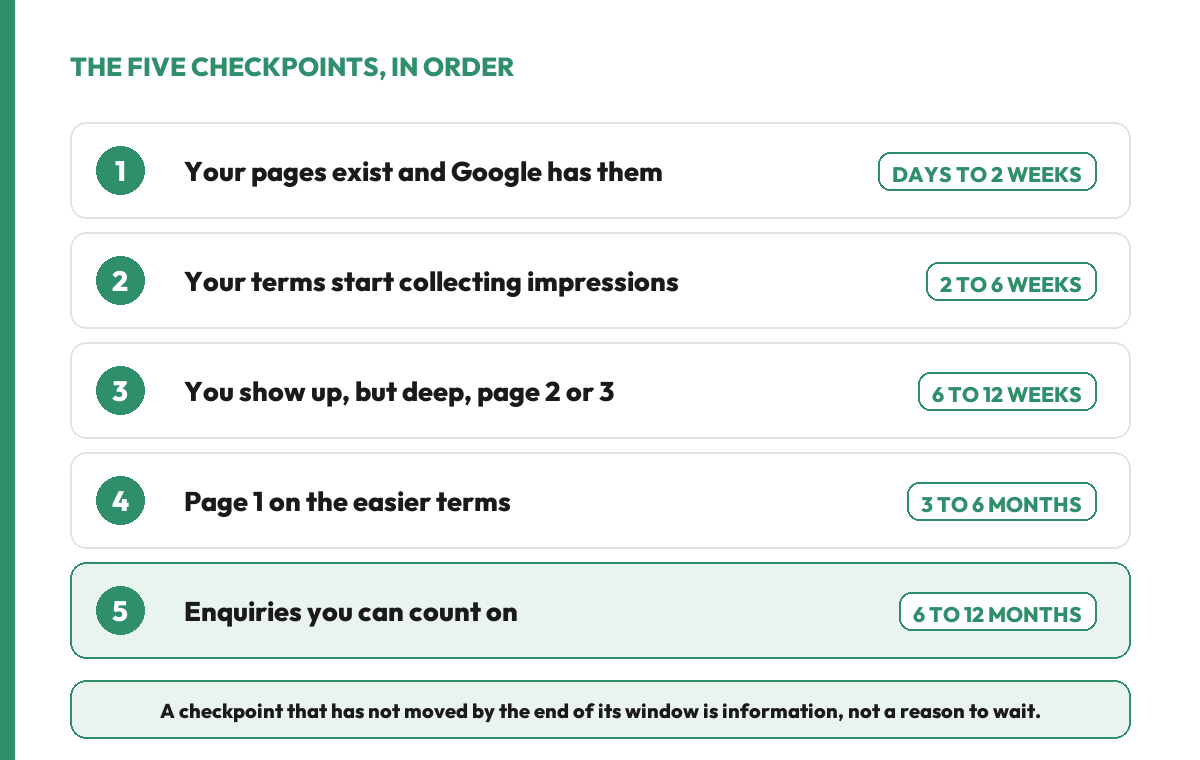
Your pages exist and Google has them. Days to two weeks. Google has to find a page and store a copy before anything else can happen. This is the fastest step and the easiest to verify, and if it has not happened after a fortnight something is technically wrong rather than merely slow.
Your terms start collecting impressions. Two to six weeks. An impression means Google showed one of your pages to a real person who searched. You are not ranking well yet. You are simply in the running. This is the first genuine sign of life, and it is the one most owners never think to look at because they are staring at positions instead.
You show up, but deep. Six to twelve weeks. You start appearing on page two or three for phrases you care about. Nobody is clicking. That is fine, and it is exactly what progress looks like at this stage.
Page one on the easier terms. Three to six months. The longer, more specific phrases come first, because fewer businesses are fighting over them. The short, obvious phrase you actually want is usually last.
Enquiries you can count on. Six to twelve months. Not the first stray enquiry, which can arrive much earlier by luck, but a flow steady enough that you can plan around it.
What a missed checkpoint actually tells you
Here is the part the timeline guides leave out, and it is the whole reason the wait feels so uncomfortable.
Every checkpoint above has a window. If a checkpoint arrives inside its window, you are on track, even if the thing you actually want is still months away. If a checkpoint does not arrive by the end of its window, that is not a reason to be more patient. It is a specific piece of information about a specific problem.
No pages stored after two weeks means a technical fault, not a slow start. No impressions after six weeks means Google does not consider your pages relevant to those phrases at all, which is usually a targeting problem. Impressions that climb steadily while positions never improve past page two normally means you picked phrases you cannot win yet.
That is the test worth running every month. Not “am I ranking”, which will be no for a long time and tells you nothing, but “did the next checkpoint arrive on time”. It is the same discipline we described for knowing whether your ads are working: pick the signal that moves first, and hold the work to it.
What quietly resets the clock
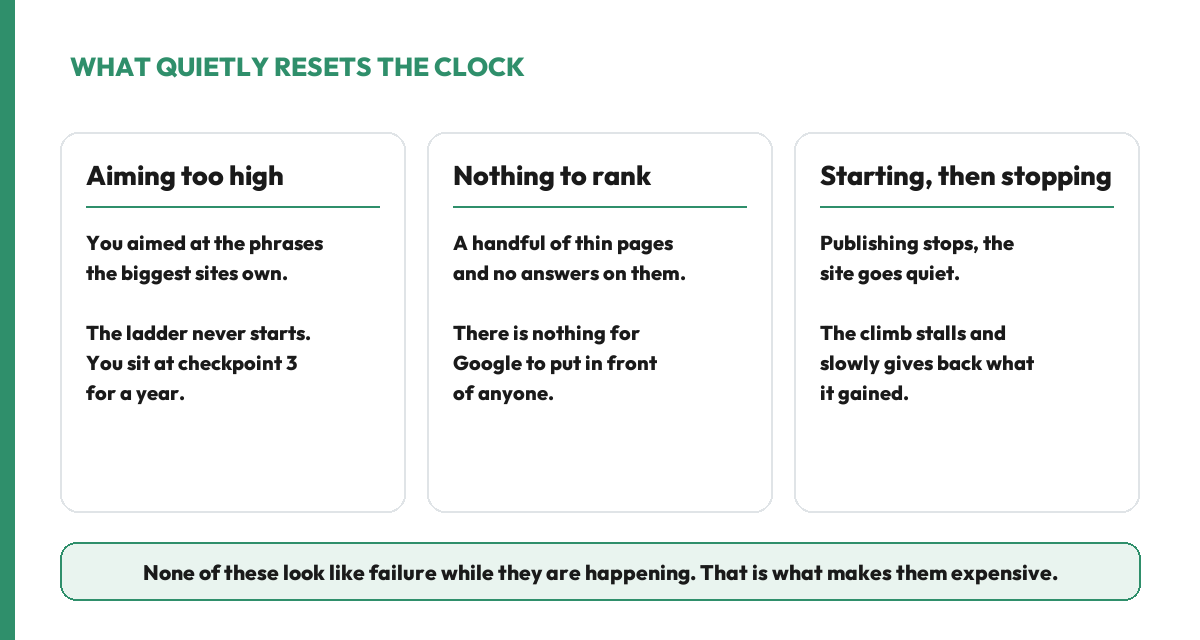
Three things push the whole timeline back, and the trouble with all three is that they feel like normal progress from the inside.
Aiming too high. If you target the phrases the largest sites in your field already own, you can do everything correctly and still sit just off page one for a year. The work was fine. The target was not.
Nothing worth ranking. A site with a few thin pages gives Google nothing to put in front of anyone. No amount of waiting fixes an empty shelf.
Starting, then stopping. Two strong months followed by silence is the most common version of this. The climb does not hold its position politely while you are busy. It stalls, then slowly gives back what it gained.
Why local results usually come faster
If you serve one city rather than a whole country, your timeline is often much shorter, and the reason is simply that you are competing against fewer businesses.
A map listing set up properly can produce calls within weeks, long before any blog post ranks for anything. That is a different mechanism from the ladder above and it runs on its own faster clock, which is why we treat it as the first move for anyone with a physical service area. We walk through the whole setup in local SEO for a service business.
What to actually look at each month
You do not need a dashboard for this. Three questions, once a month, are enough.
First, is the number of search terms you appear for going up? Not the rankings, the count of different phrases. A site gaining ground shows up for more things every month, well before any of them ranks well.
Second, are impressions on the handful of phrases you actually chose trending upward? Flat impressions after two months of work is the earliest honest warning you will get.
Third, has anything moved from page three to page two, or page two to page one? That is the climb, and it happens in steps rather than smoothly.
If those three are all moving, the work is compounding and the timeline is normal. If none of them have moved in three months, waiting longer will not fix it, and it is worth asking whether the targets were realistic before spending another quarter on them. If you are weighing that question against bringing in outside help, we wrote about how to decide whether to hire someone for exactly this call.
The honest summary
SEO takes three to six months to produce anything you would call a result, and six to twelve to produce a reliable flow of enquiries. That much matches every range you have read.
What those ranges do not give you is a way to tell, in month two, whether you are on the good version of that timeline or the bad one. The checkpoints do. Use them, and the wait stops being a leap of faith and becomes something you can actually manage.
If you want a straight answer on where your own site sits on that ladder and what is realistically winnable for you, that is where our SEO and GEO work starts with every business. Book a free discovery call and we will map out your Growth Plan together.
Frequently asked questions
How long does SEO take to see results?
Long enough that the honest answer is not a single number. What you can pin down is the order things happen in. Your pages get found and stored by Google within days to a couple of weeks. Your terms start collecting impressions somewhere between two and six weeks after that. You begin appearing for real, though buried on page two or three, at roughly six to twelve weeks. Page one on the easier terms tends to land between three and six months. Enquiries you can actually plan around usually take six to twelve months. The reason published ranges feel useless is that they quote you the last step and skip the four before it, so you have no way of telling a slow start from a stalled one.
How do I know if my SEO is working before it starts ranking?
Watch impressions rather than positions. An impression means Google showed one of your pages to somebody who searched, and it is the first sign that you exist for a phrase at all. Positions move slowly and noisily, so they are a poor early signal, but impressions climbing from nothing to a few dozen a week tells you the machinery is turning. After that, watch how many different search terms you appear for. A site that is genuinely gaining ground shows up for more phrases each month, well before any of them reaches page one.
Why is my SEO taking longer than six months with nothing to show?
Usually one of three things, and none of them look like failure while they are happening. You may have aimed at phrases the biggest sites in your field already own, in which case you can sit just off page one indefinitely. You may not have enough on the site worth ranking, so there is nothing for Google to put in front of anyone. Or the work started well and then stopped, and the climb gave back what it gained. If six months have passed with no movement in impressions at all, that is not a patience problem, it is a signal to look at what was targeted.
Is SEO faster for a local business?
Often yes, and sometimes dramatically so. Competing for a phrase nationally puts you against everyone. Competing for the same service in one city puts you against the handful of businesses actually near your customer, and a well set up map listing can start producing calls within weeks rather than months. That is why a local business with a modest site frequently sees results long before a national site with a much bigger budget.
Want a clear roadmap for your own growth?
Every partnership with The Growth Project starts with a free Growth Plan. Book a discovery call and we'll map out yours together.