SEO vs Google Analytics: they're not the same thing
SEO vs Google Analytics: they are two different things. One is a practice, the other a free measurement tool used on 47% of all websites.
SEO vs Google Analytics gets asked more often than you would expect, usually by someone who has opened their Analytics dashboard looking for their SEO and come away more confused than before. If you would rather have someone make sense of your numbers for you, you can book a free discovery call. Otherwise, here is the honest difference.
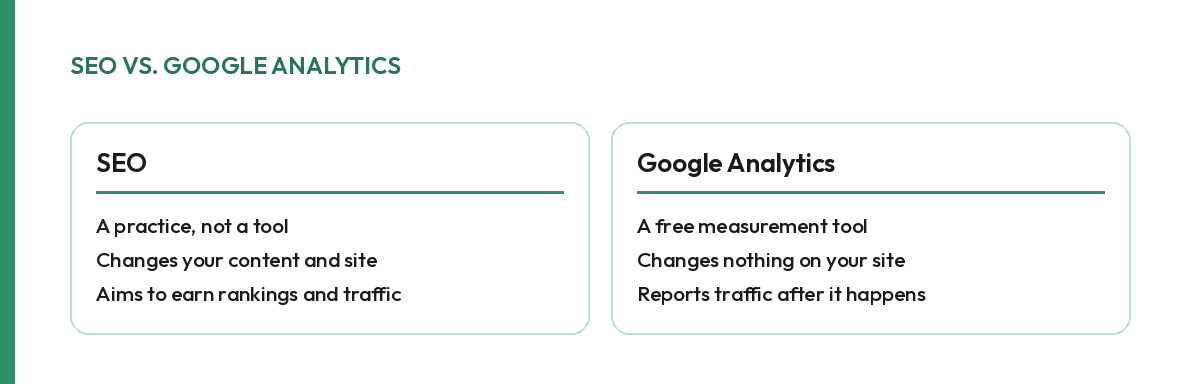
TL;DR: SEO and Google Analytics are not competing tools, they are not even the same category of thing. SEO, per Google’s own Search Central documentation, is the practice of helping search engines understand your content and helping the right people find your site through search. Google Analytics is a free measurement tool, used on 47.2% of all websites according to W3Techs, that reports on traffic after it already happened. One is work you do. The other is a dashboard that tells you whether that work is paying off.
SEO vs Google Analytics: what’s the actual difference?
The confusion is understandable, because both live in the same conversation about getting found online, but they sit on opposite sides of it. Google’s own Search Central documentation defines SEO plainly: it is “about helping search engines understand your content, and helping users find your site and make a decision about whether they should visit your site through a search engine.” That is active work: your titles, your content, your site structure, the things Google actually reads. Google Analytics does none of that. It is a measurement tool that reports on traffic your site already received, from search and from every other source, after the fact.
What Google Analytics actually is
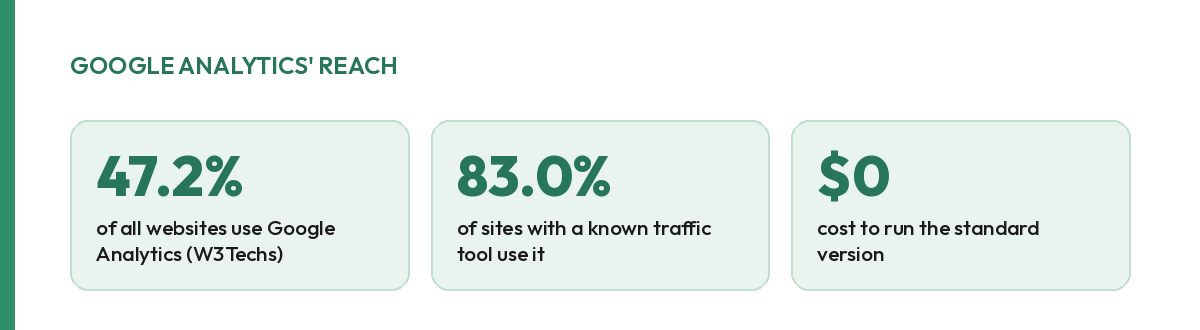
Google Analytics, now on its fourth version, is the free measurement layer sitting underneath an enormous share of the web. W3Techs puts its reach at 47.2% of all websites, and 83.0% of the websites where a traffic tool is known at all. It tells you where visitors came from, what they did once they arrived, and whether they converted, across every channel at once: search, social, email, paid ads, direct visits. What it will never tell you is why a specific page ranks where it does, because ranking is not something Analytics measures or influences. That question belongs to Search Console and the actual state of your content, not your analytics dashboard.
That scale is worth sitting with for a second. A tool used on nearly half of all websites is not a niche add-on, it is close to a default, which is exactly why so many business owners assume it does more than it does. Because Analytics is free, easy to install, and shows up first when someone starts asking “how is my website doing,” it becomes the one screen people check for every question about their site, including questions it was never built to answer. It answers “what happened.” It has no opinion on “why,” and no ability to change what happens next.
Why people mix the two up in the first place
The mix-up almost always starts the same way: someone checks “how their SEO is doing” by opening Analytics, because that is genuinely where organic traffic shows up. That habit is not wrong, it is just incomplete. Analytics is the right place to see the result of SEO work. It is the wrong place to look for the work itself, and it is a common, costly mistake to treat a quiet week in the organic traffic report as proof that SEO “isn’t working,” when the real explanation is usually timing. We go deeper on how long real movement actually takes in how long does SEO take to see results, because a lag that looks like failure in Analytics is often just SEO working on its normal timeline.
How the two actually work together
Used correctly, they are a loop, not a competition. SEO work changes what search engines find and how they understand it. Analytics, alongside Search Console, tells you whether that change actually moved real traffic and whether that traffic did anything once it landed. Run the loop in that order and each side sharpens the other: a page that Analytics shows converting well is worth building more content around, and a page Analytics shows nobody finds is a real signal to go check whether the SEO side ever actually reached it.
Neither one replaces the other, and treating GEO, the newer practice of earning citations from answer engines like ChatGPT and Perplexity, as a wholly separate discipline makes the same category mistake in a new outfit. It is closer to a sibling of SEO than a rival to it, built on much of the same on-page groundwork. We cover exactly how the two relate in SEO vs GEO. If you are further back and still weighing whether the SEO side of this is worth the investment at all before you start reading dashboards, is SEO worth it is the more useful place to start, and if cost rather than value is what is holding you back, what SEO actually costs for a small business puts real numbers behind it.
The honest answer
SEO vs Google Analytics is not a real contest, because they are not on the same side of the work. SEO is what you do to your site and its content, following the same fundamentals Google’s own documentation lays out. Analytics, used on nearly half of all websites, is how you check whether it worked. Confusing the two usually just means checking the wrong tool for the wrong question, not that anything is actually broken, and it is a genuinely easy mistake to make when one of them happens to be free, already installed, and open in a browser tab far more often than the other.
If untangling your own numbers from your own SEO work is the part that keeps eating your time, our SEO and GEO work is exactly what we take off your plate. Book a free discovery call and we will walk through what your dashboard is actually telling you.
Frequently asked questions
SEO vs Google Analytics: what's the actual difference?
SEO is a practice: the work of helping search engines understand your content and helping the right people find your site through search, as Google's own Search Central documentation defines it. Google Analytics is a free measurement tool, used on 47.2% of all websites according to W3Techs, that reports on the traffic your site already gets, from search and every other source. One is the work, the other is the dashboard that shows whether the work is paying off.
Do I need Google Analytics to do SEO?
You need it to know whether your SEO is working, not to do the SEO itself. Analytics shows you traffic, source and behavior after people arrive. It does not touch your titles, your content, your site structure or anything Google actually reads to rank you. You can run real SEO work without ever opening Analytics, you just will not know whether it moved the needle.
Why does my Google Analytics traffic not match what I expect from my SEO work?
Usually a measurement or timing gap, not a sign SEO failed. Analytics reports what already happened, and organic rankings typically take months to move, so a recent SEO change will not show up in this week's Analytics numbers yet. It is also easy to look at the wrong channel or date range and mistake a reporting gap for a performance problem.
Can Google Analytics tell me if my SEO is good?
It tells you the result, not the quality of the work behind it: organic sessions, which pages get found, and whether visitors convert once they land. It cannot tell you why a page ranks or does not, which is a question Search Console and the actual state of your content answer, not Analytics.
Want a clear roadmap for your own growth?
Every partnership with The Growth Project starts with a free Growth Plan. Book a discovery call and we'll map out yours together.