Is SEO worth it for a small business? A straight answer
Is SEO worth it? Not always, not immediately, but almost always over time if you can wait for it. Here is how to tell for your own business.
Is SEO worth it is usually asked by someone who has either been burned by a vague promise before, or is trying to decide where a limited budget should go this quarter. Both are fair reasons to ask, and the honest answer is not a flat yes or no. If you would rather have someone look at your specific situation and tell you straight, you can book a free discovery call. Otherwise, here is how to actually think it through.
TL;DR: SEO is usually worth it, but not immediately and not for every business right now. It compounds: a page that ranks keeps bringing visitors without a per-click cost, unlike ads that stop the moment spend stops. The trade-off is time, usually several months before it produces enquiries you can plan around. It fits a business that can wait for that. It is not the right first move for one that needs customers this week.
Is SEO worth it for a small business?
The honest answer depends on what you are comparing it to and how long you can wait. Compared to doing nothing, SEO is almost always worth it, because search is where people already go looking for what you sell, and not showing up there means losing that demand to whoever does. Compared to paid ads for a business that needs revenue this month, SEO is often the wrong first move, not because it does not work, but because it works on a different clock.
That clock is the part most pitches skip over. How long SEO actually takes to see results walks through the real stages: your pages get indexed within days to a couple of weeks, they start collecting impressions a few weeks after that, and enquiries you can actually plan around usually take six to twelve months. If a business cannot wait that long for this channel specifically, that is not a reason to write SEO off, it is a reason to run something faster alongside it while SEO builds underneath.
What actually makes SEO different from an ad budget
The core argument for SEO is not that it is cheaper than ads, though it often is over time. It is that it compounds. A page that ranks for a term keeps showing up in results without a per-click cost every time somebody searches it, which means work done months ago can still be earning attention today. Paid ads are the opposite: the traffic is real while the budget is running, and it stops the instant the budget does, with next month starting from zero all over again. We go through that comparison mechanically, including which one actually fits a given situation first, in SEO or SEM which is better.
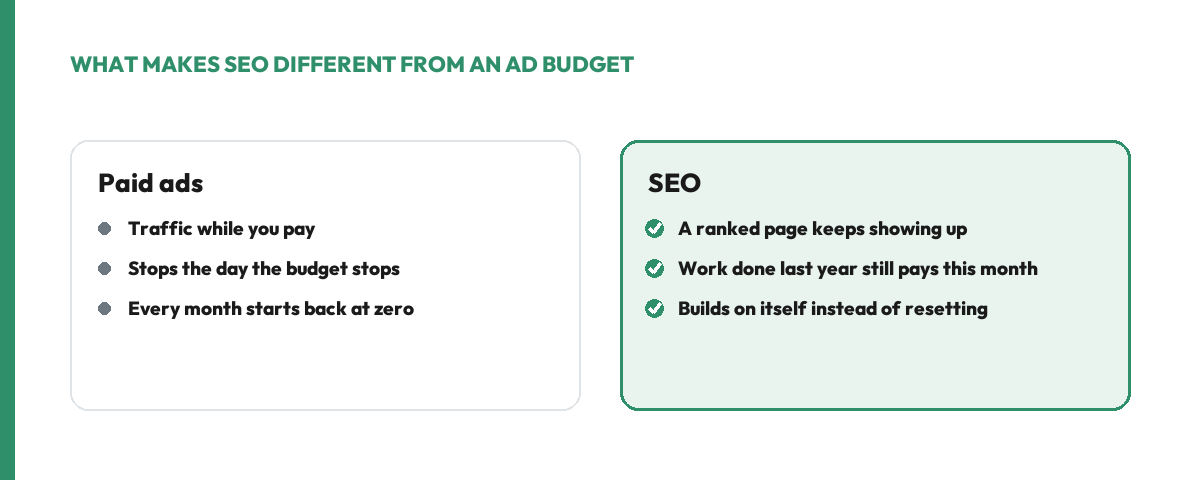
This is also why the true cost comparison rarely favors ads over a long enough horizon, even though ads look cheaper in the first month. What SEO for a small business actually costs covers the real numbers, but the short version is that the cost curve bends the opposite way from ads: SEO is relatively more expensive early and relatively cheaper later, once the pages you built are still working without new spend behind them.
When SEO is not the right first move
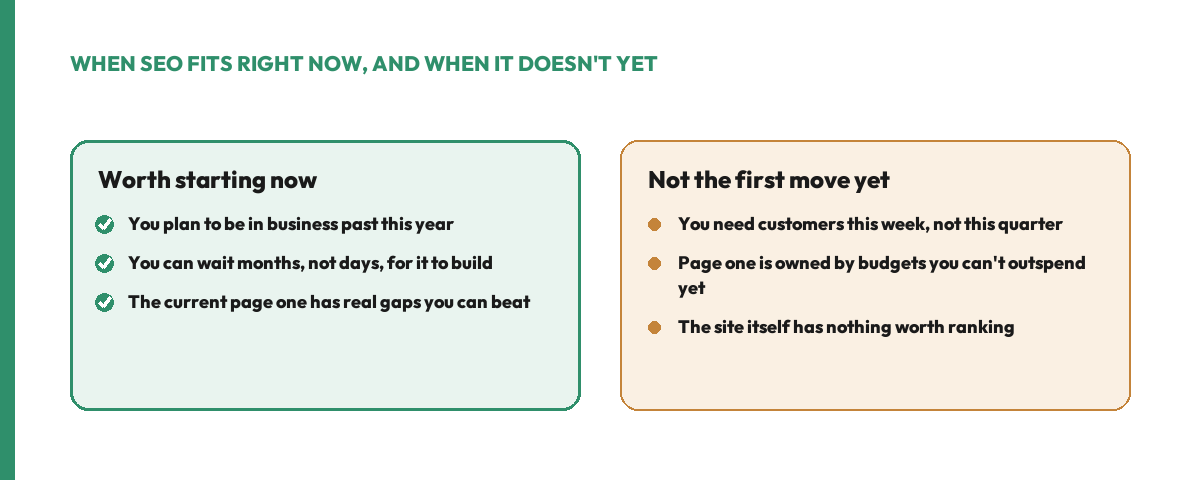
None of this means SEO fits every business at every stage. It is not the right first move when you need customers this week rather than this quarter, when the current page one for your actual terms is owned by budgets you genuinely cannot compete with yet, or when your own site does not have enough real content or offer clarity for Google to have anything worth ranking. In any of those cases, a faster channel, whether that is paid ads, your existing network, or a local listing, is the better place to start, with SEO built up alongside it rather than instead of it.
Competition matters more than most people expect here too. A single well-optimized page can outrank a much bigger competitor on a specific, well-chosen term, but only if that term is genuinely winnable. Chasing a phrase the largest players in your category already own is a slow way to learn a hard lesson, since sitting just off page one indefinitely is a real and common outcome, not a rare edge case. Understanding how SEO and GEO actually differ matters here too, since the terms worth chasing and the way tools like ChatGPT and Gemini now surface your business inside a written answer are no longer quite the same question they were a few years ago. Being worth ranking for a term someone searches on Google increasingly also means being worth mentioning inside the answer a tool like that gives, and the two rewards are close enough in the work they require that treating them as separate projects wastes effort either way.
The honest answer
SEO is worth it for most small businesses that plan to still be operating in a year and can afford to wait several months before it produces enquiries they can plan around. It is not worth treating as your only channel if you need revenue immediately, and it is not worth starting on unwinnable terms just because they have the highest search volume. The businesses that get the most from it treat it as a compounding asset built alongside whatever is already bringing in customers today, not a replacement for it on day one. Ask yourself one plain question before deciding either way: can this business afford to wait several months for a channel to start paying off, in exchange for that channel still paying off long after the ads stop. If the honest answer is yes, start now, because the earlier it begins compounding, the earlier it stops being the thing you are still waiting on.
If you want a straight read on whether SEO is the right next move for your specific business, rather than a generic yes, our SEO and GEO work starts with exactly that assessment. Book a free discovery call and we will map out your Growth Plan together, starting with what will actually move a number for you first.
Frequently asked questions
Is SEO worth it for a small business?
Usually yes, but not immediately, and not for every business at every stage. SEO compounds: a page that ranks keeps bringing visitors without you paying for each one, unlike an ad that stops the moment the budget stops. The trade-off is time. It usually takes several months before it produces enquiries you can plan around, so it fits a business that can wait for that and does not fit one that needs customers this week.
When is SEO not the right first move?
When you need customers immediately, when the page one results for your terms are owned by budgets you genuinely cannot compete with yet, or when your own site does not have enough worth ranking. In any of those cases, a faster channel like paid ads or your existing network is the better first move, with SEO started alongside it rather than instead of it.
How is SEO different from paying for ads?
Ads produce traffic for as long as you keep paying and stop the moment you stop. A ranked page keeps showing up in search results without a recurring per-click cost, so work done months ago can still be bringing in visitors today. That compounding is the core argument for SEO, and it is also why it rewards patience more than any other channel.
How do I know if SEO is actually working before I see new customers?
Watch impressions and how many different search terms you show up for, since both climb well before rankings or enquiries do. We cover the full order this happens in, with real timeframes for each stage, in how long SEO actually takes to see results.
Want a clear roadmap for your own growth?
Every partnership with The Growth Project starts with a free Growth Plan. Book a discovery call and we'll map out yours together.