SEO or SEM which is better for your marketing?
SEO or SEM which is better? Google says organic ranking is never for sale, while SEM runs on a pay per click auction judged on quality, not just bid.
SEO or SEM which is better is usually asked as if one answer settles it for good, when the honest answer is that they run on different mechanisms and solve different problems. If you’d rather have someone map out which one your business actually needs first, book a free discovery call. Here’s what actually separates them.
TL;DR: SEO or SEM which is better depends on what you need right now. Google’s own documentation states organic ranking is never for sale and is decided programmatically, which is exactly what SEO spends months earning. SEM runs on a pay-per-click auction, and Google’s own explanation of it says your position comes from your bid combined with the quality of your ad and landing page, not the bid alone, and it can start showing results the same day a campaign launches. Need traffic this month: lean SEM. Building for the next few years: lean SEO. Most established businesses eventually run both.
SEO or SEM which is better, mechanically?
Start with how each one actually decides who shows up, because that’s where the real difference sits, not in vague reputations either channel has picked up.
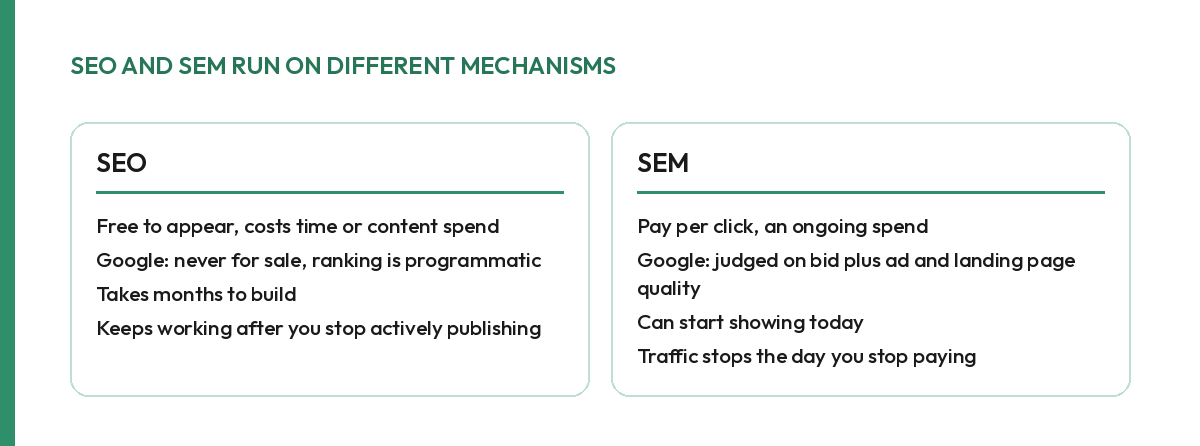
Google’s own search documentation is direct about this: “Google doesn’t accept payment to rank pages higher, and ranking is done programmatically.” That’s the entire premise of SEO. There is no invoice that moves your position, only work: content, structure and the technical basics that let Google understand and trust a page enough to show it.
SEM works on a different premise entirely. Google’s own explanation of how the ad auction works states that Ad Rank comes from “bid amount, the quality of your ads and landing page, the Ad Rank thresholds, the competitiveness of an auction, the context of the person’s search, and the expected impact of assets and other ad formats.” That’s a real auction with quality built into it, not simply the highest bidder winning, but it is still fundamentally a paid mechanism: no bid, no placement.
What that actually means when you’re choosing between them
The mechanism differences translate directly into three practical trade-offs. Speed: SEM can put you in front of searchers the same day a campaign goes live, while SEO typically takes months to show meaningful movement, a timeline we go through in detail in how long does SEO take to see results. Durability: SEO traffic doesn’t carry a per-click bill, so it doesn’t vanish the instant a budget runs out, though it does fade without upkeep. SEM traffic stops on the day you stop paying, because you were buying each click directly. Cost shape: SEO’s cost is mostly time and content, spread out and often invisible as a single number, while SEM’s cost is a direct, trackable spend you can turn on or off. We break down what SEO itself typically costs a founder-led business in how much does SEO cost for a small business, and we go specifically at the Google Ads side of this same comparison, including the myth that ad spend helps your ranking, in is SEO better than Google Ads.
How to decide which one you need first
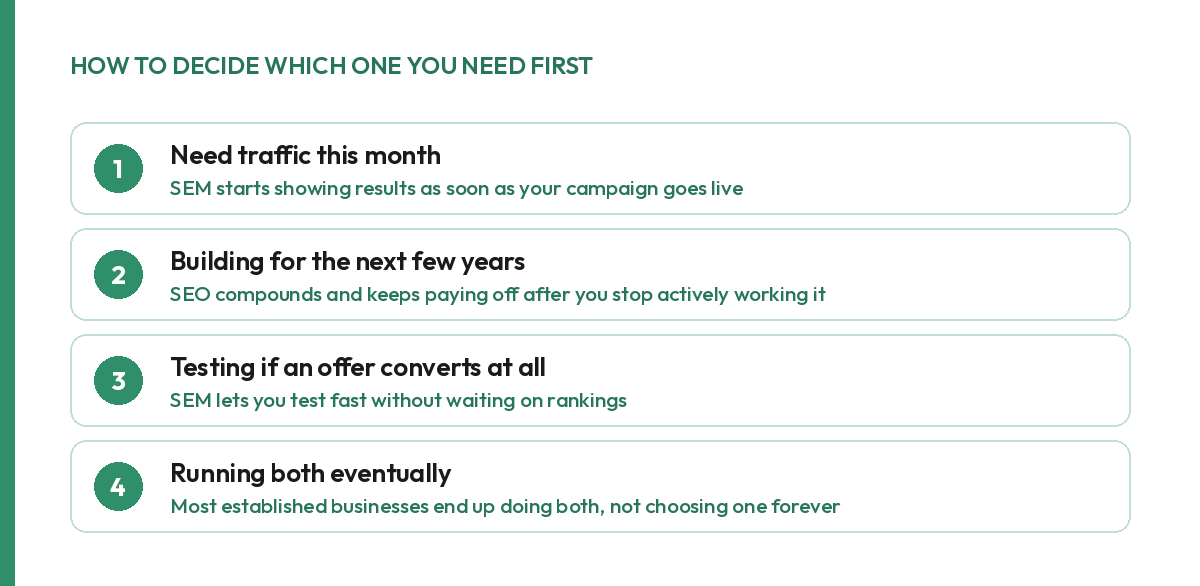
If you need traffic this month, whether that’s a launch, a slow season, or an offer you want to test quickly, SEM gets you in front of people immediately, without waiting on a ranking algorithm to trust a page it hasn’t seen before. If you’re building for the next few years and can tolerate a slower start, SEO compounds, and unlike a paid campaign, it keeps paying off after you scale back active work on it. If you’re not sure your offer converts at all yet, SEM is also the faster way to find out, since you can send traffic to a page and measure the result within days rather than months.
Where local search fits into this choice
The SEO side of this decision looks different again if most of your customers are searching for you nearby rather than searching generally. A service business competing on local map results and “near me” style searches is playing a slightly different game from a business chasing broad national keywords, since Google weighs proximity and listing signals alongside the usual content and structure work. We go through that specific version of SEO, including what it takes to actually get found locally, in local SEO for service businesses. SEM’s mechanism doesn’t change for a local business, the auction still runs the same way, but it’s worth knowing which version of the SEO half of the decision applies to you before you commit months to it.
Does it have to be one or the other?
No, and for most businesses that grow past their first year or two, it usually isn’t. A common, sensible pattern is running SEM to generate traffic and validate an offer while SEO work is still building in the background, then gradually shifting spend away from paid clicks on searches that have started ranking organically. Paying forever for a click you could eventually earn for free is the expensive version of this decision, and building only for the long term while you have no traffic today is the slow version of it. Most businesses that are getting real value from search over time are running some version of both, not treating this as a permanent either-or choice.
So, SEO or SEM which is better?
SEO or SEM which is better isn’t answered by picking a side once and moving on, it’s answered by matching the mechanism to what you actually need right now. Google’s own documentation is clear that one is earned and never for sale, and the other is bought through an auction that still rewards quality over bid alone. Need results this month: SEM. Building an asset that keeps paying off for years: SEO. Not sure which applies to you yet: that’s exactly the kind of question worth working through before spending on either.
If you’d rather have that worked out for your specific business than guess, our SEO and GEO work is what we’d bring to the SEO side of it. Book a free discovery call and we’ll map out whether SEO, SEM, or both makes sense for where you are right now.
Frequently asked questions
SEO or SEM which is better?
Neither is universally better, because they solve different problems. Google's own documentation states organic ranking is never for sale and is decided programmatically, which is what SEO works to earn over months. SEM runs on a pay-per-click auction that Google judges on bid plus the quality of your ad and landing page, and it can start showing results the same day a campaign goes live. A business that needs traffic this month leans SEM. A business building for the next few years leans SEO.
Is SEM just paying to rank higher on Google?
Not exactly. Google's own auction documentation says Ad Rank comes from your bid combined with the quality of your ad and landing page and the competitiveness of the auction at that moment, so a higher bid with a weak ad and a poor landing page can still lose to a lower bid with a strong one. It is paid placement, but it is not simply the highest bidder winning.
Does SEO traffic stop if I stop paying for it?
SEO traffic doesn't stop the moment you stop paying, since there's no per-click bill to begin with, but it does fade if you stop maintaining it, as competitors keep publishing and your own pages age. SEM traffic stops far more abruptly: turn the campaign off and the clicks stop that day, because you were paying for each one directly.
Can a small business do both SEO and SEM at once?
Yes, and most established businesses eventually do. A common pattern is using SEM to get traffic and test an offer while SEO is still building, then leaning more on SEO once it has caught up, rather than running paid spend forever on searches that could rank for free.
Want a clear roadmap for your own growth?
Every partnership with The Growth Project starts with a free Growth Plan. Book a discovery call and we'll map out yours together.