SEO vs GEO: what's actually different
SEO vs GEO: what actually differs, the 80% of the work that's identical, and which one a small business should spend its time on first.
SEO vs GEO gets asked like it is a choice between two different jobs, and for a small business it mostly is not. If you would rather have someone map out where your site already stands and what is actually worth doing next, you can book a free discovery call. Otherwise, here is the difference that actually matters and the much larger part that does not.
TL;DR: SEO earns a click from a results page. GEO earns a mention inside a written answer someone never has to click through to. About 80% of the work behind both, finding real questions and answering them clearly, is the same work. The last 20% genuinely splits: backlinks and technical health for SEO, being named in places tools like ChatGPT and Gemini already trust for GEO. Do the shared part first.
SEO vs GEO, in one line each
SEO is the work of getting your page to show up on Google’s results page for a search your customer runs, high enough that they actually click it.
GEO, generative engine optimization, is the work of getting your business mentioned or quoted inside the written answer a tool like ChatGPT or Gemini gives for that same search, often with no click at all.
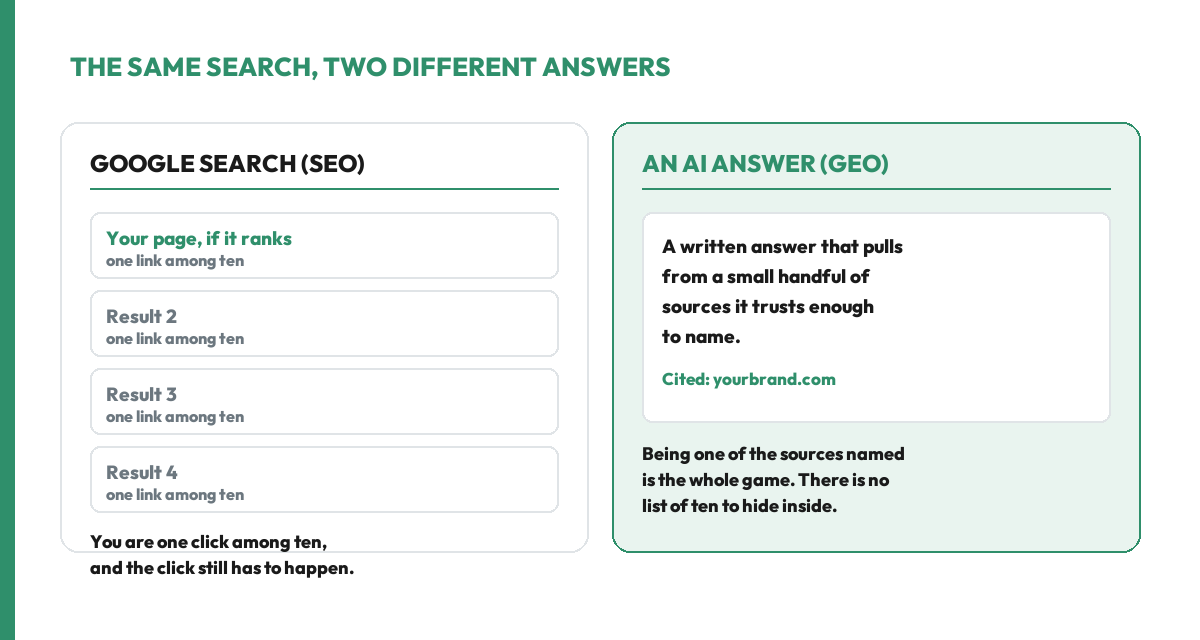
The confusion comes from treating these as two competing strategies that need two different plans. In practice they draw on almost the same well.
Why they overlap by about 80%
A written answer from a tool like ChatGPT or Gemini has to come from somewhere, and it gets built the same way Google decides what deserves to rank: by finding pages that answer a real question clearly, back it up with something specific, and are structured well enough to read cleanly. That is also, word for word, what makes a page rank on Google in the first place.
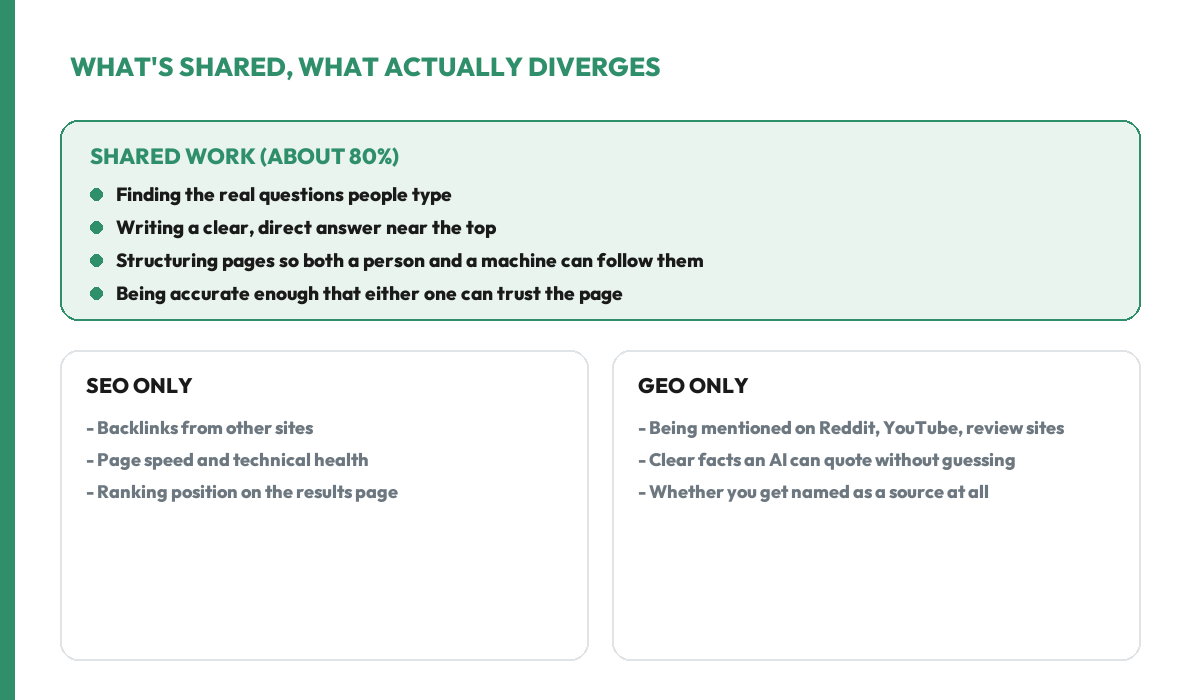
So most of what a small business actually needs to do is one list, not two:
- Find the real questions your customers type, not the phrases you assume they use
- Answer the question directly, near the top of the page, before any preamble
- Structure the page around one topic so it is easy for a person, or a tool summarizing it, to follow
- Back up claims with something specific and checkable
We cover the finding-the-real-questions part in how much SEO costs for a small business, and the same research feeds both channels without any extra work. If your business serves one city or region, the same shared work also underpins local SEO for a service business, since a map listing and a well answered page are both built on the same real questions. That map listing is worth getting right on its own terms too, and we cover the order that actually moves it in how to do SEO for Google My Business.
Where they actually split
The last fifth is where the two genuinely diverge, and it is worth knowing so you are not doing SEO-only work and calling it GEO, or the reverse.
SEO-only work: backlinks from other sites, page speed and technical health, and where exactly you land on the results page. None of that changes whether a tool like ChatGPT decides to quote you.
GEO-only work: being mentioned accurately on the third-party sites those tools already treat as trustworthy, such as Reddit threads, review sites and forums, plus having clear, specific facts about your business stated plainly enough that a written answer can quote them without guessing.
That second list is why GEO can feel unfamiliar even to a business that has already done real SEO work. A backlink campaign does nothing for it. A clean, honest mention on the sites your customers already read does.
Is this actually worth doing, or is search dying?
Worth addressing directly, because the panic version of this question gets asked a lot. Across a large sample of sites, organic search traffic has dropped only a small amount, not the collapse some headlines suggest. Google is still very much load-bearing, and most of your buying customers are still typing into it every day.
What has changed is that a growing share of research now happens inside a written answer before anyone opens a search engine at all, and that traffic tends to convert well when it does arrive, because someone who read a detailed answer and still clicked through is unusually motivated. Being invisible there is a real cost. It is not a reason to abandon everything that already works, and it is not a reason to rebuild your whole site around it either.
For a small, founder-led business specifically, the honest read is that both channels are still small in absolute numbers right now, and that is exactly why this is the cheapest possible time to start. The businesses that show up as trusted sources a year from now will mostly be the ones already building that trust today, quietly, on the pages they were already writing anyway.
What to actually do, in order
Start with the shared 80%. It moves both needles and none of it is wasted if you only ever get halfway through a GEO strategy.
- Write down the actual questions your customers ask before they buy, in their own words, not the words you would use
- Answer each one directly and specifically on its own page, rather than folding it into a general services page
- Make sure your own site states the plain facts about what you do, clearly enough that nothing needs guessing
- Once that is solid, look at where your business is already mentioned outside your own site, and make sure those mentions are accurate
If none of this feels like something you have the time to run properly alongside actually running the business, that is a fair reason to bring in outside help rather than a reason to let it sit. We covered exactly that decision in should I hire a marketing agency.
If you want a straight read on where your site already stands on both fronts and what is actually worth doing first, that is exactly where our SEO and GEO work starts. Book a free discovery call and we will map out your Growth Plan together.
Frequently asked questions
SEO vs GEO: what's the actual difference?
SEO is the work of getting a page onto Google's results page, where a person still has to click it. GEO (generative engine optimization) is the work of getting a page used as a source inside a written answer from a tool like ChatGPT or Gemini, where being named as the source is the whole result. The research and on-page work behind both is close to identical. What differs is the very end of the process: a ranking position versus a citation.
Do I need to pick one, SEO or GEO?
No, and picking one is usually the wrong move. Roughly 80% of the work, finding the real questions your customers type, answering them clearly, and structuring the page so it is easy to follow, serves both at once. The last 20% is where they split: backlinks and technical health for SEO, being mentioned in the places a tool like ChatGPT already trusts for GEO. Do the shared 80% first, because it is not wasted effort either way.
Is GEO going to replace SEO?
Not on the numbers so far. Across a large sample of sites, organic search traffic has dropped only a few percent, not the collapse the panic headlines describe. What is true is that a meaningful and fast-growing slice of buying research now happens inside a written answer instead of a search results page, and a small business with zero presence there is leaving that slice on the table.
Which one should a small business start with?
Start with the shared 80%: real questions, clear answers, one topic per page. That work alone improves both a Google ranking and your odds of being cited by tools like ChatGPT or Gemini. Layer GEO-specific work on top once the basics are in place, mainly by making sure your business is mentioned accurately anywhere those tools already look, such as review sites, forums and your own clearly stated facts.
Want a clear roadmap for your own growth?
Every partnership with The Growth Project starts with a free Growth Plan. Book a discovery call and we'll map out yours together.