How to do Google SEO for my website: a step-by-step guide
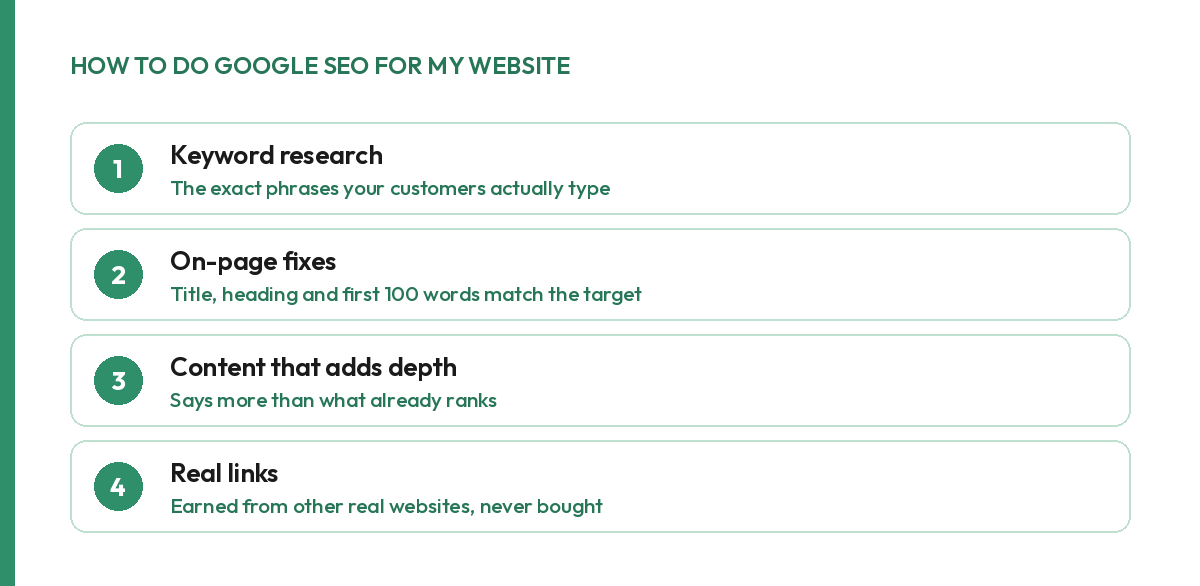
How to do Google SEO for my website, in order: pick the right keywords, fix the on-page basics, build real content, then earn the links that back it up.
How to do Google SEO for my website is one of the most common questions a founder-led business asks once the site is live and nobody is finding it. If you would rather have this mapped out for your own site than work through it alone, you can book a free discovery call and we will walk through it together. Here is the order that actually works.
TL;DR: How to do Google SEO for my website, in four steps, done in order: find the exact phrases your customers search, fix each page so its title and content answer that search directly, publish content that says more than what already ranks, then earn real links from other sites that back up what you built. Doing these out of order, especially chasing links before the on-page basics are solid, wastes the effort that goes into them.
How to do Google SEO for my website, starting with the right order
The order matters more than most founders expect. Fixing a page’s title before you know the right keyword means fixing it twice. Chasing links before the content is actually good means nobody wants to link to it anyway. Working through these four steps in sequence, rather than jumping to whichever feels most urgent, is what makes each one actually pay off.
Step one: find the exact phrases your customers search
This comes before anything else because every later step aims at whatever you find here. Think in terms of what a real customer would type into Google when they have the problem your business solves, not the internal language your business uses to describe itself. A founder often defaults to industry terms that sound professional but that almost nobody actually searches. The words your customer types are the ones worth building around.
Step two: fix the on-page basics for each page
Once you know the target phrase for a page, make sure the title tag, the main heading, and the first hundred words of the page actually contain it, in plain, natural language. This is the step with the highest return for the least effort, because it is entirely within your control and does not depend on anyone else linking to you or anything else happening off your site. A page that never mentions its own target phrase clearly has almost no chance of ranking for it, no matter how good the rest of the page is.
Step three: publish content that says more than what already ranks
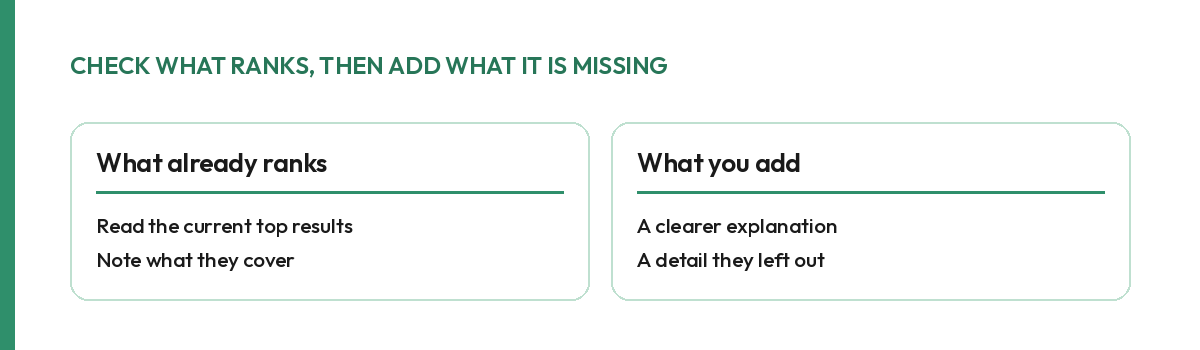
Search Google for your target phrase and actually read what currently ranks in the first few results. Your content needs to say something those pages do not, a clearer explanation, a more specific example, a genuinely useful detail they left out. A thinner version of what already exists has no reason to outrank the original. This is also where a blog earns its keep for a founder-led business: it is the easiest place to keep adding depth that a static homepage cannot hold on its own.
Step four: earn real links from other websites
A link from another real website is still one of the clearest trust signals Google uses, and it is the step most founders skip because it takes the most ongoing effort. This does not mean buying links or trading them in bulk, both of which Google penalizes. It means being genuinely worth linking to: a resource other businesses, partners, or local publications would reference on their own, and then actually reaching out to the ones most likely to care. If your business has a physical location, this step overlaps with your Google Business Profile, covered in our separate guide to Google SEO for your Google Business Profile.
What to expect after you start, and how do you know it is working?
None of these four steps produce an overnight change, and that is normal, not a sign something is wrong. Google has to crawl your updated pages, decide it trusts them, and then rank them, a process that plays out over months rather than days.
The clearest early signal is not a ranking jump, it is impressions in Google Search Console: your page starting to show up for the target phrase at all, even at a low position. That is Google telling you it has found and understood the page, which has to happen before it can ever rank it well. Watch that signal first, before you watch for clicks or bookings, because it arrives earliest and tells you the work so far is on the right track. Our full breakdown of how long SEO takes to see results sets realistic expectations so you are not judging the work too early. If cost is the part you are weighing before you start, see how much SEO costs for a small business for the real range.
Most small business websites never get past step one or two, which is exactly why a founder-led business that works through all four, in order, has a real edge over competitors who never got past picking a few keywords and hoping. The advantage compounds the longer you keep at it, since search rankings for a well-built page tend to hold rather than reset the way a social post’s reach does.
One more thing worth saying plainly: these four steps are not a one-time project you finish and move on from. Search results shift as competitors publish new content and Google refines what it rewards, so a page that ranked well a year ago can slip if nobody revisits it. Treat the sequence as a loop you return to every few months for your most important pages, not a checklist you clear once and file away.
If working through these four steps is the part that keeps stalling behind everything else your business needs, our SEO and GEO work is exactly what we take off your plate. Book a free discovery call and we will map out your Growth Plan together, starting with the step your site actually needs first.
Frequently asked questions
How do I do Google SEO for my website, in the simplest terms?
Four steps, in order: find the exact searches your customers actually type, make sure each page's title and content answer that search directly, publish content that goes deeper than what already ranks, and get a handful of other real websites linking back to you. Skipping the order, especially chasing links before the on-page basics are right, wastes the effort.
What is the very first step in SEO for a small business website?
Keyword research, before anything else gets touched. Writing content or fixing pages before you know which exact phrases your customers search means every later step is aimed at a guess instead of a real target. This is the step most small businesses skip, and it is the one that makes every later step either work or fail.
How long does Google SEO take to start working?
Meaningful movement usually takes a few months, not days, because Google has to crawl, index, and then trust a page before it ranks it well. For the fuller breakdown of a realistic timeline, see our guide to how long SEO takes to see results.
Do I need to hire someone, or can I do SEO myself?
A founder can absolutely do the first three steps, keyword research, on-page fixes, and content, without outside help, especially at a small scale. Earning real links is the step that most often benefits from outside expertise, since it takes ongoing outreach and relationships that are hard to build alongside running the actual business.
Want a clear roadmap for your own growth?
Every partnership with The Growth Project starts with a free Growth Plan. Book a discovery call and we'll map out yours together.