Is Instagram good for small businesses' social media?
Is Instagram good for small businesses? It depends on your customers' age. Pew Research data shows how many actually use it, by age group.
Is Instagram good for small businesses is one of those questions with no single right answer, because it depends entirely on who you’re trying to reach. If you would rather have someone work that out for your specific business than read the rest of this, book a free discovery call. Otherwise, here is how to work it out yourself.
TL;DR: Is Instagram good for small businesses depends almost entirely on your customers’ age. Pew Research Center puts overall US adult Instagram use at 50%, but that ranges from 80% among 18 to 29 year olds down to 19% among people 65 and older. A business selling to a younger, visual audience is starting from strength. A business selling to an older audience is fighting the platform’s own numbers before it posts a single photo. Work out where your customers actually sit before deciding whether this is worth your time.
Is Instagram good for small businesses in every case?
No, and the honest answer starts with who is actually there. Pew Research Center, surveying US adults between February and June 2025, found that 50% of US adults use Instagram at all, compared with 71% who use Facebook. That already says Instagram is not a universal channel, before you even get to what kind of content it rewards.
The bigger swing is by age.
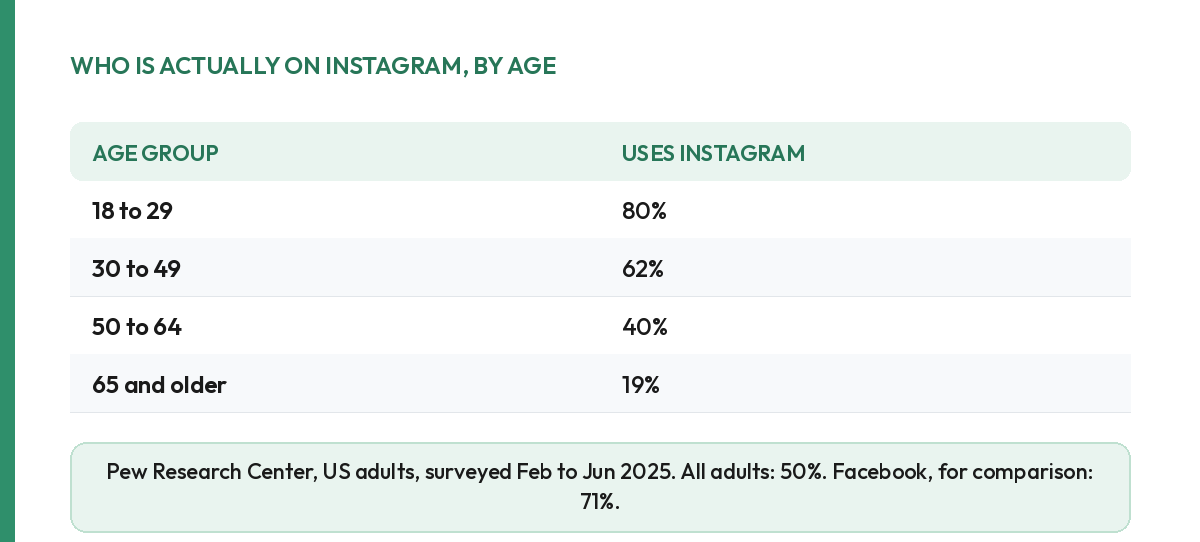
If your customers are mostly in their twenties, Instagram already reaches 80% of them, which is about as favorable a starting point as a channel ever offers before you’ve posted anything. If your customers are mostly over 65, you’re working with 19%, and no amount of good content design moves that number. Checking where your own customers actually sit takes less time than writing a single caption, and it should come before either.
What Instagram is actually good at, once your customers are there
Assuming your customers are there in the first place, Instagram’s real strength isn’t direct response, it’s discovery and trust. That’s the sense a stranger gets flicking through your feed before they’ve decided to reach out, or the check a returning customer runs to confirm you’re a real, active business before they book. That’s a different job from a Google search, where someone has already typed exactly what they want. We go deeper on that distinction, including when a proper website matters more than a profile at all, in do I need a website or just Instagram.
Photos and short video work because a feed gets browsed, not read, so a business whose product or work is visually obvious (food, a finished haircut, a renovated room, a styled client) gets more out of Instagram for the same effort than a business whose value is invisible to a photo, like bookkeeping or legal advice. That isn’t a rule against those businesses using Instagram. It’s a reason their content has to work harder to earn the same result, and often a reason to go find customers directly rather than wait to be found, which is the approach we cover in how to cold outreach on Instagram.
Which small businesses Instagram suits, and which it doesn’t
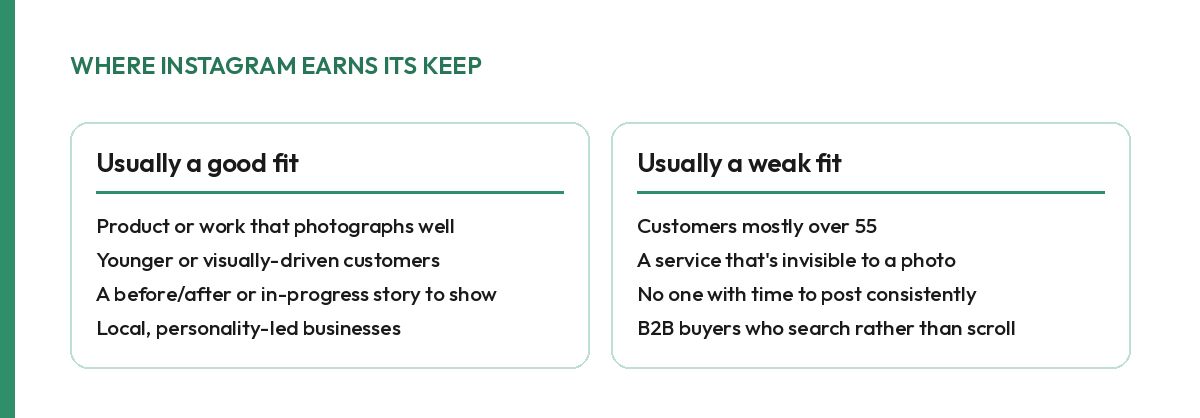
None of this is a permanent verdict on any one business. A bookkeeper with a real before-and-after story to tell, a messy set of books turned tidy, a tax bill cut down with the receipts to prove it, can still make Instagram work. A restaurant that never photographs a plate well will underperform a worse restaurant that does. The platform rewards showing your work, whatever “your work” happens to look like on camera.
Is Instagram good for small businesses that already use Facebook?
Often, and it doesn’t have to be a choice between them. Meta owns both platforms, and posting to Instagram doesn’t cost you your Facebook presence, so the real question is where your specific customers spend their time, not which platform to abandon. Pew’s numbers put Facebook ahead overall (71% versus 50%), so a business unsure where to start, and unable to run both well from day one, has a mild edge starting with Facebook on reach alone. We cover the two platforms and where each earns its keep in more depth in social media marketing vs digital marketing.
Is Instagram good, or is it just something everyone assumes you need?
This is where a lot of the “Instagram is essential” advice online falls apart under a second question. Being present isn’t the same as it working. A business can be technically good at Instagram, consistent posting, decent photos, a real following, while it produces nothing that shows up in bookings or sales. That’s a genuinely separate question from the one this post answers, and it’s the one we work through, with three concrete numbers to check against your own account, in is Instagram worth it for small business. “Good for you” is a question of fit. “Worth it” is a question of return. Answer this one first, because there’s no point measuring the return on a channel your customers were never really using.
It’s also worth being honest that showing up on Instagram isn’t automatically the same as advertising there, which is a separate spend and a separate decision. We break down when paid social makes sense at all, apart from organic posting, in does social media advertising work.
So, is Instagram good for small businesses?
Is Instagram good for small businesses comes down to one question you can answer honestly in a few minutes: are your actual customers the kind of people Pew Research shows are already there, and does your product or work give you something worth photographing regularly? A younger, visually-driven customer base with a real story to show is close to a yes by default. An older customer base, or a business with nothing visual to offer, isn’t disqualified, but it’s starting the climb from much further back, and that’s worth knowing before you invest months in a feed nobody who matters is scrolling.
Where the answer isn’t obvious, or you’d rather have someone map out where your customers actually are before you commit time to any one platform, our social media marketing work is exactly what we take off your plate. Book a free discovery call and we’ll look at your specific business before recommending where to post.
Frequently asked questions
Is Instagram good for small businesses?
It depends mostly on your customers' age. Pew Research Center puts Instagram use among all US adults at 50%, but that ranges from 80% among 18 to 29 year olds down to 19% among people 65 and older. If your customers are younger, Instagram already has most of them. If they're older, you're fighting the platform's own numbers before you post anything.
What kind of small business is Instagram bad for?
A business whose customers are mostly over 55, or whose product or service doesn't photograph well, such as legal, accounting or other advice-based work with nothing visual to show. Instagram rewards content that can be understood at a glance, so a business without a visual story to tell has to work much harder for the same result.
Do I need a huge following for Instagram to work for my business?
No. A small, real following of people who are actually potential customers earns more than a large following of the wrong people. A local business with 300 genuinely local followers who see every post is in a stronger position than one with 10,000 followers from a giveaway who never see anything again.
Is Instagram better than Facebook for a small business?
Not automatically. Pew Research Center's most recent numbers put Facebook ahead of Instagram among US adults overall, 71% versus 50%, so if you can only run one platform well, that's a mild edge for Facebook on reach alone. The better question is where your specific customers actually spend their time, since the two are owned by the same company and running both isn't an either/or choice.
Want a clear roadmap for your own growth?
Every partnership with The Growth Project starts with a free Growth Plan. Book a discovery call and we'll map out yours together.