What is a landing page and how does it work? A quick guide
What is a landing page and how does it work? A focused page with one goal, and Unbounce data puts the median conversion rate at 6.6 percent.
What is a landing page and how does it work is worth answering properly before you build one, because a landing page that looks like a normal website page usually converts like one too, which is to say, not especially well. If you’d rather have one built properly than work it out from scratch, book a free discovery call. Here’s what actually makes a landing page different, and how it works.
TL;DR: What is a landing page and how does it work? It’s a standalone page built around one goal, with no main navigation and nothing competing for attention with the single action it exists for. Someone arrives from a specific link, an ad, an email, a search result, and everything on the page points at that one action, a form fill, a booking, a purchase, which then gets tracked as a conversion. Unbounce’s Conversion Benchmark Report, from over 41,000 pages and 464 million visitors, puts the median conversion rate across industries at 6.6%.
What is a landing page and how does it work, exactly?
A landing page is a page built for exactly one purpose, and everything about how it works follows from that single fact.
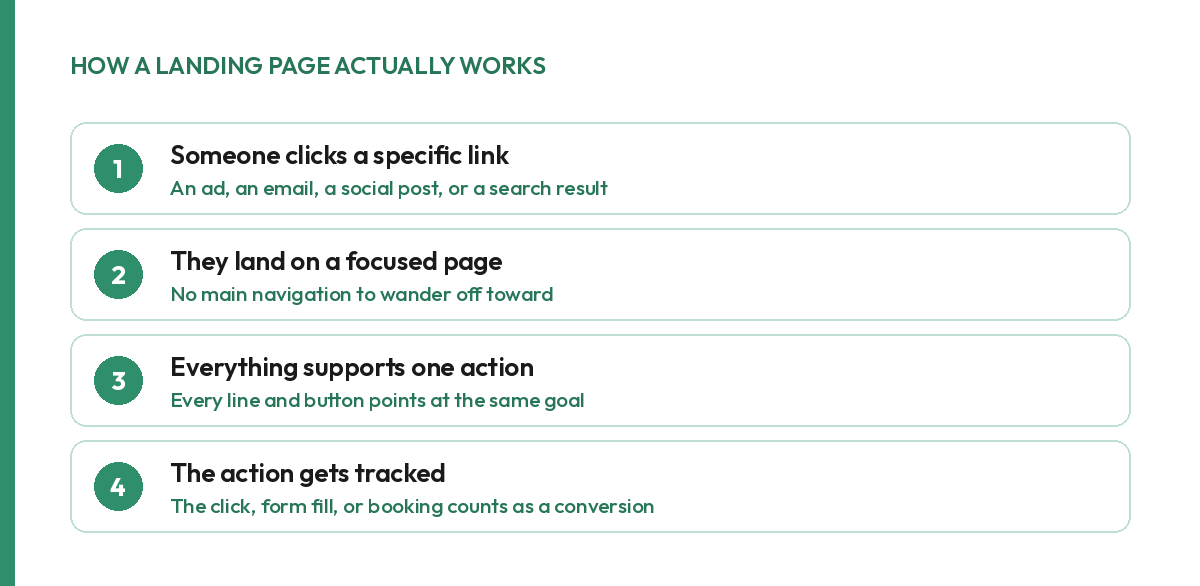
Someone clicks a specific link, an ad, an email, a social post, or a search result, that already told them roughly what they’re about to see. They land on a page built around that one thing, usually with the site’s main navigation removed or minimized so there’s nowhere else on the page to wander off toward. Every headline, image, and line of copy on the page supports that single action, rather than trying to also explain the rest of the business. When the visitor completes that action, a form fill, a booking, a purchase, it gets tracked as a conversion, which is the number the whole page is built to move.
The one thing that actually separates a landing page from a homepage
A homepage has to do many jobs at once. It’s the entry point for a first-time visitor, a returning customer, a job applicant, and a journalist, all landing on the same page with completely different intentions, so it has to offer navigation to everywhere and can’t commit hard to any single action. A landing page does the opposite on purpose: it assumes the visitor already arrived wanting one specific thing, because the link that brought them there already told it what that thing is, and it removes everything that isn’t in service of that one outcome. That narrowing is the entire mechanism behind why a landing page tends to convert better than sending the same traffic to a homepage instead.
What a landing page typically converts at
Knowing how a landing page works is one thing. Knowing what a working one should actually achieve is the other half of the question.
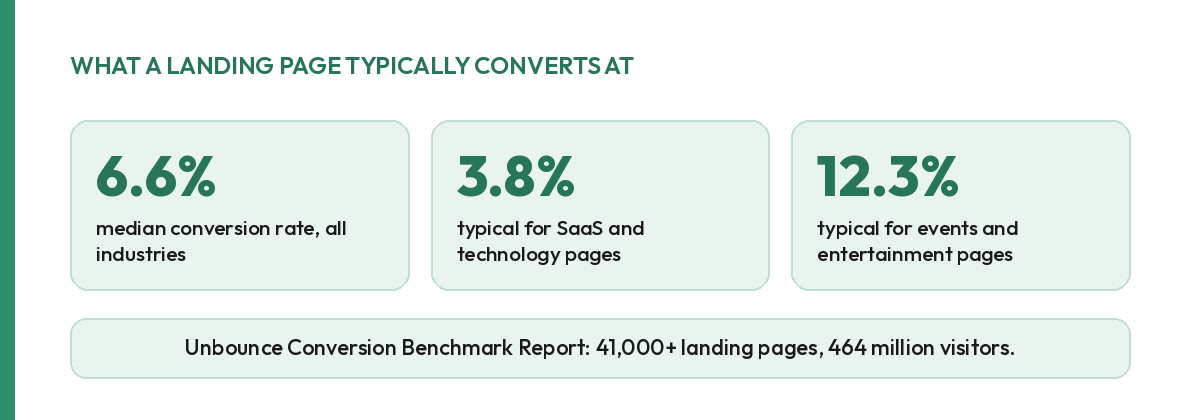
Unbounce’s Conversion Benchmark Report, built from over 41,000 landing pages and 464 million visitors, puts the median conversion rate across all industries at 6.6%. That varies a fair amount by category: SaaS and technology pages typically run closer to 3.8%, while events and entertainment pages often land near 12.3%, largely because the intent behind the click differs so much between those categories. Knowing roughly where your own industry sits is more useful than chasing a single “good” number that doesn’t account for what you’re actually asking someone to do.
Landing page vs. your homepage vs. your whole website
It’s worth being precise about the difference, since the three terms get used loosely. Your website, as a whole, is the entire collection of pages a visitor can reach through navigation, built to serve every kind of visitor for every reason they might show up. Your homepage is the front door to that whole website, general by design because it doesn’t know why any particular visitor arrived. A landing page is neither of those, it typically isn’t even linked from your main navigation at all, and it exists specifically to catch traffic that already arrived with a known intent and convert it before that intent fades. We go deeper on why that distinction matters for your actual results in what is a landing page and why is it important, and on what specifically makes one convert well once it’s built, in how to build a landing page that converts.
When a landing page stops working, it’s usually the mechanism, not the design
A landing page that isn’t converting has usually broken the mechanism described above somewhere, not failed on visual polish. The most common cause is a mismatch between what the link promised and what the page delivers, which breaks the visitor’s sense that they landed in the right place. Navigation that was supposed to be removed but crept back in is another common one, since it reopens the exit the whole format exists to close. We go through the fuller list of what actually causes a landing page to underperform in why is my landing page not converting.
So, what is a landing page and how does it work?
What is a landing page and how does it work comes down to one mechanism: a focused page, reached through a specific link, stripped of distractions, built entirely around one action, with that action tracked as a conversion. Unbounce’s own data puts the typical result at a 6.6% median conversion rate across industries, with real variation depending on what you’re actually asking a visitor to do. Get the mechanism right and the design work has something solid to sit on top of, rather than trying to make an unfocused page look convincing through visuals alone.
If you’d rather have one built properly around your own specific offer than start from a completely blank page, our website and landing page work is exactly this. Book a free discovery call and we’ll build it together with you.
Frequently asked questions
What is a landing page and how does it work?
A landing page is a standalone page built around one goal, with no main site navigation to distract from it. Someone arrives there from a specific link, an ad, an email, a social post, or a search result, and every element on the page supports the single action it exists for, whether that's a form fill, a booking, or a purchase. That action is then tracked as a conversion.
What's the difference between a landing page and a homepage?
A homepage has to serve many purposes at once: navigation to every part of the site, multiple messages for different visitors, and a dozen possible next steps. A landing page strips almost all of that away and asks a visitor who already arrived with one specific intent to take one specific action, which is why a good landing page usually converts better than sending the same traffic to a homepage.
What is a good landing page conversion rate?
Unbounce's Conversion Benchmark Report, drawn from more than 41,000 landing pages and 464 million visitors, puts the median conversion rate across all industries at 6.6%, with real variation by industry, from about 3.8% for SaaS and technology pages up to 12.3% for events and entertainment. Anything meaningfully above your own industry's median is a genuinely good result.
Do I need a landing page if I already have a website?
Yes, for anything you're sending targeted traffic to, an ad campaign, an email promotion, a specific offer. Your homepage is built to serve everyone who might visit for any reason, while a landing page is built to convert one specific kind of visitor who already arrived wanting one specific thing, which is a different job even if your website already exists and works well.
Want a clear roadmap for your own growth?
Every partnership with The Growth Project starts with a free Growth Plan. Book a discovery call and we'll map out yours together.