What is a landing page and why is it important?
What is a landing page and why is it important? Unbounce's own data across 41,000 pages puts the median conversion rate at 6.6%.
What is a landing page and why is it important, in plain terms, without the jargon a lot of explanations bury it under? If you would rather have us look at your specific traffic and tell you honestly whether you need one, you can book a free discovery call. Otherwise, here is the plain answer, backed by real conversion data rather than a guess.
TL;DR: A landing page is a standalone page built for one visitor and one action, unlike a homepage, which has to serve everyone at once. That single focus is why it matters: Unbounce’s own analysis of 41,000 landing pages and 464 million pageviews puts the median conversion rate at 6.6%, and the top quarter of pages clear 11% to 40% depending on the industry. A homepage asked to do the same job almost never gets close.
What is a landing page and why is it important?
A landing page is a standalone web page built to do exactly one thing: take a visitor who arrived for a specific reason and move them toward a specific action, whether that is booking a call, signing up, or buying. It is not a section of your website and it is not your homepage with a different headline. It typically has no main navigation menu, no links to five other pages, and no attempt to explain your whole business. Every element on it exists to support the one promise that brought that visitor there. What is a landing page and how does it work goes deeper into the actual mechanics behind that single-action design.
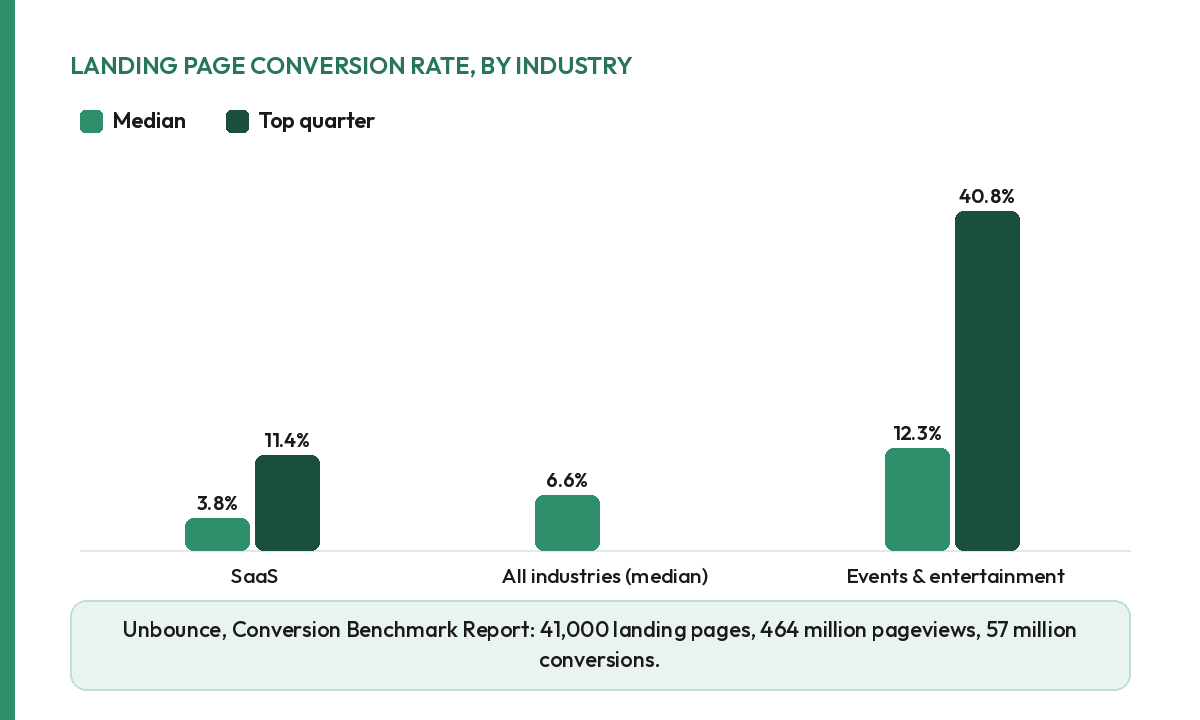
Why it matters comes down to a number. Unbounce, one of the more established landing page tools, analyzed 41,000 landing pages, 464 million pageviews and 57 million conversions to find the median conversion rate across all industries: 6.6%. That is the middle of the pack, not the best case. The top quarter of pages clear 11.4% in a conservative industry like ecommerce and as high as 40.8% in a high-intent industry like events and entertainment. A general page trying to serve every visitor at once essentially never reaches those numbers, because it was never built to.
How is a landing page different from a homepage or a regular website page?
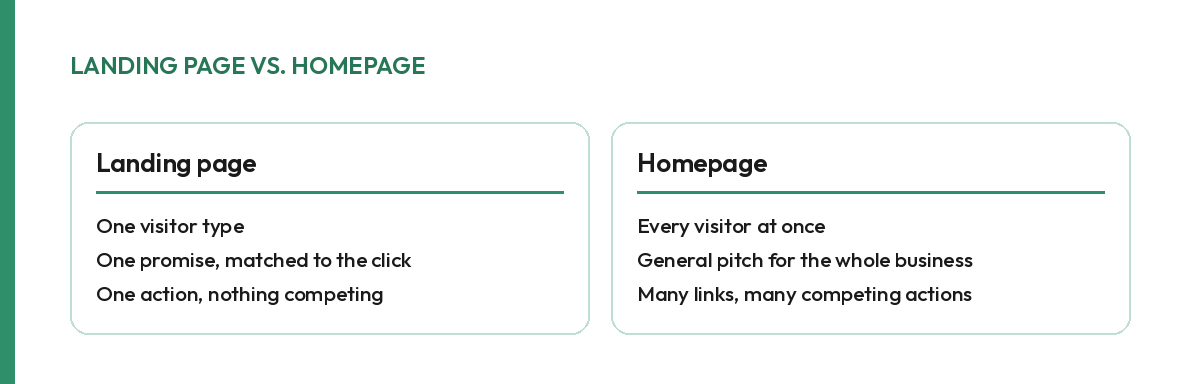
Your homepage has a hard job: it has to explain the whole business, link out to every service, and work equally well for a stranger who has never heard of you and a returning visitor who already knows exactly what they want. That is the right job for a homepage to have. It is the wrong page to send someone to the moment you already know why they clicked. If you are weighing whether your situation actually calls for a dedicated page at all, why do I need a landing page at all walks through exactly when the answer is yes and when your homepage is genuinely enough.
A landing page removes the choice a homepage has to offer. There is no menu to wander off through, no second or third link competing for attention, and no attempt to be all things to all visitors. It exists for one traffic source, makes one promise that matches what that traffic source already said, and asks for one action. Fewer choices, in this specific context, is not a limitation, it is the entire mechanism behind the conversion numbers above.
When does a landing page actually matter for your business?
It matters most the moment you are sending traffic somewhere on purpose: a paid ad, an email campaign, a specific offer, or a referral that already knows what it is looking for. In every one of those cases, the visitor arrived with a specific expectation, and a general homepage forces them to go find the thing they were promised instead of simply seeing it. Casual, general browsing traffic is a different case, where a homepage genuinely does a fine job, because there is no single promise yet to match.
Think about the difference from the visitor’s side, not yours. Someone who clicks a search ad for one specific offer has already made a small decision to act on that offer. Landing them on a homepage asks them to make that decision a second time, unassisted, while scanning a menu built for a completely different kind of visitor. Every extra decision a visitor has to make between the click and the action is a place they can quietly leave instead, and a homepage is built almost entirely out of those extra decisions.
What does a good landing page actually need to get right?
Getting the concept right does not automatically get the execution right. A page can be a genuine standalone landing page and still convert badly if it makes too many asks, buries the one action under competing links after all, or simply does not match what the visitor was promised before they clicked. Design is usually not the problem. A plain page that gets the promise, the single action and the removal of distractions right will consistently beat a beautifully designed page that asks for three things at once or opens on a headline that has nothing to do with the ad that sent the visitor there.
We cover the structure that actually converts, one clear action, matched promise, and the mistakes that quietly cost you, in how to build a landing page that converts. If you already have one live and the numbers are not showing up, why is my landing page not converting is the more direct next read, since a page that already exists usually needs a diagnosis, not a rebuild from scratch.
The honest answer
A landing page is a page built for one visitor and one action, and it matters because that single focus is measurably worth more than a general page asked to do the same job: a 6.6% median conversion rate against homepages that were never designed to be measured that way in the first place. Whether you need one depends entirely on whether you are already sending traffic somewhere on purpose.
If you are running paid ads, email campaigns or a specific offer without a dedicated page behind it, how we build websites and landing pages is exactly what we take off your plate. Book a free discovery call and we will look at your actual traffic before recommending anything.
Frequently asked questions
What is a landing page and why is it important?
A landing page is a standalone web page built for one specific visitor and one specific action, unlike a homepage, which has to serve every visitor and every intention at once. It matters because that single focus converts. Unbounce's own analysis of 41,000 landing pages and 464 million pageviews puts the median conversion rate at 6.6%, with the top quarter of pages clearing 11% to 40% depending on the industry.
What is the difference between a landing page and a regular website page?
A regular website page, including your homepage, is built to inform and to link onward: it carries a menu, several calls to action, and has to work for a stranger and a returning visitor alike. A landing page drops all of that on purpose. It has no menu to wander off through, makes one promise, and asks for one action, matched to whatever brought that specific visitor there.
Do I actually need a landing page, or can I just send people to my homepage?
You can send people to your homepage, and for casual, general traffic that is often fine. The moment you are paying for a click, sending an email, or making a specific offer, a homepage's many competing links and general pitch cost you conversions that a dedicated page built for that one promise would have kept.
What makes a landing page actually work?
Matching the page to the promise that brought the visitor there, giving them exactly one action to take, and removing everything that is not directly in service of that one action. Design matters far less than those three things, which is also why a plain page that gets them right regularly outperforms a beautiful page that does not.
Want a clear roadmap for your own growth?
Every partnership with The Growth Project starts with a free Growth Plan. Book a discovery call and we'll map out yours together.