Why do I need a landing page at all?
Why do I need a landing page at all? What a dedicated landing page does that your homepage cannot, and when building one is actually worth it.
Why do I need a landing page at all is the question most founders only ask after they have already spent money finding out the hard way: an ad campaign, an email send or a partnership brought real traffic to the website, and almost none of it turned into a booking. The site looked fine. The offer was real. The traffic even converted somewhere, just not here. If that sounds familiar, book a free discovery call and we will look at exactly where those visitors are dropping off. Otherwise, here is the actual answer, and when it does and does not apply to you.
TL;DR: A homepage is built to serve every visitor and every intention at once. A landing page is built to serve one traffic source and one action. The moment you are sending paid, email or campaign traffic somewhere on purpose, sending it to a page built for everyone instead of a page built for that one promise is what is quietly costing you the booking.
Why do I need a landing page at all?
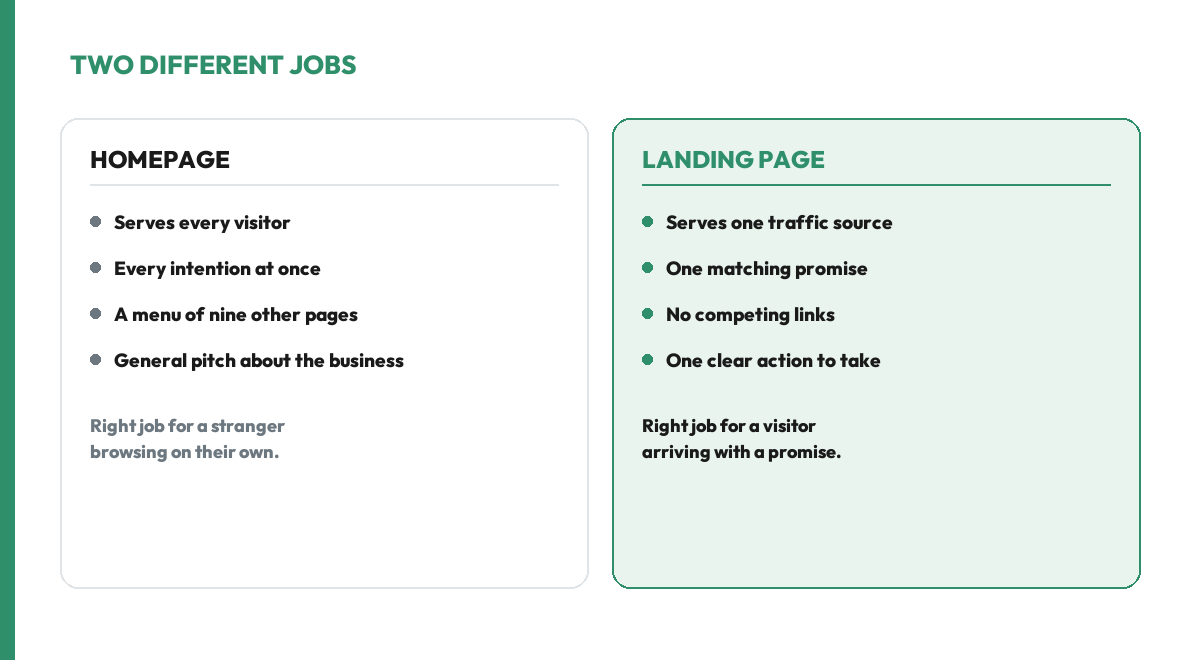
A homepage has a hard job by design. It has to explain the whole business, link out to every service, every page a returning visitor might want, and work equally well for a stranger who has never heard of you and a regular who already knows exactly what they are after. That is the right job for a homepage. It is the wrong job for the page a paid ad, an email or a specific offer sends someone to.
A landing page drops almost everything a homepage carries, on purpose. It exists for one traffic source, makes one promise that matches what brought the visitor there, and asks for exactly one action. No menu pulling attention toward six other pages. No general pitch about the business as a whole. Just the specific thing that was promised, and one clear way to act on it. If you want the plain definition before going further, what is a landing page and why is it important covers it with the actual conversion numbers behind it, and what is a landing page and how does it work walks through the mechanics in more depth.
What actually goes wrong without one
Send a paid click to your homepage and watch what happens. The visitor arrives expecting the specific thing the ad promised, a particular service, a particular offer, a particular price. Instead they land on a page introducing the whole business, with a navigation bar offering nine other things to click on instead. Some of those visitors poke around. Most just leave, because the page never confirmed they were in the right place for the thing that got the click.
This is not a design problem in the usual sense. The homepage can be well built and still be the wrong page for that visitor, because it was never meant to answer one specific promise. A landing page fixes this by removing the choice entirely. There is one message, matched word for word to what the visitor was told before they clicked, and one thing to do next.
When you actually need one
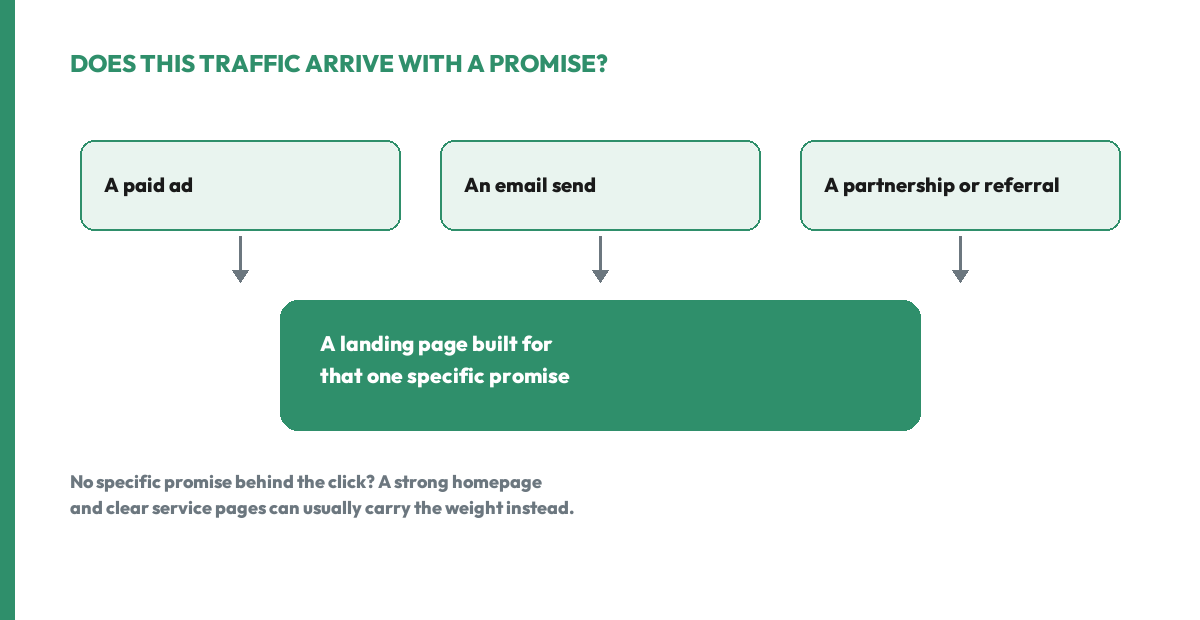
Not every business needs a landing page for everything. If nobody is being sent to your site with a specific promise attached, a strong homepage and clear service pages can carry the weight fine. A landing page earns its place the moment traffic is arriving with an expectation behind it: a paid ad campaign, an email send built around one offer, a partnership or referral pointing at one specific service.
The test is simple. Ask whether the traffic hitting a given page was told something specific before it arrived. If yes, that page needs to confirm and act on that specific promise, not introduce the whole business again. That is exactly the gap our website and landing page work is built to close, matching the page to whatever got the click and stripping out everything competing with the one action that matters.
One page per promise, not one page for everything
A common mistake once a business does decide to build a landing page is trying to make one page cover two different offers or two different traffic sources at once. A page built to serve a Meta ad for one service and an email campaign for a different one ends up half serving both and fully serving neither, because the visitor from each source arrives expecting something different from the same headline.
The fix is not more design work on that one page. It is building a second, narrower page instead, each one matched to a single promise. A business running two real campaigns is usually better served by two focused pages than by one page carrying twice the message and half the clarity.
What happens after someone converts
A landing page’s whole job ends the moment someone takes the one action it asks for, whether that is booking a call or leaving contact details. What happens immediately after matters just as much. A visitor who fills in a form and then hears nothing for three days has effectively been dropped, and a lot of the trust built by a focused, well-matched page leaks straight back out. We cover exactly how to hold onto that momentum in our guide to a proper welcome email sequence, which is the piece that usually needs to exist right behind a converting landing page.
It is also worth being honest that a landing page is not the only foundational decision worth questioning early. Do you need a website at all, or is Instagram enough covers the layer below this one, and what actually makes a landing page convert once it exists picks up right where this post leaves off.
The honest summary
You do not need a landing page for the sake of having one. You need a landing page the moment you are sending traffic somewhere with a specific promise attached, because a homepage built to serve everyone will always underperform a page built to serve exactly that one visitor and that one promise. If you are running paid ads, email campaigns or partnerships and sending them all to the same general page, that mismatch is very likely costing you bookings right now.
If you want a straight read on whether your current setup needs a dedicated landing page or whether your existing site can carry the weight, book a free discovery call and we will map out your Growth Plan together.
Frequently asked questions
Why do I need a landing page at all?
Because your homepage is built to serve every visitor and every intention at once, while a landing page is built to serve one traffic source and one action. If you are sending paid clicks, an email campaign or a specific offer anywhere, sending it to a page with a dozen competing links and a general pitch loses far more of those visitors than sending it to a page built for that one promise.
Is a landing page different from a homepage?
Yes. A homepage has to explain the whole business, link to every service and page, and work for a stranger who has never heard of you and a returning visitor who already knows exactly what they want. A landing page drops all of that on purpose. It exists for one traffic source, makes one promise, and asks for one action.
Do I need a landing page if I already have a website?
Only once you are sending traffic somewhere on purpose, such as a paid ad, an email send, or a specific offer. A website with no paid or campaign traffic can often get by without one. The moment money or a specific promise is behind the click, a general homepage page starts costing you conversions that a dedicated page would have kept.
How many landing pages does a small business actually need?
One per distinct offer or traffic source, not one for the whole business. A business running Meta ads for one service and email campaigns for another is better served by two focused pages than by one page trying to hold both promises at once.
Want a clear roadmap for your own growth?
Every partnership with The Growth Project starts with a free Growth Plan. Book a discovery call and we'll map out yours together.