Is SEO outdated? What actually changed
Is SEO outdated? Real data says no: organic traffic across 40,000 US sites is down just 2.5 percent, not the 25 to 60 percent the panic claims.
Is SEO outdated is a question that gets a confident “yes” from a lot of headlines and a much more boring “not really” from the actual data. If you’d rather have someone read your own numbers than take either side’s word for it, book a free discovery call. Here’s what a real, sourced study found.
TL;DR: Is SEO outdated? Graphite, in partnership with Similarweb, analyzed organic traffic across more than 40,000 of the largest US sites and found it down just 2.5% year over year overall, while the top 10 sites actually grew 1.6%. Google’s generated answer summaries now appear on about 30% of searches and cut click-through by roughly 35% when they do, which is a real change worth planning around, but organic clicks still outnumber ad clicks by roughly 10 to 1. SEO changed. It did not collapse.
Is SEO outdated because of Google’s new answer summaries?
Not according to the numbers, and this is worth checking against a real study rather than a headline, because the two tell very different stories.
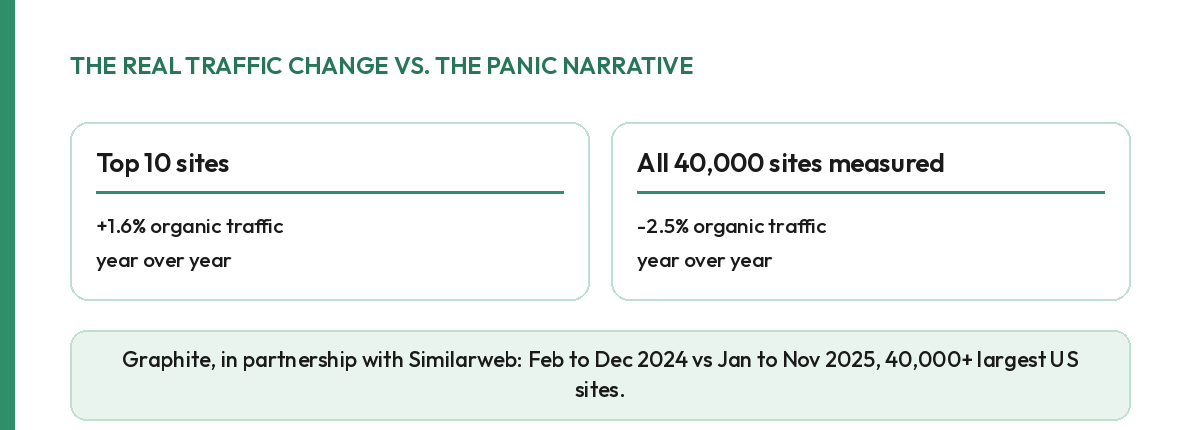
Graphite, working with Similarweb’s traffic data, compared organic search traffic across more than 40,000 of the largest US sites between February to December 2024 and January to November 2025. The result: organic traffic was down 2.5% year over year overall, and the top 10 sites in the sample actually grew 1.6%. That is a real, measurable shift. It is nowhere near the 25% to 60% collapse that “SEO is dead” claims tend to throw around, and the gap between the headline number and the measured one is the whole reason this question keeps getting asked.
What actually changed
If traffic overall barely moved, something more specific must be shifting underneath it, and the same research points at exactly what.
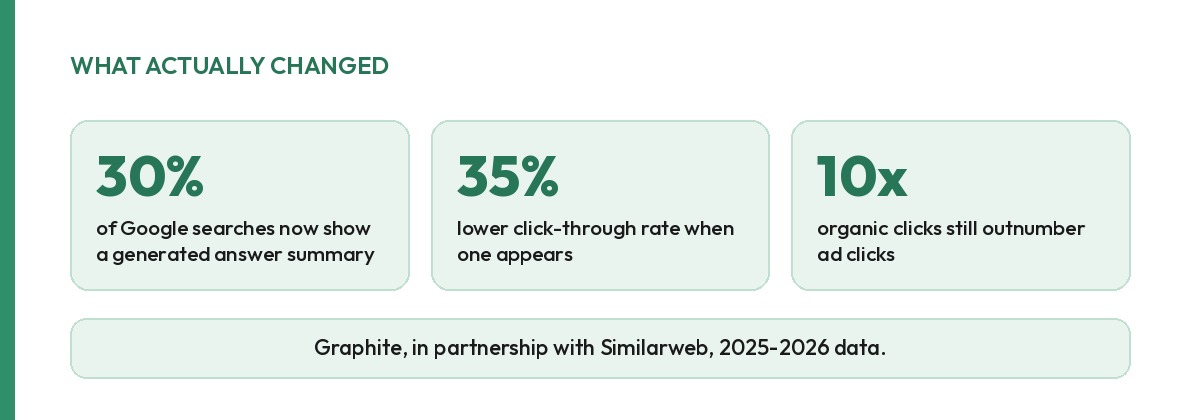
Google’s generated answer summary, the short written answer Google sometimes shows above the normal results, now appears on roughly 30% of searches, and when one shows up, click-through drops by about 35%. That’s a genuine cost on the searches where it appears, and it explains why some businesses feel a sharper hit than the 2.5% overall average suggests. It also means 70% of searches show no generated summary at all, and organic clicks still outnumber ad clicks by roughly 10 to 1 across the board. The channel is shifting where the loss concentrates, not disappearing.
Who actually lost traffic, and who didn’t
The decline wasn’t spread evenly, which is itself a clue about what’s really going on. The research found the losses concentrated in the middle of the market, roughly the sites ranked 100th to 10,000th by size, while the very largest sites grew. That pattern looks less like search replacing itself and more like a squeeze on sites without enough authority or depth to be the source a generated summary or a searcher trusts by default, a dynamic we go through in more detail, alongside how it differs from classic ranking, in SEO vs GEO. A newer or smaller site isn’t excluded from this, but it means the bar for standing out is about depth and trust, not about the channel itself having stopped working.
So what should you actually do differently?
Given the real numbers, the sensible response isn’t panic, it’s a few specific adjustments. Write content that answers the question directly and early, since a page being summarized rather than clicked on still needs a clear, quotable answer near the top for that summary to actually pull from. Go deeper than a surface-level overview on the topics that matter to your business, since the sites growing in this data were generally the more established, more thorough ones. And keep your timeline realistic: this is still a channel that takes months to build, a reality we cover in how long does SEO take to see results, and one worth weighing against faster paid options in the meantime, which we compare directly in is SEO better than Google Ads.
Why the panic version of this story spreads anyway
If the real number is a 2.5% dip, it’s worth asking why so much of what gets shared says otherwise. Part of it is simple selection: a business that lost real traffic has an obvious reason to write about it, while a business whose traffic barely moved has nothing dramatic to post, so the visible stories skew heavily toward the worst outcomes even when they aren’t the typical one. Part of it is also that tools selling a fix for the “collapse” have an incentive to describe the problem as bigger than it is, the same way any product benefits from a scarier version of the problem it solves. Neither of those things makes the underlying shift fake. It just means the loudest accounts of it are not a representative sample, and a business deciding whether to keep investing in this channel deserves the measured number, not the version optimized to get shared, especially when that decision affects a real monthly budget rather than just an opinion in a comment section.
So, is SEO outdated?
Is SEO outdated is the wrong question, based on what the actual data shows. Organic search traffic across the largest US sites moved by 2.5% in a year, not the double-digit collapse the panic version of this story describes, and the sites at the very top actually grew. What changed is where Google’s generated answer summaries cut into clicks and which sites are absorbing the middle-market squeeze, not whether ranking well still works. Betting your marketing plan on a headline instead of the underlying numbers is the more expensive mistake here, and it is a different mistake from the one most small businesses are actually making, which is SEO still important covers directly: most already believe search visibility matters, they just are not acting on it.
If you’d rather have someone read your own site’s numbers than guess from a headline, book a free discovery call, and our SEO and GEO work is exactly what we’d bring to showing you where you stand.
Frequently asked questions
Is SEO outdated?
No. Graphite, in partnership with Similarweb, analyzed organic traffic across more than 40,000 of the largest US sites and found it down just 2.5% year over year, with the top 10 sites actually growing 1.6%. That is a real but modest shift, not the collapse the 'SEO is dead' narrative describes.
Are Google's generated answer summaries killing organic traffic?
They're changing it, not killing it. The same research found these generated summary boxes appear on about 30% of searches and cut click-through by roughly 35% when they do appear. That's a real cost on the searches where they show up, but it means 70% of searches are unaffected, and organic clicks still outnumber ad clicks by roughly 10 to 1 overall.
If SEO isn't outdated, has anything actually changed about how it works?
Yes. The decline is concentrated in the middle of the market, sites ranked roughly 100th to 10,000th, while the very largest sites grew. That pattern points at authority and depth mattering more than before, not at SEO stopping working. Content also increasingly needs to be structured so it can be quoted directly, since a generated summary pulls a short answer rather than sending a click for every question.
Should a small business still invest in SEO?
Yes. Organic search is still sending roughly ten times the clicks that paid ads do, and a smaller or newer site has more room to grow into a gap than a large incumbent already near the top does. The channel changed, it did not disappear, and abandoning it on the strength of a headline rather than the underlying data is the more expensive mistake.
Want a clear roadmap for your own growth?
Every partnership with The Growth Project starts with a free Growth Plan. Book a discovery call and we'll map out yours together.