Is SEO still important for a small business website?
Is SEO still important? Google says the new summary box runs on the same ranked pages, yet most small businesses that call search critical still skip SEO.
Is SEO still important keeps surfacing in the same conversation lately, usually right after someone has seen a search end in a block of generated text instead of the usual ten blue links. If you want a straight read on where your own site stands rather than a general argument, book a free discovery call and we will look at what is actually happening on your searches. We covered the related question of return on the time it takes in is SEO worth it for a small business, this one goes at relevance itself.
TL;DR: Is SEO still important, yes, and Google’s own documentation is the reason to believe it rather than take it on faith. Ranking is still decided by relevance and quality, payment still buys none of it, and a page still has to be indexed and already eligible for a regular listing before it can appear anywhere else on the results page, summary box included. What actually changed is sentiment, not mechanics: a 2026 survey found most small businesses call search visibility critical while most still skip SEO entirely, which is the real gap worth closing.
Is SEO still important if a generated summary answers the question before anyone clicks?
This is the version of the question that is actually driving the doubt, so it is worth settling directly. Some searches on Google now return a written summary near the top of the page, built from the same pool of ranked, indexed pages Google was already using for its regular listings.
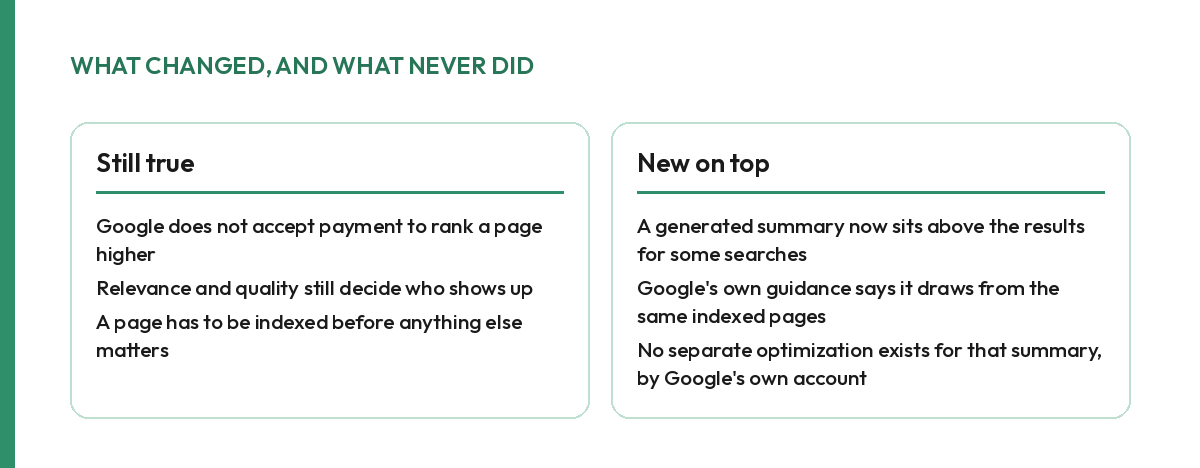
Google’s own guidance on this is unusually direct for a company that is normally vague about ranking mechanics. Its documentation on the summary feature states that a page must be “indexed and eligible to be shown in Google Search with a snippet” to be used as a supporting source, and adds plainly: “There are no additional technical requirements.” The same page goes further on strategy, stating in its own words that no extra requirements and no special, separate optimization work exist for a page to be picked up inside that summary. Standard SEO fundamentals, crawlability, clear internal linking, content that actually answers the query, are the whole playbook, for both surfaces at once. A page that was never earning a regular listing was never going to be picked up as a source either, because the second surface is built entirely out of the first.
What actually decides ranking, and what still does not
Before the summary box existed at all, the two biggest misconceptions about SEO were already (1) that paying Google buys a better position, and (2) that the rules change often enough that last year’s work stops counting. Neither has ever been true, and Google’s own fundamentals documentation is explicit about the first one: “Google doesn’t accept payment to rank pages higher, and ranking is done programmatically.” The same source says relevance is “determined by hundreds of factors,” including things like location and language, but payment has never been one of them, on the regular results page or the summary built on top of it.
That matters for anyone weighing whether SEO is still a worthwhile use of a founder’s limited time against simply running ads instead, a comparison we go through properly in is SEO better than Google Ads. The short version carries over here too: ads buy speed, SEO buys a ranked page that keeps showing up without a recurring bill, and neither one is a substitute for the other. If your real constraint is a single budget rather than a philosophical pick, we go through deciding which one to fund first on its own. Neither one is going away either. A business that only ever pays for clicks never builds the part that keeps bringing people in once the spend stops, and a business that only does SEO loses the speed an urgent launch sometimes needs. The two questions, is SEO still important and is it the only lever worth pulling, have different answers, and conflating them is how a founder ends up abandoning a channel that was never actually the problem.
The real gap is not belief, it is follow-through
If the mechanics have not changed, why does “is SEO still important” keep getting asked at all? The honest answer is not about Google, it is about what small businesses actually do with that information.
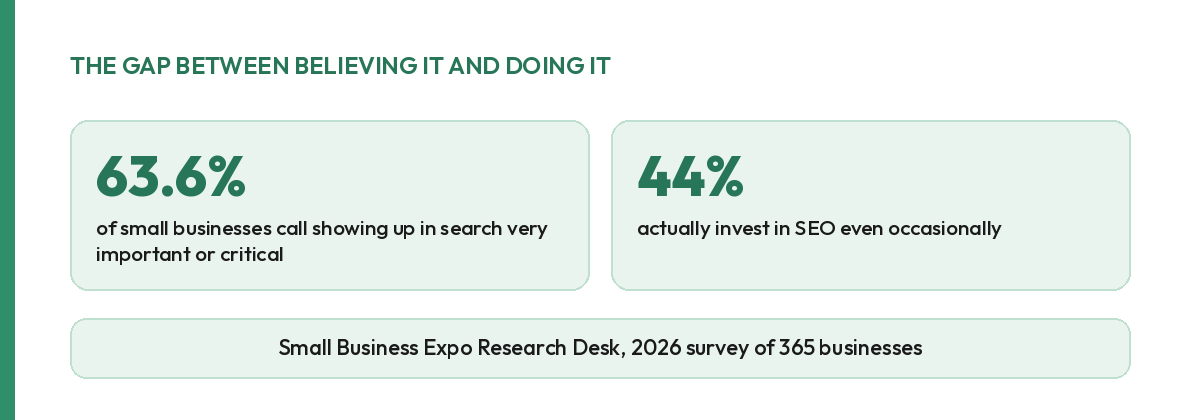
A 2026 Small Business Expo Research Desk survey of 365 businesses found that 63.6% consider appearing in Google and search results very important or critical to their success. Yet among those same businesses, only about 44% invest in SEO even occasionally, and most of that smaller group invests occasionally rather than consistently. That is not a company deciding SEO stopped mattering. That is a company agreeing it matters and still not getting to it, usually because SEO takes months to show anything measurable and whatever is loudest this week keeps winning the calendar.
This is also where the generated summary box genuinely does change the stakes, just not in the direction most people assume. Fewer total searches may end in a click once a summary answers the question outright, and the research behind getting ranked well enough to matter either way is close to identical, a point we unpack fully in SEO vs GEO. If the pool of available clicks on a given search is smaller, the businesses that already rank keep a larger share of a smaller pie, and the businesses that never showed up get none of either outcome. Sitting out does not become safer when the prize shrinks. It becomes more expensive.
So, is SEO still important?
Is SEO still important comes down to whether the foundation Google itself describes, indexed, relevant, genuinely useful pages, still decides who gets seen, and by Google’s own account it does, on the regular results page and on the summary layered on top of it. What has not kept pace is follow-through: most small businesses already believe search visibility is critical, and most still have not acted on that belief. If figuring out where your own site actually stands is the part that keeps getting pushed to next month, our SEO and GEO work is what we would bring to closing that gap. Book a free discovery call and we will give you a straight read on your own search visibility before you decide anything else.
Frequently asked questions
Is SEO still important for a small business?
Yes. Google's own documentation states that ranking is still decided by relevance and quality rather than payment, and that a page has to be indexed and already eligible to appear in regular results before it can show up anywhere else on the page, including the generated summary some searches now carry. Nothing about that foundation has gone away, it has just picked up an extra reason to matter.
Do I need a different strategy now that Google shows a generated summary on some searches?
No. Google's own guidance on the summary box is direct: there are no additional requirements to appear there and no special optimizations needed beyond the same crawlability, internal linking and content quality that regular SEO already asks for. A page that was never going to rank was never going to be quoted there either.
If search visibility matters this much, why do so few small businesses actually do SEO?
A 2026 Small Business Expo survey of 365 businesses found 63.6% call showing up in search very important or critical to their success, yet only about 44% invest in SEO even occasionally, and most of that group only occasionally rather than consistently. The gap is not a belief problem, it is a doing problem, usually because SEO takes months to show anything and the next urgent task always wins the week.
Can I just pay for ads instead of doing SEO?
You can run ads, and for speed they often make sense, but Google is explicit that paying does not buy a higher ranking position: 'Google doesn't accept payment to rank pages higher, and ranking is done programmatically.' Ads and ranking are separate systems. Spending more on one does not substitute for the other, so a business that only ever pays for clicks never builds the asset that keeps showing up once the budget stops.
Want a clear roadmap for your own growth?
Every partnership with The Growth Project starts with a free Growth Plan. Book a discovery call and we'll map out yours together.