SEO or SEM marketing: which should you fund first?
SEO or SEM marketing: which should get a small business's funding first? SBA budget benchmarks, plus a simple way to decide.
SEO or SEM marketing is usually framed as a one-time pick, but for a small business watching a single marketing budget, the real question is sequencing: which one gets funded first, and when does the other one join it. If you’d rather have someone map that out for your specific budget and timeline, book a free discovery call. Here’s a grounded way to work through it yourself first.
TL;DR: SEO or SEM marketing isn’t an either-or forever, it’s a funding order. The U.S. Small Business Administration notes most businesses spend somewhere between about 1% and 8% of revenue on marketing depending on industry and stage, and a thin budget split across both channels often leaves neither one properly funded. Fund SEM marketing first if you need bookings this month or haven’t proven your offer converts yet. Fund SEO marketing first if you can wait a few months and want a channel that keeps paying off without a per-click bill attached to each visitor. Most small businesses that stay in search long enough eventually fund both.
How much should a small business even budget for marketing?
Less than you’d think, and it varies a lot by industry. The U.S. Small Business Administration’s own guidance on marketing budgets points to a few real benchmarks rather than one clean number: the average business spends about 1.08% of revenue on advertising alone, while total marketing spend across methods averaged 7.9% of revenue in a 2018 benchmark the SBA cites. That average hides real industry spread, retailers spend closer to 4% of revenue on marketing, restaurants closer to 1.93%.
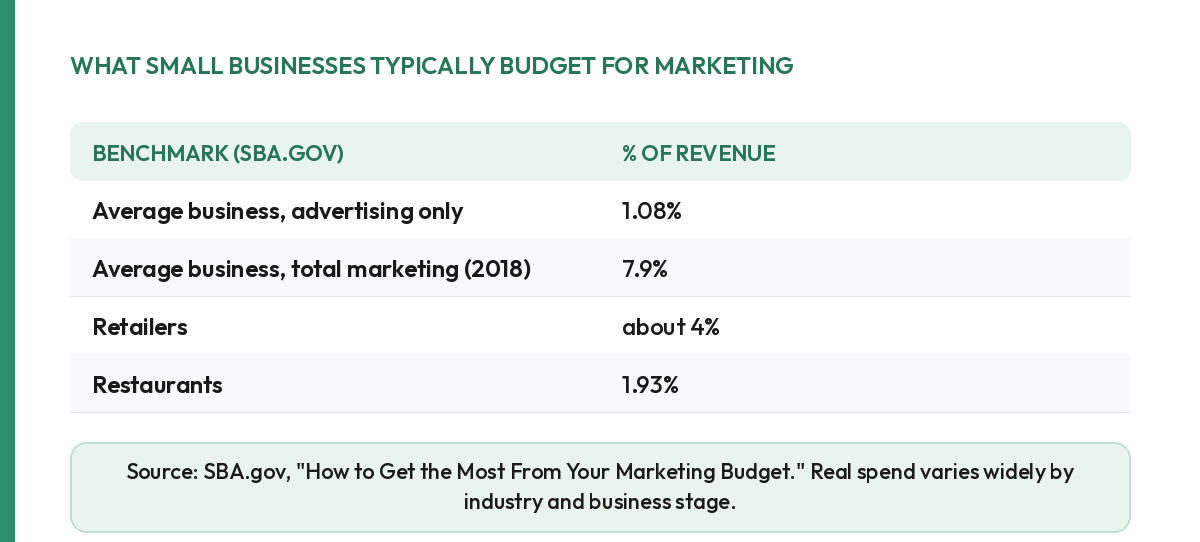
The SBA’s guidance also ties the number to where a business is in its life: a brand-new business usually needs a bigger budget to build awareness from nothing, while an established one can spend less and still hold its position, though it still needs to keep attracting and retaining customers. None of that tells you whether SEO marketing or SEM marketing should get the first dollar of it. That’s a separate decision, and it’s the one most small businesses actually get stuck on.
SEO or SEM marketing: where should the first dollar go?
The first dollar should go wherever the mechanism actually matches your situation, not wherever feels more credible. SEO marketing is never bought directly: Google’s own documentation is explicit that “Google doesn’t accept payment to rank pages higher, and ranking is done programmatically,” so the budget behind SEO marketing goes into content, structure and the technical basics that earn trust over months, not into a line-item bill per visitor. We lay out that actual order of operations, keyword research through on-page fixes through links, in how to do Google SEO for my website. SEM marketing runs on the opposite mechanism, a live auction. Google’s own explanation of Ad Rank lists six factors behind it: your bid, the quality of your ad and landing page, Ad Rank thresholds, how competitive the auction is, the context of the search, and the expected impact of your ad assets and formats. Pay, and you’re in it. Stop paying, and you’re out of it, the same day.
That mechanical difference is the whole case for funding one channel first rather than splitting a thin budget across both. A dollar split two ways often buys a half-built SEO content program and a SEM marketing budget too small to gather useful data in a competitive auction, which tends to be a worse outcome than fully funding either one. We go through the full mechanism comparison, cost pattern and timeline in SEO or SEM, which is better, and we go specifically at Google Ads budgeting in is SEO better than Google Ads.
Does spending on SEM marketing help your SEO ranking?
No, and this is worth settling before the budget gets split. Running a SEM marketing campaign puts you in the paid results for as long as it’s funded. It does nothing for your organic position, because Google keeps the two systems separate by design, and turning the campaign off doesn’t hurt your organic ranking either. If part of the reasoning for funding SEM marketing first has been “it’ll help the SEO side too,” that assumption doesn’t hold, and it shouldn’t be part of the decision.
A simple way to decide which to fund first
Four questions settle it for most small businesses, in roughly this order.
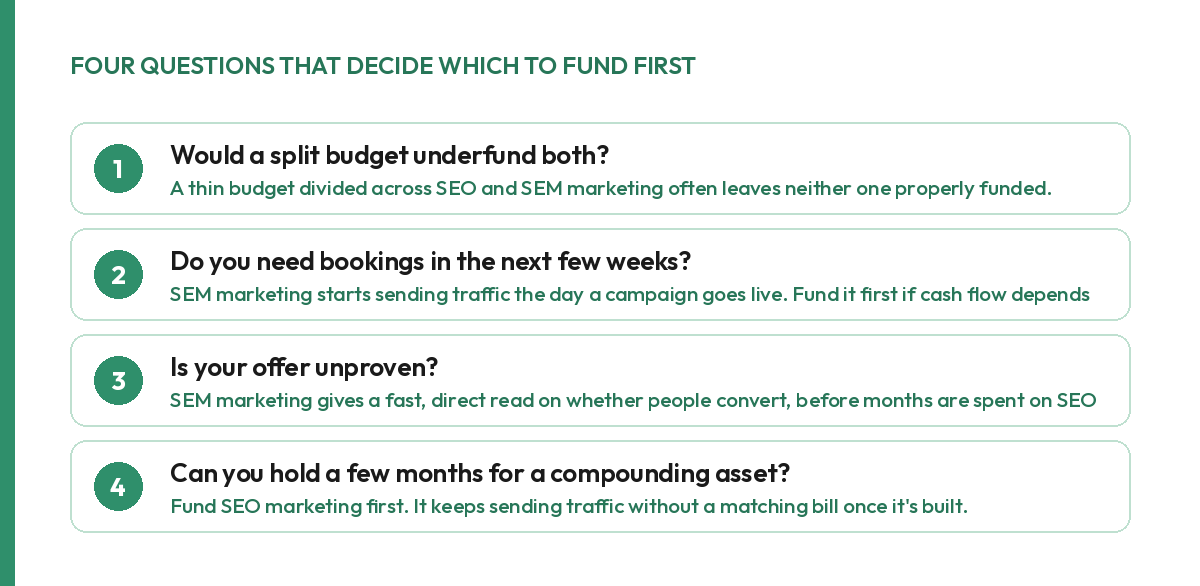
If more than one answer points the same direction, that’s your first dollar. If they conflict, the one about cash flow usually wins, because a business that runs out of runway before SEO marketing compounds never gets to collect on it.
What if you can only afford one channel right now?
Fund it fully rather than funding both thinly. The SBA’s own guidance on tight budgets is direct about this: when money is limited, prioritize the lower-cost methods you can actually sustain and be selective about the ones that cost more, rather than spreading a small budget across every channel at once. A half-funded SEO marketing program rarely earns enough trust to rank, and a SEM marketing budget too small to gather real auction data rarely tells you anything useful either. We break down what SEO marketing alone typically costs a business this size, separate from the question of funding order, in how much does SEO cost for a small business.
So, SEO or SEM marketing, which gets funded first?
SEO or SEM marketing isn’t a verdict you make once, it’s an order you set based on your budget, your runway, and whether your offer has already proven it converts. Fund SEM marketing first out of a thin budget if you need bookings this month or you’re still testing the offer itself. Fund SEO marketing first if you can hold a few months without matching revenue from it and you want a channel that keeps sending traffic without a bill attached to each visitor. Most small businesses that stay in search long enough end up funding both, just not on the same day.
If you’d rather have that funding order worked out for your actual budget than guess at it, our SEO and GEO work is what we’d bring to the SEO side of that decision. Book a free discovery call and we’ll map out which one deserves your first dollar.
Frequently asked questions
SEO or SEM marketing, which should a small business fund first?
There's no universal answer, it depends on budget size and timeline. The U.S. Small Business Administration's own guidance notes that businesses typically spend somewhere between about 1% and 8% of revenue on marketing depending on industry and stage, and a thin budget split across both SEO and SEM marketing often leaves neither one properly funded. A business that needs bookings this month and has one marketing budget to work with usually funds SEM marketing first, then adds SEO marketing once cash flow allows it.
Does paying for SEM marketing improve SEO ranking?
No. Google's own documentation states that ranking is done programmatically and that Google doesn't accept payment to rank pages higher, which covers ad spend too. Running SEM marketing campaigns puts you in the paid results while they're active, it does nothing for where you sit organically. We go through this specific myth in more depth in is SEO better than Google Ads.
How much should a small business actually budget for SEO or SEM marketing combined?
The SBA's own guidance notes that the average business spends about 1.08% of revenue on advertising alone, and total marketing spend across methods averaged 7.9% of revenue in a 2018 benchmark the SBA cites, with real variation by industry: retailers spend closer to 4%, restaurants closer to 1.93%. How much of that goes to SEO marketing versus SEM marketing is a separate decision from how much to set aside in the first place.
Can a small business switch from funding SEM marketing first to funding SEO marketing first later?
Yes, and it's a common pattern rather than an exception. A business often funds SEM marketing first to get traffic and validate an offer quickly, then shifts budget toward SEO marketing once there's more breathing room, since SEO keeps sending traffic without a matching per-click bill once it's built. Few businesses that stay in search long-term treat the choice as permanent.
Want a clear roadmap for your own growth?
Every partnership with The Growth Project starts with a free Growth Plan. Book a discovery call and we'll map out yours together.